
Google Patents a System That Moves Tasks Off Your Overheating Phone
Instead of letting your phone get sluggish when it runs hot, Google is patenting a way to quietly hand off whatever you're doing to a cooler device nearby — before you ever notice the slowdown.
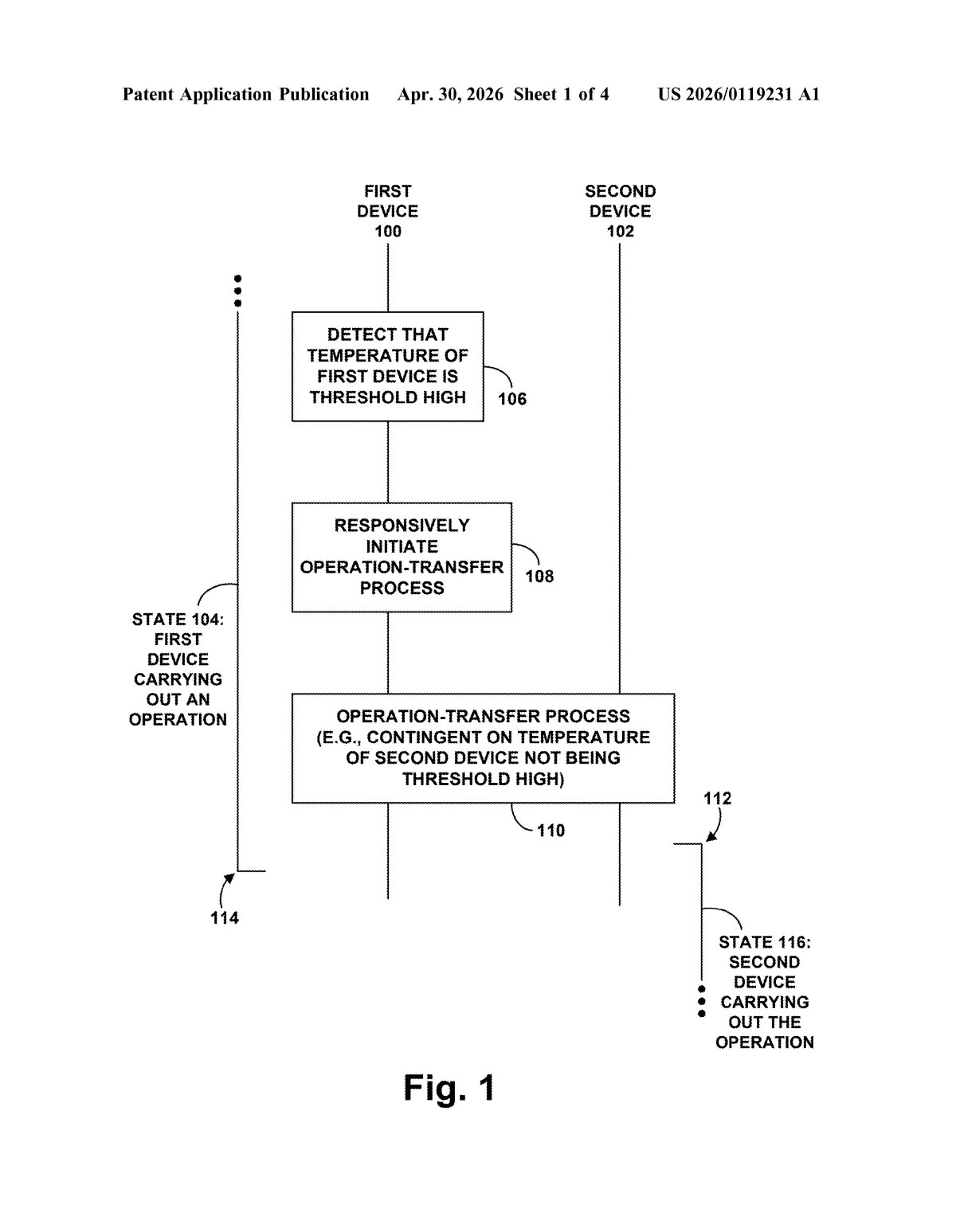
What Google's thermal task-handoff actually does
Imagine you're running a heavy video export on your phone and it starts getting warm. Rather than grinding to a crawl — that frustrating slowdown called thermal throttling — your phone could simply pass the job to your tablet or laptop sitting on the desk next to you.
That's the core idea in this Google patent. When your phone's temperature hits a certain threshold, it checks whether a nearby second device is cool enough to take over the task. If it is, the operation moves over. If not, the old fallback — throttling — still happens.
You're not left out of the loop, either. The patent describes user prompts that let you decide: accept the handoff or just let the phone slow down on its own. It's an opt-in escape hatch from one of the most annoying everyday smartphone problems.
How the two-device temperature check triggers a transfer
The patent describes a two-stage temperature-gate system. The first device (say, your phone) continuously monitors its own temperature using an onboard sensor. When that reading crosses a defined threshold — the first prerequisite — it doesn't immediately throttle. Instead, it checks in with a second device.
The second device reports its own temperature back. Only if that reading satisfies a second prerequisite (i.e., the second device is cool enough to safely absorb the workload) does the transfer actually happen. Both conditions must be true simultaneously — this prevents the system from just moving a hot potato from one struggling device to another.
The transfer mechanism itself isn't deeply specified in this filing, but the claim covers:
- Detecting the thermal threshold on device one
- Querying the thermal state of device two
- Conditionally migrating the operation based on both readings
- Presenting a user prompt to allow manual override
Thermal throttling — where a processor deliberately slows itself down to shed heat — is the current default for every modern smartphone. This patent positions task migration as a smarter alternative, not just a band-aid.
What this means for Android's cross-device ecosystem
For everyday Android users, this could mean a noticeably smoother experience during demanding tasks — long video calls, local AI inference, gaming sessions — without having to babysit your phone's temperature or wait for it to cool down. The user prompt mechanic is a nice touch: it keeps you in control rather than making invisible decisions about your workload.
Strategically, this fits neatly into Google's push to make Android feel like a connected device ecosystem rather than a collection of siloed gadgets. Features like Cross Device SDK and Continuity-style handoffs are already in the Android roadmap. A thermal-aware task scheduler is exactly the kind of plumbing that makes those higher-level features feel seamless — and it gives Google a concrete, practical reason for your phone and tablet to stay in constant communication.
This is a genuinely practical patent solving a real, persistent problem — thermal throttling is one of the most quietly infuriating parts of using a smartphone for intensive work. The two-device temperature-gate logic is clean and defensible. Whether Google ships this as a polished feature or it quietly disappears into infrastructure depends entirely on how well Cross Device SDK matures, but the underlying idea is sound.
There are more where this came from
We read every patent application Big Tech publishes and send you the ones worth knowing. Plain English, free, every week.
Want this weekly breakdown for a company we don't cover? Patentlyze Pro →