
Salesforce Patents a System That Builds AI Customer Service Agents From Old Support Transcripts
Instead of programming an AI agent from scratch, what if it could learn what to do by reading thousands of real customer service conversations? That's exactly what Salesforce is describing in this patent.
How Salesforce turns support chat logs into AI agents
Imagine your company has years of chat logs and email threads from your customer support team. Every time an agent helped someone reset a password, process a refund, or troubleshoot a broken order, that conversation was saved somewhere. Salesforce's patent describes a system that reads through all of those old conversations and uses them to automatically build an AI agent that can handle similar requests on its own.
The system goes through each saved conversation one by one, figuring out what actions the human agent took and what steps they followed. It then packages all of that into a definition, essentially a set of instructions, that a software AI agent can use to do the same job.
Once the AI agent is defined, a separate part of the system figures out a plan for how the agent should handle a new request, choosing which actions to take from a menu of things it already knows how to do inside Salesforce's software environment. The whole process is meant to reduce the manual work of configuring AI agents by letting the historical record do the teaching.
… an agent creation engine configured to create and store an autonomous agent definition in accordance with the unified metadata framework by iteratively selecting a database record from the plurality of database records and determining autonomous agent definition update information based on text included in the database record …
Translation: The system builds a virtual agent by scanning old customer support chat logs one by one.
How the agent creation engine reads and learns from records
The patent describes a system built on top of Salesforce's existing relational database (a structured store of records, like a giant organized spreadsheet). That database holds records of past text-based interactions between customers and human support staff.
An agent creation engine loops through those records one at a time, extracting information about what happened in each conversation. It uses that information to fill out an autonomous agent definition, a structured template (stored in what the patent calls a "unified metadata framework") that describes what the AI agent knows how to do and what actions it can take.
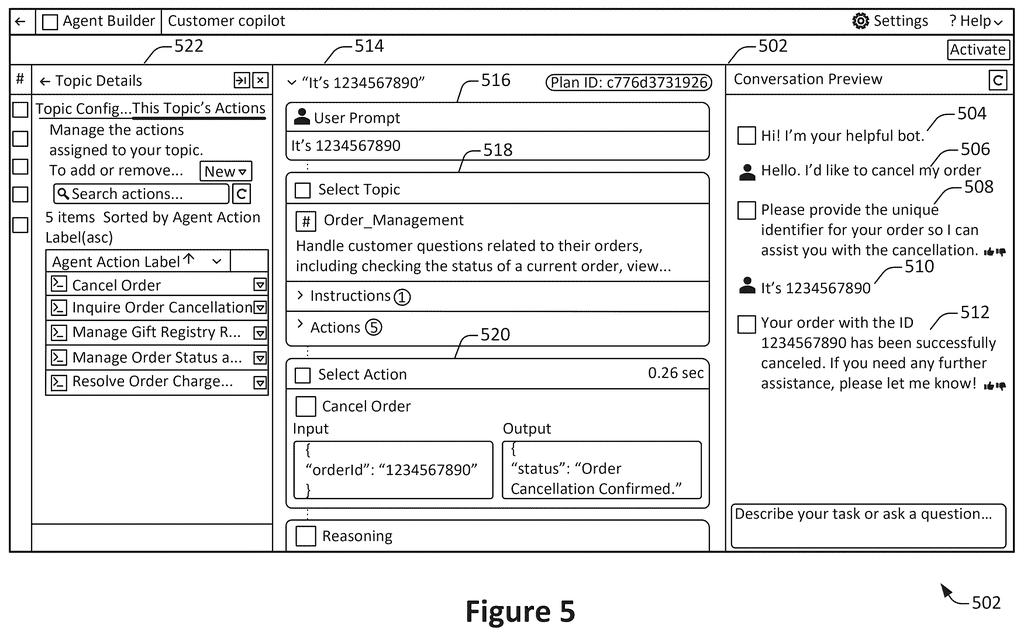
The agent service then spins up a live AI agent instance based on that definition. When a new customer request comes in, an orchestration layer sends the agent's definition to a generative language model (an LLM, similar in concept to what powers ChatGPT) and asks it to produce a plan. That plan picks a specific sequence of actions from the list defined earlier and then executes them.
Key components include:
- Agent creation engine: reads historic records, builds agent definitions
- Unified metadata framework: standardized format for storing agent definitions
- Agent service: launches a live agent from the definition
- Orchestration layer: uses an LLM to plan what the agent should do for each new task
The orchestration layer may determine an orchestration plan based on the autonomous agent definition.
Translation: A control module figures out what steps the AI bot should take next.
What this means for companies running customer service on Salesforce
For businesses that run customer service on Salesforce, this could significantly cut down the time it takes to deploy AI agents. Right now, setting up an AI agent typically means manually writing rules, defining workflows, and specifying what the agent can and can't do. This patent describes automating most of that setup by mining the company's own historical support data.
If Salesforce ships something like this, it fits squarely into the company's push around Agentforce, its existing AI agent platform. The ability to auto-generate agents from your own CRM data would give Salesforce a concrete selling point: your past support conversations become the training material, and the system does the rest.
This is a genuinely interesting patent because it addresses one of the real friction points in enterprise AI adoption: nobody wants to spend weeks manually configuring AI agents. Mining historical support transcripts to auto-build agents is a logical and practical idea, and it maps directly onto Salesforce's Agentforce strategy. Whether the system works well in practice depends heavily on data quality, but the architecture here is at least solving a real problem.
There are more where this came from
We read every patent application Big Tech publishes and send you the ones worth knowing. Plain English, free, every week.
The drawings
12 drawing sheets from US 2026/0228451 A1 · click any drawing to enlarge


Want this weekly breakdown for a company we don't cover? Patentlyze Pro →
Be the first to weigh in