
Zoox Patents a Way for Its Self-Driving Cars to Ignore Unlikely Threats
Every car on the road is a potential threat to a self-driving vehicle, but most of them just don't matter. Zoox is patenting a system that figures out which nearby vehicles' possible moves are actually worth planning around, and which ones can be safely deprioritized.
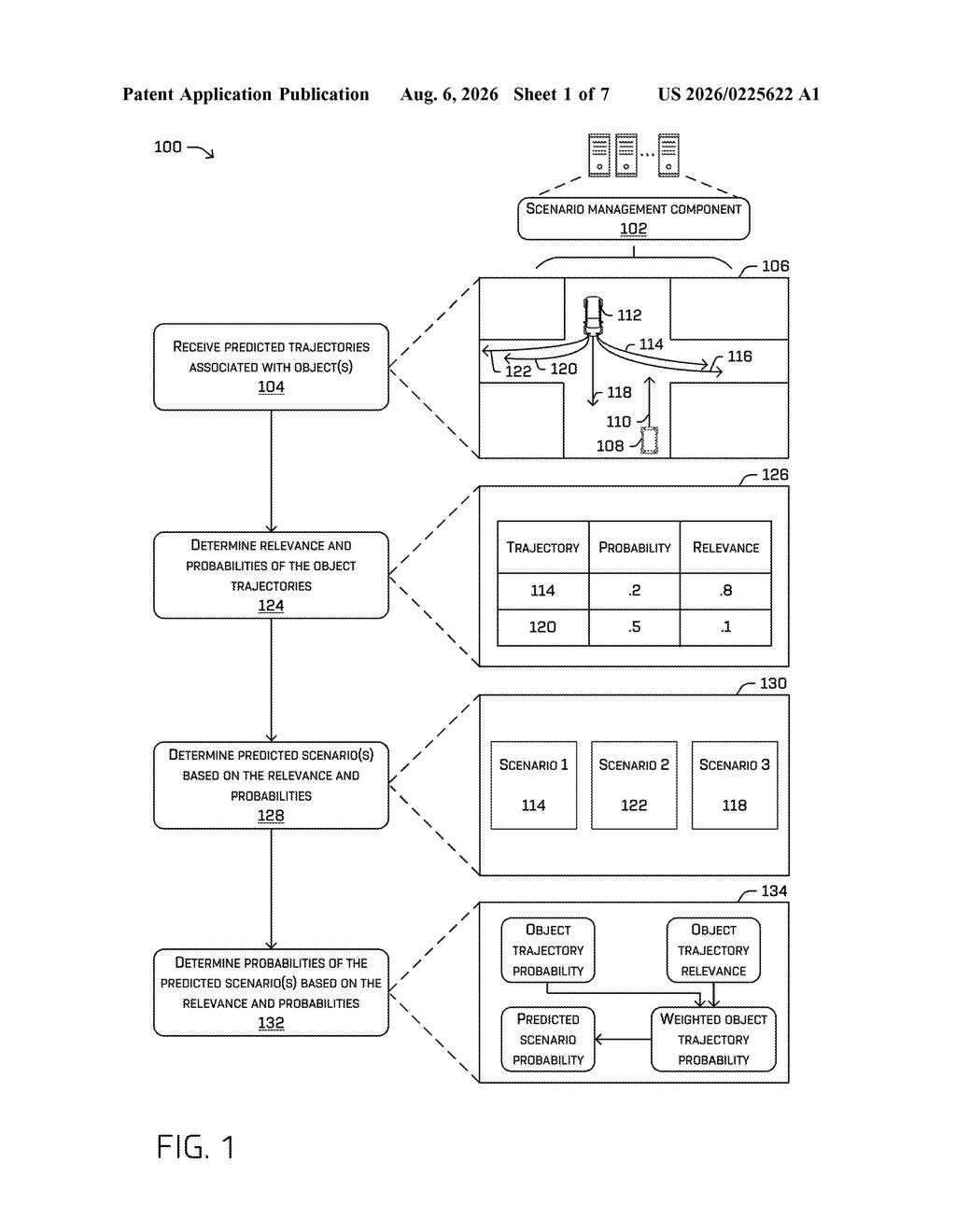
How Zoox decides which nearby cars to worry about
Imagine you're driving on a highway and a car three lanes over could theoretically drift into your path, but it would have to cut across every lane to reach you. You instinctively spend less mental energy on that car than on the one directly beside you. Zoox's patent teaches its self-driving cars to do exactly the same thing.
When the vehicle spots another car or pedestrian, it calculates a set of possible paths that object might take, each with its own likelihood. Then it adds a second layer: a relevance score that measures how much each of those possible paths would actually affect its own planned route. A pedestrian walking away from the road scores low; one stepping off the curb directly ahead scores high.
Those two numbers, probability and relevance, combine to build a realistic picture of the driving moment. The car then uses that picture to decide how to steer, brake, or accelerate, spending the most caution on the scenarios that are both likely and genuinely threatening.
… determining, for the predicted object trajectory, a relevance score representing a level of relevance to a candidate trajectory of the autonomous vehicle; …
Translation: The car figures out how much a nearby object actually matters to its own path.
How relevance scores reshape scenario probabilities
The system starts by pulling in sensor data from the vehicle's cameras, lidar, and radar. When it detects a nearby object, it generates a set of predicted trajectories for that object, each tagged with a probability. Think of these as branches on a decision tree: the pedestrian might cross the street (40%), stop at the curb (50%), or turn around (10%).
Next, for each predicted trajectory, the system calculates a relevance score. This score represents how much that specific path would intersect with or affect the autonomous vehicle's own planned route. A trajectory that crosses directly into the vehicle's path scores high; one that diverges away from it scores low.
The system then combines these two numbers to build predicted driving scenarios and assign each scenario its own weighted probability. The math effectively discounts scenarios that are unlikely or irrelevant, while amplifying attention to scenarios that are both plausible and directly threatening.
Finally, the vehicle evaluates a set of candidate actions (steer left, brake, hold speed) and calculates a cost value for each. Those costs are weighted by the scenario probabilities, so the car plans around the futures that actually matter. The result is a control trajectory, the specific path the vehicle will follow.
The vehicle may use the object trajectory probabilities and relevance scores to generate predicted driving scenarios and/or probabilities associated therewith.
Translation: It combines the odds of where things are moving with how relevant they are to plan safe driving scenarios.
What this means for self-driving decision speed
Self-driving vehicles have always struggled with computational overload. Every object in a busy intersection multiplies the number of scenarios to evaluate, and naive systems treat every possibility with equal weight. That burns processing time and can cause hesitant, overly cautious behavior that frustrates riders and disrupts traffic flow.
By filtering scenarios through a relevance lens before they enter the planning stage, Zoox could get more decisive responses out of its vehicles in dense urban environments. Zoox's robotaxi operates in cities like San Francisco and Las Vegas, where pedestrians, cyclists, and cars constantly interweave. A system that focuses computational effort where it counts most is a practical engineering improvement for real-world operation, not just a theoretical exercise.
This is a focused, practical piece of engineering rather than a conceptual leap. The core idea, weight predictions by how much they actually affect you, is intuitive, but getting the math right in real time, with real sensor noise, is genuinely hard. It's a signal that Zoox is doing the kind of careful, unglamorous work that tends to separate functional robotaxis from perpetual demos.
There are more where this came from
We read every patent application Big Tech publishes and send you the ones worth knowing. Plain English, free, every week.
The drawings
7 drawing sheets from US 2026/0225622 A1 · click any drawing to enlarge


Want this weekly breakdown for a company we don't cover? Patentlyze Pro →
Be the first to weigh in