
IBM Patent Trains Physics-Informed AI to Process Noisy Real-World Data
Most AI models learn from data alone, which means they fall apart when the data is messy or scarce. IBM's new patent embeds the laws of physics directly into the neural network so the model has something reliable to lean on even when the sensor readings are garbage.
How IBM's physics-plus-AI hybrid actually works
Imagine you're trying to predict how heat spreads through a metal pipe using sensor data, but half your sensors are unreliable and the readings are full of noise. A regular AI would get confused fast. IBM's approach gives the AI a cheat sheet: actual physics equations describing how heat (or fluid, or stress) behaves, baked right into how it learns.
The system trains in two stages. First, the AI learns the fundamental physics. Then, a second phase exposes it to noisy, real-world data, and a technique called elastic weight consolidation makes sure the model doesn't "forget" the physics it already learned while adapting to the messy new information.
Think of it like a physics student who memorizes the textbook first, then does lab experiments. The goal is to end up with a model that respects the rules of the physical world and handles imperfect data from the real world.
training a physics-informed neural network (PINN) by incorporating a mathematical equation model, and its boundary and initial conditions, into the PINN …
Translation: Teaching the AI system the fundamental rules and starting limits of a physical science.
How EWC keeps the network from forgetting its physics training
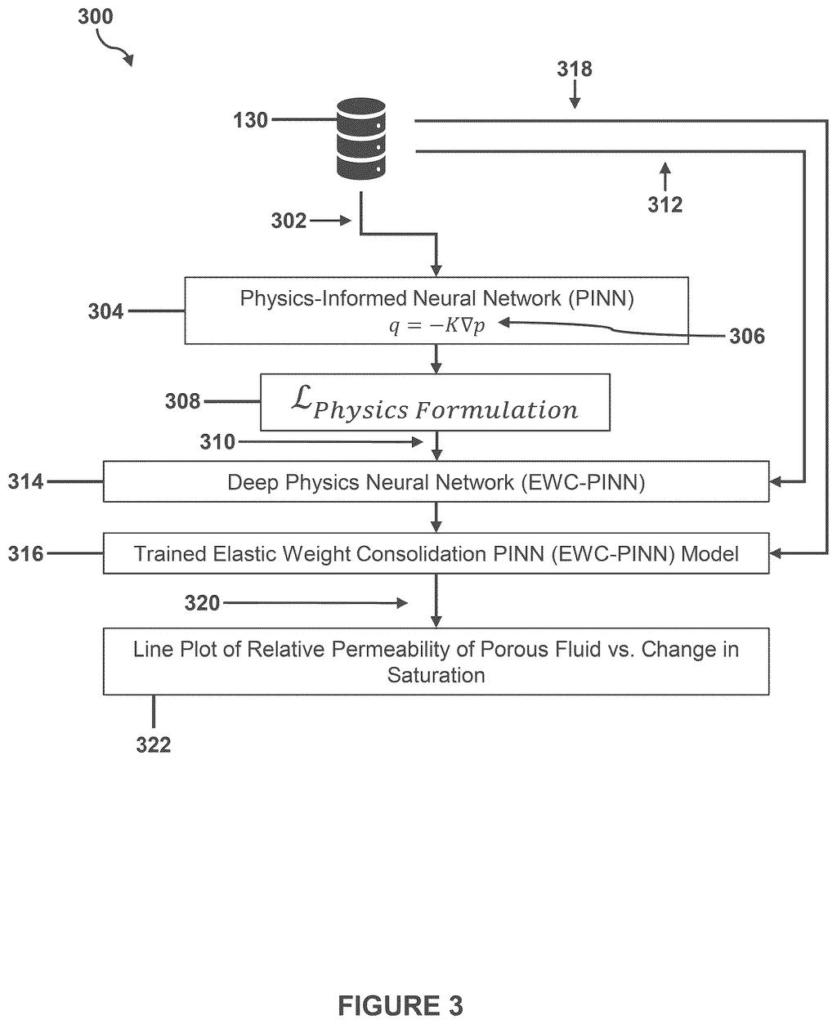
The patent describes a two-model training pipeline built around physics-informed neural networks (PINNs), a class of AI that incorporates known mathematical equations (like partial differential equations governing fluid flow or heat transfer) directly into the training process rather than learning purely from observations.
The first step trains a standard PINN on the physics equations and their boundary and initial conditions (the constraints that define where and when the equations apply, like the edges of a pipe or the temperature at time zero).
From there, the system uses transfer learning (taking what a model has already learned and applying it as a starting point for a new task) to initialize a second network called the EWC-PINN. The EWC part stands for elastic weight consolidation, a technique borrowed from continual learning research. EWC works by identifying which internal parameters were most important for the physics knowledge the model already has, then penalizing any training step that would overwrite those parameters too aggressively.
The result is a model that can be fine-tuned on noisy, real-world sensor data without losing the physics grounding it built up in the first phase. This addresses a well-known problem in AI called catastrophic forgetting, where a model trained on new data simply overwrites what it learned before.
… pre-training an elastic weight consolidation physics-informed neural network (EWC-PINN) using a transfer learning method; and training the EWC-PINN using noisy training data.
Translation: Preparing the neural network with prior knowledge so it can handle messy real-world measurements.
What this means for industrial and scientific AI modeling
For engineering and scientific applications, this kind of model could be genuinely useful. Industries like energy, aerospace, and manufacturing routinely deal with sensor data that is incomplete, delayed, or corrupted, and existing AI models that ignore physics often produce predictions that are physically impossible. A model grounded in the actual governing equations is less likely to output nonsense even when the input data is bad.
For IBM specifically, this sits squarely in the industrial AI and enterprise simulation space where the company competes with players like Siemens, ANSYS, and Nvidia's Modulus platform. It's incremental research rather than a product announcement, but it points to where IBM sees value in AI for physical systems.
This is a solid piece of applied research that tackles a real problem in scientific machine learning, namely that AI models trained on messy sensor data tend to violate basic physics. The elastic weight consolidation angle is a genuine contribution, not a buzzword. That said, it's also fairly niche: the average enterprise software buyer won't care about this directly, and it's squarely an academic-to-product pipeline filing.
There are more where this came from
We read every patent application Big Tech publishes and send you the ones worth knowing. Plain English, free, every week.
The drawings
3 drawing sheets from US 2026/0228554 A1 · click any drawing to enlarge


Want this weekly breakdown for a company we don't cover? Patentlyze Pro →
Be the first to weigh in