
Amazon Patents a Drone Docking System That Lands Fast First, Corrects Later
Most drones try to hover precisely over a target before dropping down. Amazon's new patent flips that instinct: get down fast, then adjust, as long as you're inside a safe zone.
How Amazon's drone auto-landing actually works
Imagine a delivery drone trying to land on a small pad on your rooftop or in your backyard. The cautious approach is to hover carefully, inch sideways until perfectly centered, then slowly descend. That works, but it's slow and wastes battery.
Amazon's patent describes a different strategy. The drone establishes an invisible 3D "safe zone" around the landing pad. As long as it stays inside that zone and can see the pad below, it descends as fast as possible rather than waiting to be perfectly centered. It uses a built-in light and camera to constantly read reflective markers on the pad, checking how far it is from the edges of that safe zone. The closer it drifts to the edge, the more it slows down.
The result is a landing that feels less like a helicopter gingerly touching down and more like someone confidently stepping off an escalator. Speed is the priority, with safety as the guardrail, not the other way around.
… determine a safety margin between the aerial vehicle and at least one boundary of the safety envelope based on the pose; and instruct descent of the aerial vehicle during the docking evolution at a speed based on the safety margin.
Translation: The drone adjusts how fast it descends by checking its distance from the safe landing zone borders.
How the safety envelope controls descent speed
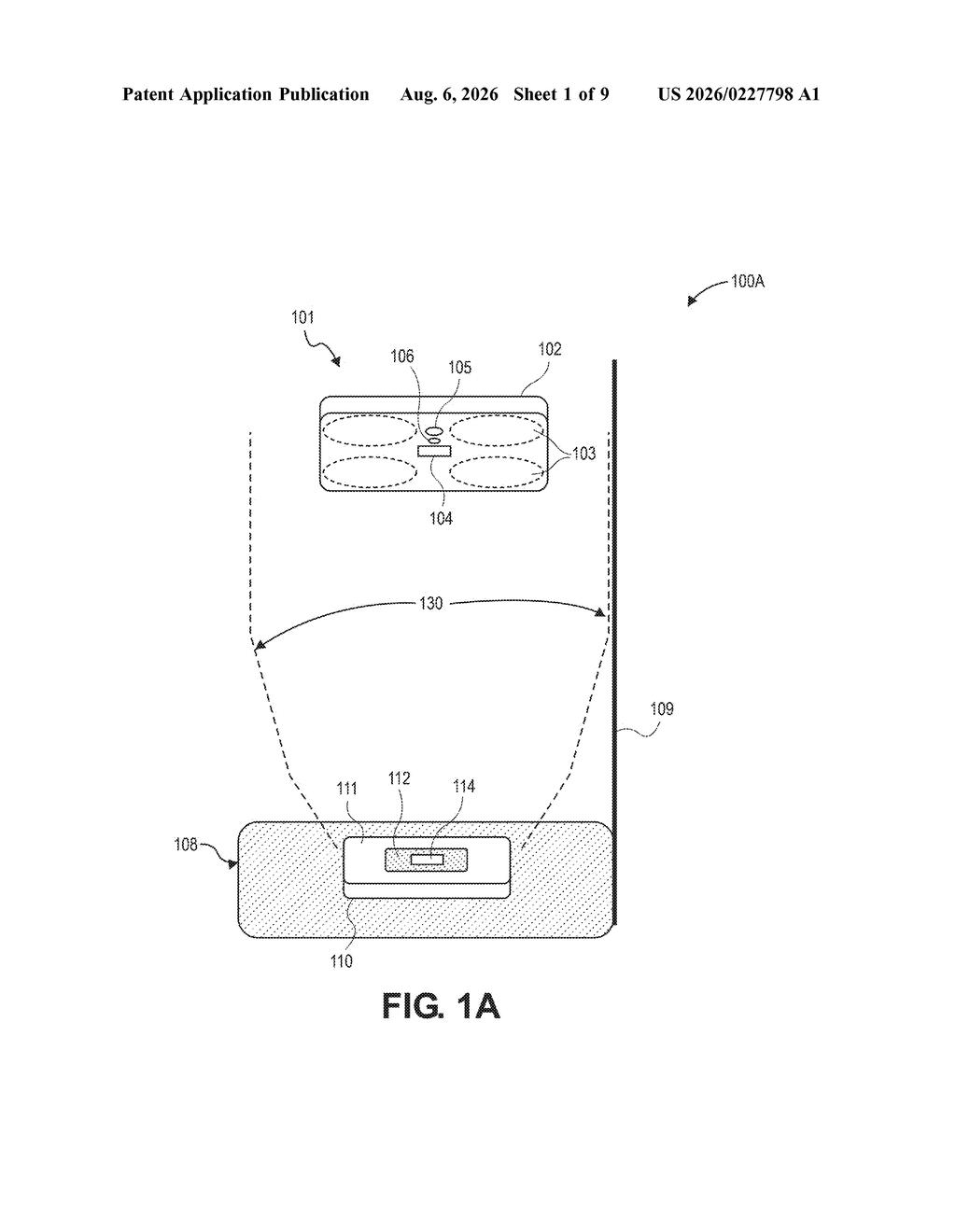
The system has three main parts working together: an aerial vehicle with a light source and camera, a landing pad covered in retroreflective markers (think the same reflective tape on road signs), and a control system making real-time decisions.
The landing pad uses multiple sets of retroreflectors (materials that bounce light directly back toward the camera) so the drone's onboard camera can reliably spot and track the pad even in varying light conditions.
The control system continuously calculates the drone's pose (its exact position and orientation in three dimensions relative to the pad) from that camera feed. It then checks how far the drone sits from the edges of a predefined safety envelope, a 3D volume of acceptable airspace above the pad.
- Large safety margin: the drone descends quickly
- Shrinking margin (drone drifting sideways): descent slows and horizontal correction kicks in
- Visibility of the pad lost: the protocol stops until reacquired
The key design choice is that vertical speed takes priority over horizontal accuracy, provided the drone stays within bounds and keeps the pad in sight. This makes landings faster without sacrificing the ability to abort if something goes wrong.
… the control strategy may prioritize descent speed over horizontal positioning as long as the aerial vehicle remains within the safety envelope with visibility of the landing pad.
Translation: The drone focuses on dropping down quickly before worrying about centering itself, as long as it stays safe and can see the target.
What this means for Amazon's delivery drone network
Amazon has been running drone delivery trials under its Prime Air program for several years, and one persistent bottleneck is the landing itself. A drone that can touch down in fewer seconds per delivery dramatically improves throughput if you're talking about hundreds of deliveries a day from a single hub or a neighborhood docking station.
This patent also hints at a more infrastructure-heavy future for drone delivery, one where dedicated docking pads with embedded reflectors are placed at homes or neighborhood pickup points rather than drones dropping packages from altitude. If that model takes hold, a faster, more reliable auto-docking system becomes one of the core pieces of the whole operation, and you'd notice it simply as a drone that lands confidently instead of hovering awkwardly for half a minute.
This is genuinely practical engineering, not a speculative moonshot. The insight that landing speed should dominate over positioning precision (within a safety boundary) is the kind of operational optimization that separates a working delivery network from a demo. Amazon appears to be solving real friction in its drone program, and this patent is evidence that the docking problem is being taken seriously at the algorithm level.
There are more where this came from
We read every patent application Big Tech publishes and send you the ones worth knowing. Plain English, free, every week.
The drawings
9 drawing sheets from US 2026/0227798 A1 · click any drawing to enlarge


Want this weekly breakdown for a company we don't cover? Patentlyze Pro →
Be the first to weigh in