
Qualcomm Patent Reimagines the Math Behind AI Softmax Functions with FlexMax
Deep inside almost every AI model is a math function called softmax that turns raw scores into probabilities. Qualcomm thinks the version everyone uses is too rigid, and this patent describes a way to make it adjustable.
What Qualcomm's tunable AI decision math actually does
Imagine an AI assistant picking the most likely word to complete your sentence. Under the hood, it's constantly running a calculation that converts a pile of raw scores into percentages, then picks the highest one. That calculation is called softmax, and it uses a fixed mathematical formula that hasn't changed much in decades.
Qualcomm's patent describes a version called FlexMax that lets engineers change a key setting in that formula, called the base parameter, so the AI can be tuned to behave differently depending on what it's being trained to do. Think of it like adjusting the sensitivity of a dial rather than being stuck with one fixed setting.
The idea is that during training, the model can be configured to use the version of the formula that works best for its task, whether that's translation, image recognition, or something running on a phone. It's a behind-the-scenes tweak, but one that could make AI models more efficient or accurate without rebuilding them from scratch.
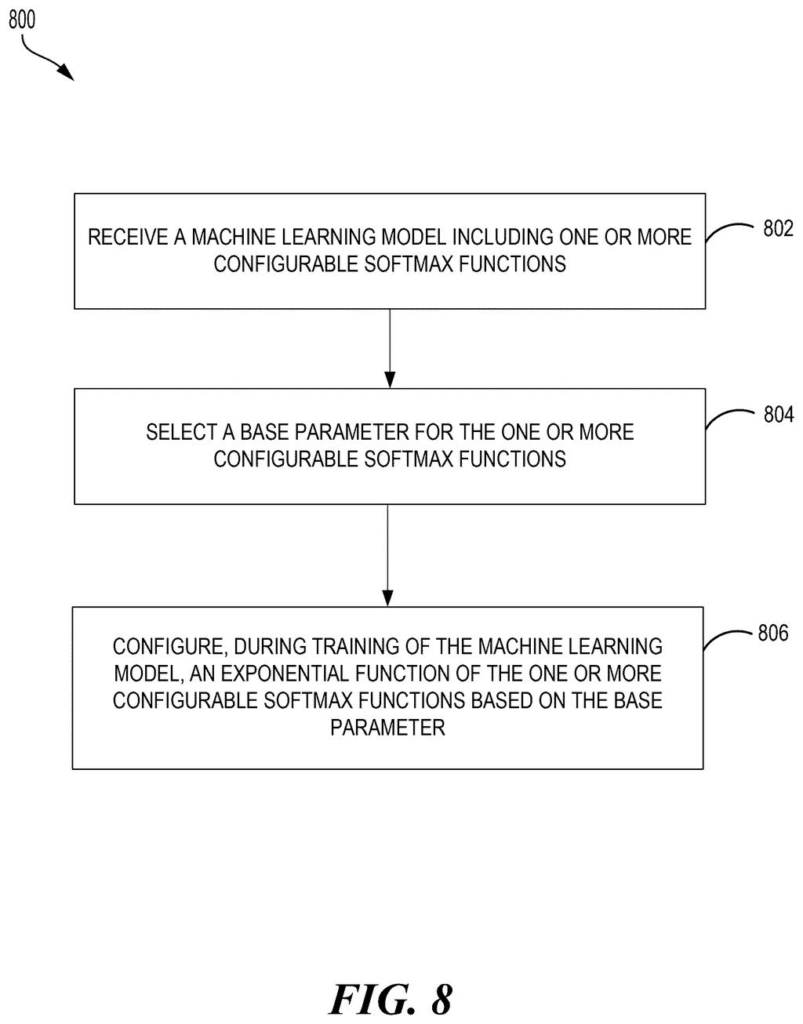
… select a base parameter for the one or more configurable softmax functions; and configure, during training of the machine learning model, an exponential function of the one or more configurable softmax functions based on the base parameter.
Translation: The system picks a starting value to tweak how the AI calculates probabilities while it learns.
How FlexMax adjusts the softmax exponential base
The softmax function is a mathematical operation used in nearly every modern AI model. It takes a list of raw numbers (called logits) and converts them into a probability distribution, meaning all the values add up to 100% and the model can pick the most likely answer. The standard version uses Euler's number (e, roughly 2.718) as its fixed base in the exponential calculation.
Qualcomm's FlexMax system replaces that fixed base with a configurable base parameter. Instead of always using e, an engineer or the training process itself can choose a different numerical base, changing how sharply or gently the function distributes probability across the options.
The patent describes a processor and memory setup that:
- Receives a machine learning model containing one or more softmax functions
- Selects a base parameter for those functions before or during training
- Configures the exponential calculation to use that chosen base throughout the training run
In practical terms, a sharper base means the model becomes more decisive (puts more weight on its top choice), while a flatter base spreads confidence more evenly. Being able to tune this per model or per layer gives engineers a new knob to turn when optimizing for speed, accuracy, or power use.
A processor-implemented method for applying a flexible softmax function in machine learning models includes receiving a machine learning model including one or more configurable softmax functions.
Translation: The software takes in an artificial intelligence model that has adjustable probability calculations built into it.
What this means for AI running on Qualcomm chips
Qualcomm makes the Snapdragon chips that run AI workloads on hundreds of millions of Android phones and laptops. Any technique that lets those chips run AI models more efficiently, or lets models be better adapted to on-device constraints, matters at scale. FlexMax is the kind of low-level optimization that could improve how well a model performs within tight power and memory budgets.
For you as a user, the impact would be invisible but real: faster responses, better accuracy, or longer battery life from the AI features already built into your phone. For AI researchers and chip designers, a tunable softmax could also open up new model architectures that the fixed version makes awkward to train.
This is a narrow, infrastructure-level patent that won't make headlines anywhere but matters quite a bit to the people building AI models for mobile hardware. Adjusting the softmax base is a small lever, but Qualcomm's entire competitive edge is in squeezing performance out of constrained chips, and patents like this are how they protect those incremental gains.
There are more where this came from
We read every patent application Big Tech publishes and send you the ones worth knowing. Plain English, free, every week.
The drawings
7 drawing sheets from US 2026/0227957 A1 · click any drawing to enlarge


Want this weekly breakdown for a company we don't cover? Patentlyze Pro →
Be the first to weigh in