
Qualcomm Patents a Way to Keep On-Device AI From Overheating Your Phone
Running a powerful AI model on your phone generates real heat — and Qualcomm wants the device to respond to that heat by automatically dialing the AI back before your phone turns into a hand warmer.
What Qualcomm's heat-aware AI throttling actually does
Imagine you're using an AI assistant built into your phone — asking it to summarize documents, draft messages, or answer questions — and behind the scenes, the chip is working hard enough to warm the device in your hand. At some point, that heat becomes a problem: it can throttle performance, drain the battery faster, or just make the phone uncomfortable to hold.
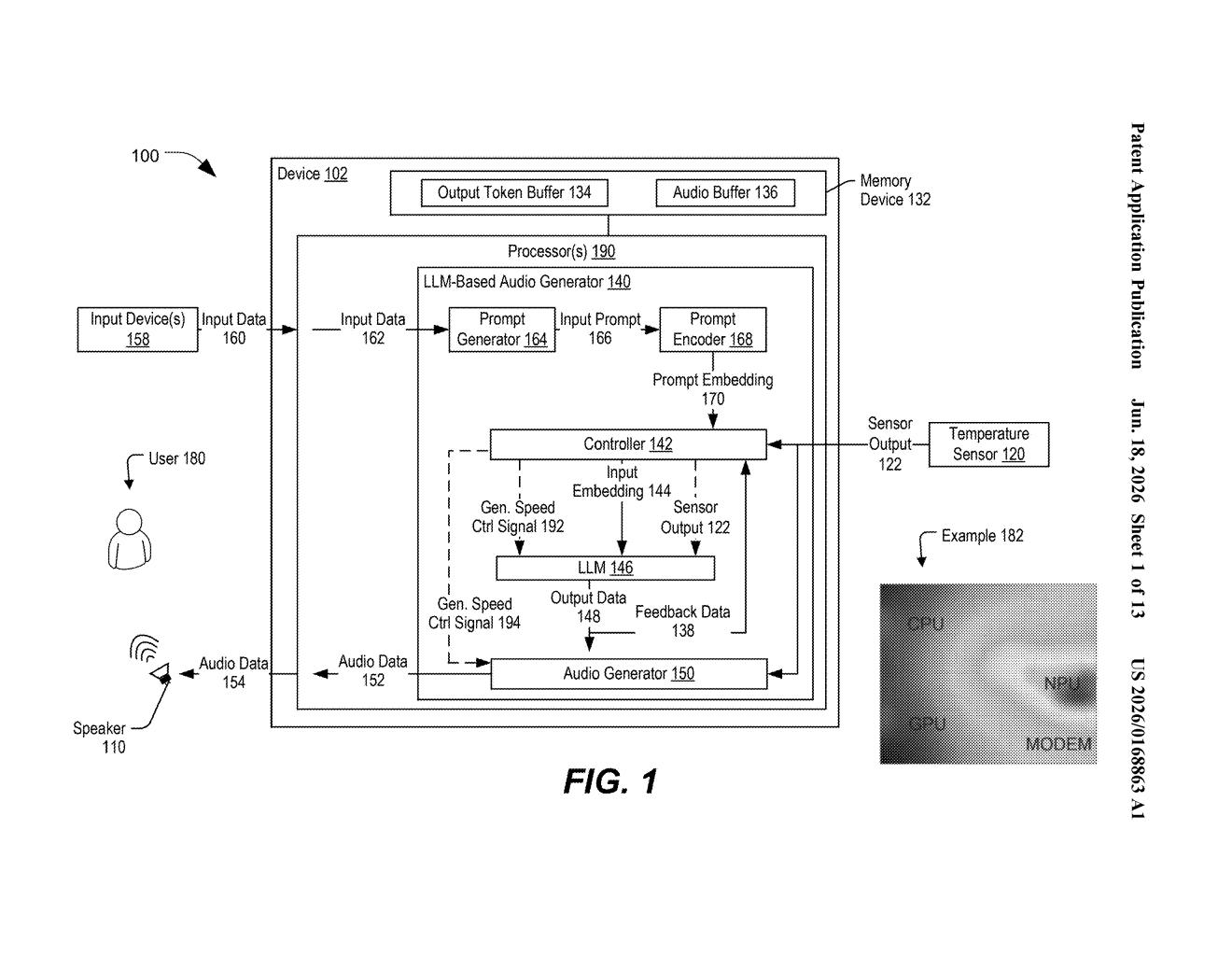
Qualcomm's patent describes a system where the phone's own temperature sensor is wired into the AI model's behavior. If the device gets too warm, the system uses that temperature reading — along with what the AI has already generated — to change how the AI produces its next response. That could mean shorter answers, lower-precision outputs, or pausing certain tasks entirely.
The goal is to let on-device AI run longer and more safely without forcing you to close the app or wait for the phone to cool down. It's essentially a thermostat for your AI assistant.
How the temperature sensor feeds back into the LLM output loop
The patent describes a device — most likely a smartphone or tablet — that stores the output of a large language model (LLM) (the type of AI that powers chatbots and writing assistants) in memory. One or more processors continuously monitor a temperature sensor attached to the device.
The key mechanism is a feedback loop: the processors take both the current device temperature and the AI's most recent output, then use that combination to decide how the AI generates its next output. In plain terms, the AI isn't just responding to your prompt — it's also responding to how hot the chip is running.
What "control generation" could mean in practice:
- Reducing the length or complexity of the AI's responses
- Switching to a smaller, less compute-intensive version of the model
- Delaying or queuing certain AI tasks until the device cools
- Adjusting the precision of the model's calculations to reduce heat output
The patent keeps the specific control methods broad, which is intentional — it lets Qualcomm apply this framework across many different implementations on its Snapdragon chips.
What this means for running AI directly on your phone
On-device AI — running a language model directly on your phone instead of sending your data to a cloud server — is one of the biggest trends in mobile right now. Apple, Google, Samsung, and Qualcomm are all pushing it hard. But running these models locally is genuinely taxing on mobile hardware, and sustained heat is one of the main reasons devices throttle or become uncomfortable to use.
If Qualcomm can build heat-awareness directly into how an LLM operates, it gives Snapdragon-powered Android phones a practical edge: longer AI sessions without the device slowing to a crawl. For you as a user, that means fewer moments where your phone suddenly feels sluggish mid-conversation with an AI assistant. It also matters for battery life, since a chip running cooler tends to be a chip running more efficiently.
This is unglamorous but genuinely useful engineering. The gap between what on-device AI can do in a demo versus what it sustains over a real 20-minute session is real, and heat is a big reason why. A patent that puts temperature feedback directly inside the AI control loop is a practical answer to a practical problem — not a flashy capability, but the kind of infrastructure work that determines whether on-device AI actually feels good to use day-to-day.
There are more where this came from
We read every patent application Big Tech publishes and send you the ones worth knowing. Plain English, free, every week.
Want this weekly breakdown for a company we don't cover? Patentlyze Pro →