
Google Patents an AI Photo Editor That Changes Your Look Without Touching Your Face
Imagine asking an AI to change your jacket in a photo, and watching it do exactly that without smudging, warping, or reimagining your face at all. That's the specific problem Google is trying to solve here.
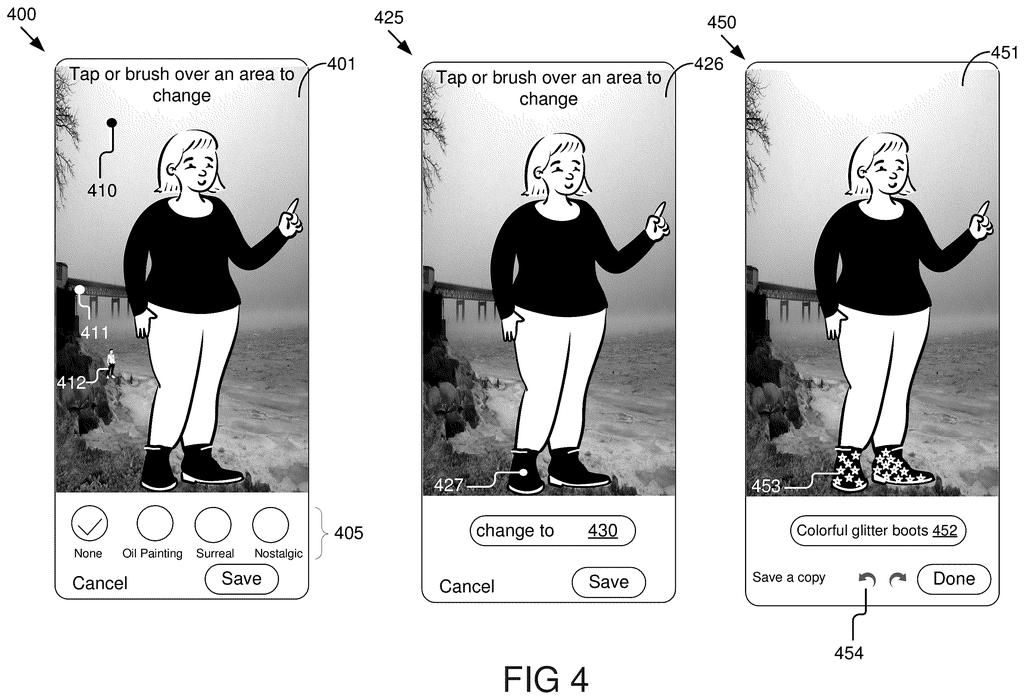
How Google's face-locking photo edit actually works
You know that frustrating thing AI image editors do? You ask them to change your outfit or put you on a beach, and suddenly your face looks subtly wrong, a bit too smooth, a different angle, or just slightly not you. Google's patent is aimed directly at that problem.
The idea is to give the AI a "do not touch" zone before it starts editing. The system automatically detects the face in your photo and draws an invisible boundary around it. Everything outside that boundary (clothes, background, lighting style) is fair game for changes based on whatever text instruction you type in. The face stays frozen exactly as it was in the original photo.
When the edit is done, the AI stitches the untouched face back over the newly generated scene, blending the two so they look natural together. The result is an edited image that reflects your text request while keeping your actual face intact.
… generating a preserving mask that corresponds to the face of the subject; providing the textual request, the initial image, and the preserving mask as input to a diffusion model; outputting, with the diffusion model, a denoised initial image based on the initial image; …
Translation: The system maps the person's face and feeds it along with your text prompt into an AI image generator.
Inside the diffusion model's mask-and-blend pipeline
The system works in three broad stages.
First, face detection and masking: When you feed the system an image plus a text prompt (say, "wearing a red winter coat"), it automatically generates a preserving mask, essentially a pixel map that identifies exactly where the face is in the image. This mask tells the model: do not alter anything here.
Second, a diffusion model runs two parallel tracks: A diffusion model (an AI that learns to generate images by practicing how to "de-noise" static back into a picture) processes the image two ways simultaneously. One track reconstructs the original image faithfully. The other track takes the text prompt and applies it through a process called text conditioning, essentially nudging the image generation toward the visual idea described in words, producing a "translated" version that matches the request.
Third, blending: The system takes:
- The faithfully reconstructed original
- The AI-generated edit that satisfies the text prompt
- The preserving mask for the face
...and composites them together. The mask ensures the final output uses the original face pixels while the rest of the image reflects the requested changes. The patent also references self-attention maps (internal guides the AI uses to keep track of which image regions relate to which) to help maintain visual coherence across the blend.
The media application blends the denoised initial image, the preserving mask, and the denoised translated image to form an output image, wherein the preserving mask prevents modification to the face from the initial image.
Translation: It combines the new edits with the original face to create the final picture without altering the person's features.
What this means for AI portrait editing tools
For anyone who uses AI photo tools, face distortion is one of the most common complaints. Portrait photos are especially sensitive because people immediately notice when a face looks "off." A system that structurally separates face preservation from the edit request solves a real and persistent usability problem rather than just making the model bigger and hoping it improves.
For Google, this fits into the broader competitive push around AI editing features in Photos. Tools like this could show up in Google Photos or Pixel camera software, where users regularly want to change backgrounds or fix clothing in portraits without hiring a retoucher. Whether it works as cleanly as the patent describes in practice is another question, but the underlying approach is technically sound.
This is a genuinely useful patent addressing a real problem that irritates real users. Face distortion in AI edits is not a niche complaint, and explicitly baking a face-protection step into the architecture, rather than relying on the model to "figure it out," is a cleaner engineering choice. Whether Google ships it into a consumer product soon depends on factors outside the patent, but the mechanism itself is practical and specific.
There are more where this came from
We read every patent application Big Tech publishes and send you the ones worth knowing. Plain English, free, every week.
The drawings
12 drawing sheets from US 2026/0228944 A1 · click any drawing to enlarge


Want this weekly breakdown for a company we don't cover? Patentlyze Pro →
Be the first to weigh in