
Samsung Patents a Way to Wake Your Smart Ring Only When You Need to Gesture
Samsung's latest patent describes smart glasses that watch where your hand is going, then wake up your smart ring just in time to read your gesture, and not a moment sooner.
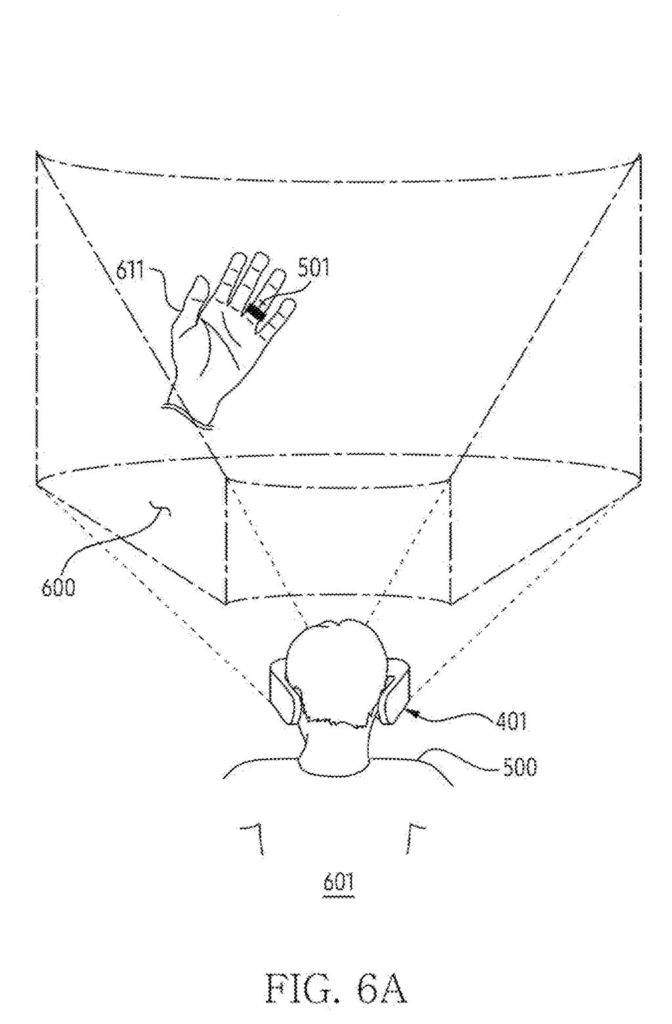
How Samsung's glasses-and-ring gesture system actually works
Imagine you're wearing a pair of smart glasses and a smart ring. To save battery, the ring is mostly asleep. But the moment you raise your hand to tap or swipe, the glasses need the ring to spring to life instantly. The problem: if the glasses wait until your hand is already in frame, it's too late to get useful motion data.
Samsung's solution is to teach the glasses to predict your hand's arrival. The glasses camera constantly watches the edges of its field of view. When your hand disappears behind something (like your body) and is clearly moving toward the frame, the glasses mark a "buffer zone" just outside the visible area. The moment your hand crosses into that zone, the glasses send a wake-up signal to the ring.
By the time your hand is actually visible and you make a gesture, the ring has already powered up its motion sensors and is ready to report exactly what your hand did. You get responsive gesture control without draining the ring's battery sitting idle all day.
… wherein the other wearable device is in a low-power state in which obtaining motion data of the other wearable device, through a sensor of the other wearable device, is ceased; …
Translation: The ring stays asleep to save battery by turning off its motion sensors until it is needed.
How the camera predicts hand entry and triggers the ring
The patent describes a two-device wearable system, most likely smart glasses paired with a smart ring or wristband. The glasses carry a camera and handle the visual tracking; the ring carries motion sensors (accelerometers, gyroscopes) but stays in a low-power state (sensors off) when not needed.
The core mechanism works in three steps:
- Track the missing hand: The glasses camera identifies when the hand leaves its field of view into an "obstruction area" (behind the body, below frame, etc.) and tracks the hand's movement direction and speed leading up to that disappearance.
- Set a wake-up zone: Based on that trajectory, the glasses calculate a "first area", a predicted boundary just outside the camera's view. Think of it as a tripwire drawn in space where the hand is likely to re-enter the frame.
- Wake and read: The instant the hand crosses that boundary (detected visually), the glasses radio the ring to power up. The ring transitions from sleep to normal mode, starts sampling motion, and sends that data back to the glasses, which then identify the full gesture.
The result is that the ring is awake and logging motion data before the gesture is completed, giving the system enough signal to classify what the user actually did.
identifying a relative movement of a hand of the user wearing another wearable device in a FOV, wherein the other wearable device is in a low-power state; …
Translation: The main device watches for hand movement in its camera view while the smart ring is resting.
What this means for Galaxy Ring and smart glasses battery life
Battery life is the defining constraint of wearables. A smart ring that runs its gyroscope and accelerometer constantly would drain in hours. By keeping the ring asleep until the glasses predict an incoming gesture, Samsung can extend ring battery life significantly without making gesture input feel sluggish or unreliable.
This is directly relevant to Samsung's existing product line: the Galaxy Ring and any future smart glasses Samsung releases. The patent also signals that Samsung is thinking about these devices as a coordinated system rather than independent gadgets, which aligns with broader industry pressure to make multi-device wearable ecosystems feel like a single, coherent experience rather than a collection of separate sensors you have to manage yourself.
This is a genuinely practical piece of engineering. The clever part isn't the gesture recognition itself, that's well-trodden ground, it's the predictive wake-up logic that makes a low-power ring feel instantaneous. Whether it ships in Galaxy Ring 2 or some future Samsung glasses product, the underlying idea of using one device's camera to manage another device's power state is a real contribution to wearable system design.
There are more where this came from
We read every patent application Big Tech publishes and send you the ones worth knowing. Plain English, free, every week.
The drawings
22 drawing sheets from US 2026/0227865 A1 · click any drawing to enlarge


Want this weekly breakdown for a company we don't cover? Patentlyze Pro →
Be the first to weigh in