Meta
Meta · Wearable · Filed Nov 20, 2025 · USPTO published May 21, 2026 · May 21 release
Meta Patents a Wake Word Arbitration System for Glasses and Wristbands
If you're wearing both smart glasses and a smartwatch, which one should respond when you say 'Hey Meta'? This patent describes a coordination system that picks the right device so they don't both answer at once.
- Publication number
- US 2026/0140694 A1(US20260140694A1)
- Applicant
- Meta Platforms Technologies, LLC
- Filed · Published
- Nov 20, 2025 · May 21, 2026
- Inventors
- Yuhui Lin, Marcin Kwiatkowski, Rahul Yogendra Verma, Serhat Yilmaz
- Status when we published
- Waiting for an examiner
- Document
- 20 claims
- US classification
- 704/275
- Parent application
- Claims priority from a provisional application 63722971 (filed Nov 20, 2024)
How Meta decides which wearable hears your voice
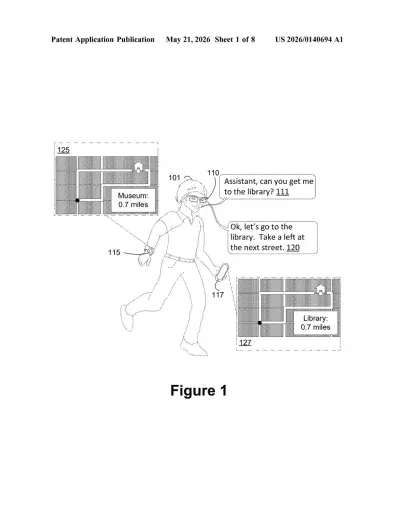
Imagine saying a wake word while wearing smart glasses and a wristband at the same time. Both devices hear you — and without some kind of referee, they'd both try to respond, talking over each other or triggering duplicate actions.
Meta's patent describes a system that acts as that referee. It checks the current state of each device — think: is the head-wearable active and ready, or is it sleeping, removed, or busy? — and then assigns one device to "listen" while the other stands down. If your glasses are active, they take the call. If they're off your face or in a low-power state, your wristband picks up the slack.
The result is that you don't have to think about which gadget to talk to. You just speak, and the ecosystem figures out which device is best positioned to hear and respond. It's a behind-the-scenes coordination layer for a world where you might be wearing several voice-enabled gadgets simultaneously.
How device state toggles wake word ownership
The patent describes a wake word arbitration system — essentially a decision engine that runs while a head-wearable (like smart glasses) and a wrist-wearable (like a smartband or smartwatch) are connected to each other.
The logic works in two branches:
- If the head-wearable is in its "first state" (active, on-head, ready), it claims the wake word. The wrist device is instructed to forgo detection entirely — it doesn't listen for the trigger phrase at all.
- If the head-wearable switches to a "second state" (off-head, low-power, unavailable) and the wrist-wearable is in its own ready state, the handoff happens automatically. Now the wristband listens, processes the command, and delivers a response — the glasses stay silent.
The "states" here are the key technical variable. They likely encode things like whether a device is being worn (using proximity or IMU sensors), its battery level, or its current power mode — though the patent focuses on the abstract state machine rather than enumerating every possible trigger.
Responses can be audio or visual depending on which device wins the arbitration, which makes sense: smart glasses can display text in your field of view, while a wristband might vibrate or speak through a paired earbud.
What this means for Meta's wearable ecosystem
As Meta pushes deeper into wearables — with Ray-Ban smart glasses already shipping and wristband/neural interface hardware reportedly in development — the friction of managing multiple voice-activated devices becomes a real product problem. Without arbitration, two devices catching the same wake word creates the kind of embarrassing, annoying experience that kills consumer trust in a platform.
For you as a user, this is the kind of invisible infrastructure that makes a multi-device ecosystem feel coherent rather than cobbled together. It's also a sign that Meta is designing these products as a connected system from the ground up, not just releasing standalone gadgets that happen to share a brand name.
Source: US 2026/0140694 A1 at the USPTO (PDF). Full patent text and figures are in the official publication.
Get our take in your Top Stories
Liked this breakdown? Add Patentlyze as a preferred source on Google, and our plain-English take shows up more often in your Top Stories the next time Meta patent news breaks.
Add Patentlyze on Google
One click.
There are more where this came from
We read the new patents from Big Tech, carmakers and more and send you the ones worth knowing. Plain English, free, every week.
More from Meta
All 192 Meta patents →
More in Hardware
All 2,375 Hardware patents →
Samsung
Samsung Patents a Way to Wake Your Smart Ring Only When You Need to Gesture
Apple
Apple Patents Glasses That Automatically Tighten Their Grip on Your Nose
Google
Google's New Patent Teaches Smart Glasses to Feel Your Voice, Not Just Hear It
Samsung