
New Patent Teaches AI Image Generators to Sharpen Their Own Output
Nvidia has filed a patent for a training technique that fixes one of the oldest problems in AI image generation: the tendency for models to play it safe and produce blurry, averaged-out pictures instead of sharp, realistic ones.
Why Nvidia's AI images go blurry in the first place
Imagine asking an AI to draw a cat, and instead of getting a crisp, detailed animal, you get something that looks like it was painted with a sponge. That happens because the AI is trained to make images that are statistically "safe" across millions of possibilities, which often means mushing details together.
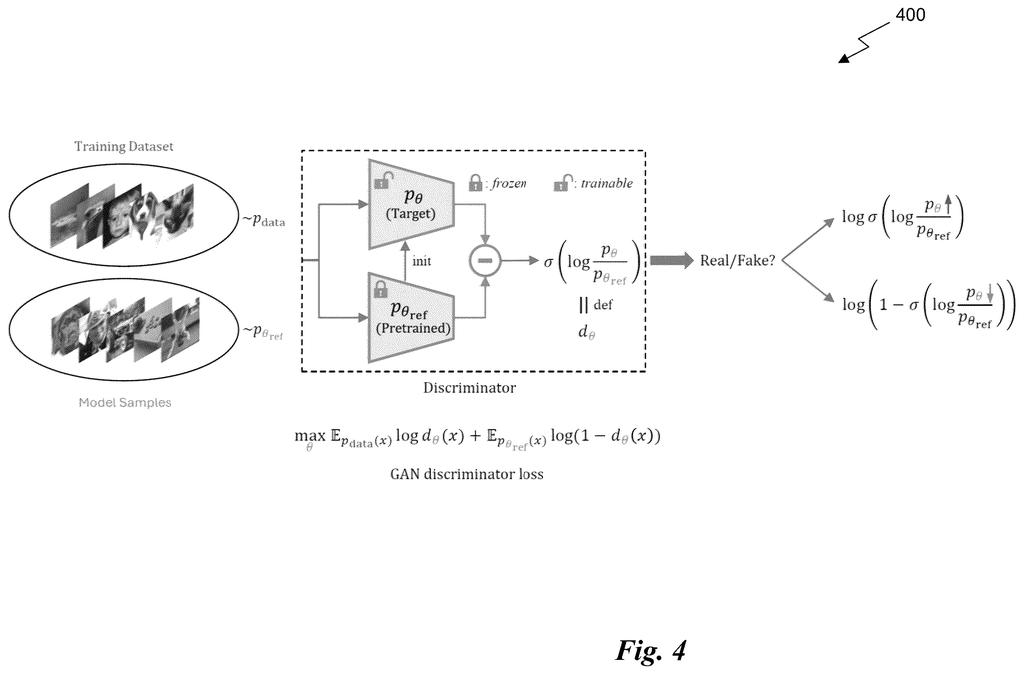
Nvidia's patent describes a way to fix that during a second round of training called fine-tuning. The system brings in a judge model (called a discriminator) that has one job: look at real photos and AI-generated ones and decide which is which. When the main image model gets fooled by its own blurry output, the judge penalizes it, pushing it to produce crisper results.
The clever part is that the judge itself is built on top of the image model being improved, so the two are tightly linked. The result is that existing AI image and video generators can be upgraded without being rebuilt from scratch.
fine-tuning a target likelihood-based generative model by: accessing a plurality of ground truth visual data samples and a plurality of reference visual data samples generated by a pretrained reference likelihood-based generative model …
Translation: The system improves an AI model by comparing real images against pictures made by an older AI.
How the GAN discriminator corrects the base model
Most AI image generators are trained using a method called maximum likelihood estimation (MLE), which tells the model to produce outputs that are plausible across the entire range of training images. The downside is that "plausible across everything" often means blurry and generic, because the model hedges its bets.
Nvidia's approach adds a second training phase that borrows a technique from a different family of AI models: Generative Adversarial Networks (GANs). In a GAN setup, a separate "discriminator" model judges whether an image looks real or generated. The generator keeps improving until the discriminator can no longer tell the difference.
The patent's specific method works like this:
- A pre-trained reference image model generates a batch of sample images.
- Those samples and real training images are both fed to the GAN discriminator.
- The discriminator, which is built on top of the model being fine-tuned, classifies each image as real or generated.
- A GAN loss (a score measuring how badly the model was fooled) is calculated, and the main model is updated to reduce that score.
Because the discriminator shares weights with the model being improved, the feedback is unusually direct, letting the system correct over-smoothed outputs without destabilizing the model.
… forcing the learned density to spread out excessively, potentially leading to blurry samples.
Translation: Standard training methods often make the resulting artificial images look fuzzy.
What this means for AI video and image quality
Blurry AI images are not just an aesthetic problem. For video generation, medical imaging, or design tools, soft details can make outputs unusable. A technique that fixes blurriness after a model has already been trained means Nvidia (and anyone using its tools) can upgrade existing generators without expensive full retraining.
This also positions Nvidia's generative AI stack (used in tools like Edify and inside products built on the Picasso platform) to produce sharper results than models trained only with standard likelihood methods. For the companies licensing Nvidia's AI infrastructure to make images and video, sharper outputs translate directly into better products.
This is a real technical contribution, not a patent-as-placeholder. The core insight, using a discriminator that shares parameters with the model being fine-tuned, is a meaningful twist on established GAN theory, and the blurriness problem it targets is a genuine pain point in production image generation. It's not flashy, but it's the kind of careful engineering that shows up in shipping products.
There are more where this came from
We read every patent application Big Tech publishes and send you the ones worth knowing. Plain English, free, every week.
The drawings
10 drawing sheets from US 2026/0228508 A1 · click any drawing to enlarge


Want this weekly breakdown for a company we don't cover? Patentlyze Pro →
Be the first to weigh in