
Samsung Patents Video Technology That Cuts Unnecessary Steps to Restore Picture Quality
Every time your phone plays a compressed video, a decoder is reading thousands of tiny data flags telling it where the picture information actually lives. Samsung's new patent describes a way to skip some of those flags entirely when the decoder can already figure out the answer on its own.
How Samsung's decoder cuts wasted data in compressed video
When a video is compressed and then played back, the decoder needs a roadmap to reconstruct each frame. Part of that roadmap consists of small flags, essentially yes/no signals, that tell the decoder whether a given block of pixels contains any real image data worth processing.
Samsung's patent describes a situation where one of those flags can be safely skipped. When a video block is encoded using a technique called merge mode (where motion information is borrowed from neighboring blocks instead of being sent fresh), the decoder can infer that the block contains meaningful pixel data without being explicitly told. That means one flag can be dropped from the compressed data stream entirely.
For large blocks, the patent adds a second, more specific flag that narrows down exactly which part of the block carries the data. The net result is a decoder that does the same job with fewer instructions baked into the video file, which can mean smaller file sizes or more efficient decoding at the same quality level.
… when a merge flag indicates that a prediction mode of the current coding unit is a merge mode, determining motion information of the current block based on previously-decoded motion information without obtaining the motion information of the current block from a bitstream; …
Translation: It skips reading motion data from the file by reusing details from earlier decoded frames.
How the two-flag system splits coding units by size
The patent covers a video decoding method built around a two-level block inspection system.
First, a video frame is divided into a hierarchy of coding units (rectangular blocks of pixels) using a process that allows binary, tri, or quad splitting. Each unit can be split further until the decoder reaches a workable size. The top-level blocks are always square.
When a coding unit uses merge mode (meaning its motion data is copied from already-decoded neighboring blocks rather than transmitted explicitly), the patent says the decoder can skip reading the first coded block flag from the bitstream entirely. Instead, it assumes the block contains non-zero transform coefficients, which is the technical way of saying there is real image detail present worth decoding.
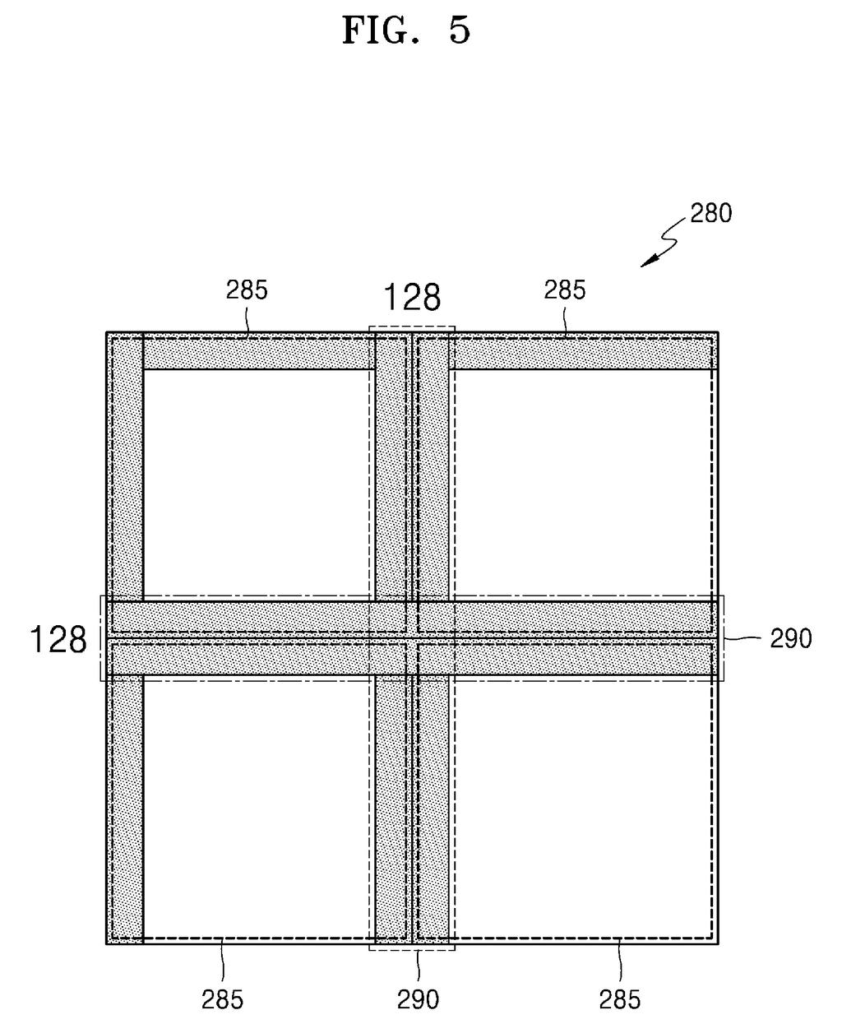
From there, the decoder checks whether the block's height or width exceeds a predetermined size threshold. If it does, the block gets divided into transform units (smaller sub-blocks used for the actual mathematical decoding step), and a second coded block flag is read from the bitstream. This second flag tells the decoder whether the luma (brightness) component of that sub-block contains meaningful data.
- Flag 1: inferred, never read from the file in merge mode
- Flag 2: read only for oversized blocks, targeting the luma channel specifically
- Residual signal: reconstructed from whatever the flag confirms is present
… identifying whether at least one of a height and a width of the current coding unit is greater than a predetermined size, based on whether the at least one of the height and the width of the current coding unit is greater than the predetermined size, obtaining at least one transform unit …
Translation: The system checks block dimensions against a set limit to decide how to process the image pieces.
What this means for video streaming efficiency
Codec efficiency patents like this one are the unglamorous engine behind streaming quality. Shaving even a handful of bits per block across millions of blocks per second adds up to real differences in bitrate, storage costs, and battery drain on decoding hardware. This is the kind of work that eventually shows up in standards like HEVC or VVC, where Samsung is an active contributor.
For you as a viewer, the most likely outcome of this kind of improvement is that a video at your current streaming quality level takes slightly less bandwidth, or that the same bandwidth delivers a sharper picture. It is not a single dramatic change, but incremental codec work is how streaming got from DVD-quality to 4K HDR on a phone.
This is a narrow, technical codec patent with no obvious consumer-facing story. Samsung files heavily in video compression standards work, and this reads like a building block for future codec standardization rather than a standalone product feature. Worth noting for anyone tracking HEVC or VVC standards activity, but not a patent that signals a major strategic shift.
Get our take in your Top Stories
Liked this breakdown? Add Patentlyze as a preferred source on Google, and our plain-English take shows up more often in your Top Stories the next time Samsung patent news breaks.
There are more where this came from
We read every patent application Big Tech publishes and send you the ones worth knowing. Plain English, free, every week.
The drawings
26 drawing sheets from US 2026/0230641 A1 · click any drawing to enlarge


Show the other 18 sheets


Want this weekly breakdown for a company we don't cover? Patentlyze Pro →