
Google's New Patent Hides the Tap-to-Pay Antenna Inside a Foldable Phone's Frame
Google is working on a way to hide the NFC coil that powers tap-to-pay inside the metal frame of a foldable phone, rather than adding a separate layer inside the device. The trick is getting that antenna to behave correctly whether the phone is open flat or folded shut.
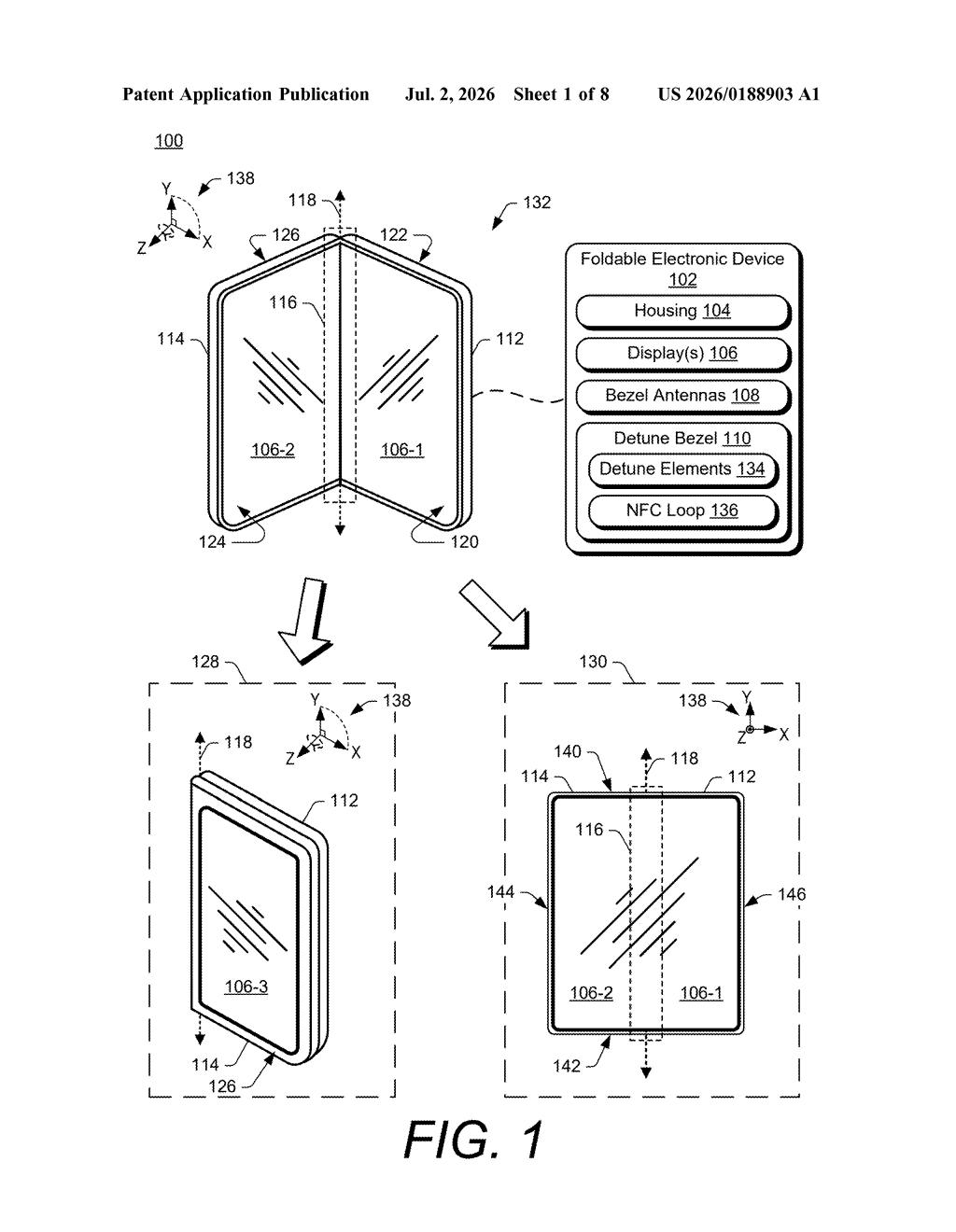
What Google's bezel-NFC trick actually does
Imagine you tap your phone at a coffee shop to pay. That quick tap works because your phone has a small antenna coil buried inside it, specifically for near-field communication (NFC). On a normal slab phone, there's room to tuck that coil away. On a foldable phone that folds in half like a clamshell, space is extremely tight, and folding the phone changes how all the antennas behave.
Google's patent describes a way to skip that dedicated NFC coil entirely. Instead, it builds the NFC function directly into the thin metal bezel (the rim around the screen) of one of the two halves of a foldable phone. Small metal elements along that bezel, which are already there to manage how other antennas like cellular and Wi-Fi work when the phone is folded, get connected together to act as the NFC loop.
The payoff is a thinner device. By repurposing hardware that was already needed anyway, Google avoids stacking yet another component inside an already crowded folding body. And the system is designed so that NFC keeps working whether the phone is lying open flat on a desk or snapped shut in your pocket.
How the detune elements double as an NFC loop
The patent covers a foldable phone with two housing halves connected by a hinge. When the phone folds closed, the inner screens face each other, and metal components on one half sit very close to the antennas on the other half. That physical proximity causes interference, a known headache for foldable device engineers.
To manage that interference, the design already includes detune elements (small conductive pieces on the bezel of the inner half that intentionally nudge nearby antennas off their operating frequency when the phone is closed, so they don't interfere with each other). Google's insight is that those same detune elements can be electrically bridged together to form a continuous loop, long enough to work as an NFC antenna.
The NFC loop sits on the bezel of the second housing member (the flip side of the clamshell). Key design goals include:
- The loop must work in both open mode (phone flat) and closed mode (phone folded shut)
- It must not degrade the actively driven antennas (cellular, Wi-Fi, Bluetooth) on the opposite half
- It replaces the conventional standalone NFC coil, reducing total device thickness
The detune elements serve double duty: passively managing antenna interference when closed, and collectively forming the NFC loop at all times. Bridging multiple shorter elements together achieves the antenna length NFC requires without adding new physical components.
What this means for thinner foldable phones
Foldable phones are already thicker than traditional smartphones when folded, which is one of the main reasons casual buyers hesitate. Every component that can be consolidated or eliminated helps. If Google can remove the dedicated NFC coil layer from the internal stack entirely, that is a real, measurable reduction in thickness, not a rounding error.
This patent also signals that Google is doing serious antenna engineering work around the Pixel Fold line. Antenna design in foldables is notoriously harder than in flat phones because the geometry changes every time you open or close the device. A solution that handles both modes with a single hardware element, rather than switching between separate antennas, is the kind of practical fix that tends to show up in real products.
This is a genuine engineering problem with a clever solution, not a vague concept patent. Foldable antenna management is one of the harder physical problems in that product category, and repurposing detune elements as an NFC loop is the kind of dual-use hardware thinking that actually makes devices thinner. It's worth following as a signal that Google's Pixel Fold team is still actively iterating on the fundamentals.
Get our take in your Top Stories
Liked this breakdown? Add Patentlyze as a preferred source on Google, and our plain-English take shows up more often in your Top Stories the next time Google patent news breaks.
There are more where this came from
We read every patent application Big Tech publishes and send you the ones worth knowing. Plain English, free, every week.
Want this weekly breakdown for a company we don't cover? Patentlyze Pro →