
Samsung Patent Reveals Digital Prescriptions That Automatically Configure Your Smart Devices
What if your doctor could send a prescription that didn't just tell you what to do, but actually told your devices to help you do it? That's the core idea behind this Samsung patent.
How Samsung's digital prescription system actually works
Imagine your doctor diagnoses you with high blood pressure and, instead of just handing you a printout, they send a digital prescription directly to your phone. Your phone reads that prescription and automatically adjusts your connected devices to support your recovery, maybe setting your smart lighting to encourage a consistent sleep schedule or prompting your fitness tracker to nudge you toward a daily walk.
That's the system Samsung is describing here. A healthcare provider's app or system sends an access request to your phone, you approve it, and your phone shares information about what devices you own. The healthcare system then sends back a personalized configuration, and your phone turns that into a set of instructions your devices follow.
You stay in control at every step: the patent is clear that your approval is required before any personal or device information is shared. Think of it as a permission gate between your doctor's office and your smart home.
… receive device configuration information generated based on the personal information and a digital prescription, from the external electronic device via the communication circuitry …
Translation: Your phone receives custom setup instructions created by combining your health details with a doctor's digital prescription.
How the phone translates a prescription into device commands
The patent describes a phone (or similar device) acting as a secure bridge between a healthcare provider and a person's collection of connected gadgets.
Here's the flow:
- A healthcare provider's system sends an access request to the user's phone.
- The user approves the request, and the phone sends back personal device information, basically a list of what gadgets the person owns and their relevant settings.
- The external healthcare system combines that device list with a digital prescription (a structured, machine-readable version of a doctor's orders) to generate device configuration information tailored to the patient.
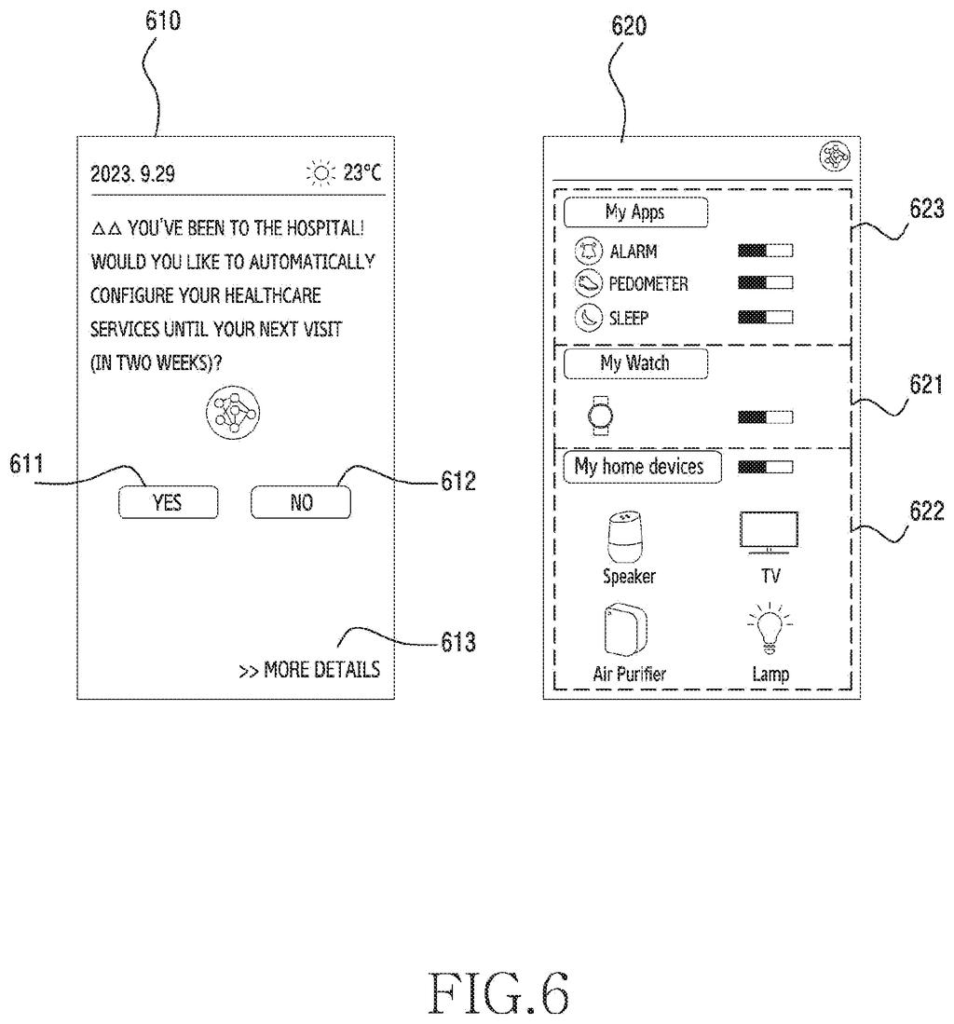
- The phone takes that configuration, creates healthcare guide information, displays a step-by-step interface to walk the user through health activities, and sends control commands directly to the connected devices to support those activities.
The key technical idea is that the phone does the translation work: it converts abstract prescription data into concrete device instructions, so the healthcare provider never needs to know the specifics of every gadget brand or model the user owns. The user's phone handles compatibility.
… transmitting a device control command to the at least one device to support the health activity …
Translation: The system automatically adjusts your smart home gadgets to help you complete your prescribed health routine.
What this means for Samsung's health and smart home ambitions
Samsung sells both the Galaxy phones that would act as the hub and a wide range of connected devices through its SmartThings ecosystem, from televisions and air conditioners to washing machines and fitness bands. A system like this would give Samsung a structural reason for patients to stay within its device family, since a tighter ecosystem makes the prescription-to-device pipeline much easier to build.
For you as a user, the appeal is obvious: healthcare advice that your devices actually act on, rather than advice you have to remember to follow yourself. The open question, as always with health data systems, is privacy. The patent does include a user-consent step, but how that consent is implemented in practice would determine how comfortable most people feel handing their device list to a third-party medical platform.
This is a genuinely interesting patent because it sits at the intersection of three things Samsung already controls: smartphones, a smart home platform, and wearable health sensors. The digital prescription concept isn't new in healthcare circles, but wiring it directly to device control commands is a specific and practical take. Whether it ships as a product depends entirely on whether Samsung can get healthcare providers to build for it.
There are more where this came from
We read every patent application Big Tech publishes and send you the ones worth knowing. Plain English, free, every week.
The drawings
9 drawing sheets from US 2026/0228360 A1 · click any drawing to enlarge


Want this weekly breakdown for a company we don't cover? Patentlyze Pro →
Be the first to weigh in