
Apple Patents a System for Adding and Sharing Digital IDs From Your Device
Apple has filed a patent describing a system that lets you add a digital ID to your device and then wirelessly share it with a second device that's asking for it. It's a formal technical blueprint for the kind of phone-as-ID experience that airports and states have been slowly rolling out.
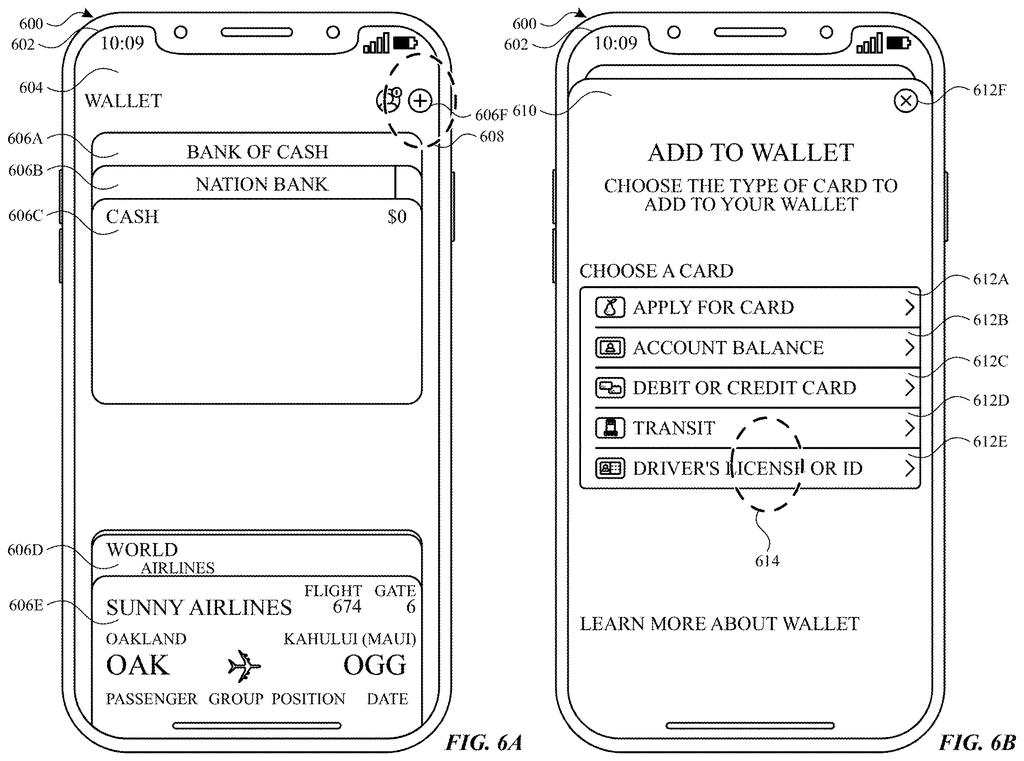
What Apple's digital ID sharing system actually does
You're at an airport security checkpoint and the agent needs to see your ID. Instead of digging through your bag for a physical card, you tap your phone and it sends your credentials wirelessly to the scanner in front of you.
That's the core scenario Apple is building toward here. The patent describes a computer system (most likely an iPhone or Apple Watch) that can receive a digital identification credential, store it, and then transmit it on request to another device nearby. The whole chain is automatic: a reader asks, your device responds.
This is less about inventing something brand new and more about locking in the exact user interface flow for how you add, manage, and share digital IDs. The details of those screens and taps are what Apple is protecting.
detecting, via the one or more input devices, one or more user inputs corresponding to a request to add a digital identification credential to the computer system; in response to the one or more user inputs, adding the digital identification credential to the computer system; …
Translation: Your device recognizes when you want to save a new digital ID and securely stores it for you.
How the credential moves from your device to a reader
The patent describes a three-step flow at the software level.
- Adding the credential: The system detects a user input requesting that a digital ID be added to the device. This could be a tap, a button press, or a scan of a physical card.
- Storing it: Once confirmed, the digital ID is saved inside the computer system, essentially your device's secure storage.
- Transmitting it: When a separate external device (a reader, a kiosk, an agent's terminal) requests the credential, your device sends the data to a first external device, which then forwards it to the second external device making the actual request. That two-hop architecture means your phone talks to an intermediary, not always directly to the final destination reader.
The two-device relay structure is notable. Rather than your phone broadcasting directly to every reader, it hands off to a trusted middleman device first. This kind of layered design is common in secure transactions because it keeps the reader from having to talk directly to arbitrary user hardware.
The claim is broad: it covers any computer system with processors, memory, and a connection to input devices and external hardware. That language is wide enough to cover iPhones, iPads, and Apple Watch.
The present disclosure generally relates to digital identification credential user interfaces.
Translation: Apple's patent describes the screens and controls used for managing your digital IDs.
What this means for digital wallets and ID checks
Physical IDs get lost, damaged, and stolen. More practically, they create bottlenecks: ID checks at airports, bars, pharmacies, and government offices require a person to physically hand over a card, wait, and get it back. A digital credential that transmits automatically cuts that interaction to seconds.
Apple already has driver's licenses in Apple Wallet in several US states, so this patent is closer to defensive documentation of existing work than a sketch of something purely future. What Apple is protecting here is the specific user interface logic around adding and sharing those credentials. That matters because the UX layer, not just the underlying technology, is where the real experience lives for you as a user.
That makes this Apple's 375th filing in our Apple coverage since May, adding to work like the private browsing lock screen and cross-device photo alert applications.
Losing a physical ID is a genuine headache, and fumbling for a wallet at airport security or a pharmacy counter is a small but daily annoyance for millions of people. Those costs are real, and a reliable digital alternative would matter to ordinary life.
This patent covers the interface layer of Apple's digital ID system, which is already available in select states through the iPhone's Wallet app. That narrow scope suggests Apple is protecting existing work rather than staking out new territory, which is a legal necessity but not a signal of something dramatically new coming.
The one detail that stands out is a design where two devices pass credential information through each other rather than one phone talking directly to a reader. Whether that structure makes the system more secure or simply more compatible with existing airport scanners is unclear from the filing, and that ambiguity limits how much weight to put on it.
Get our take in your Top Stories
Liked this breakdown? Add Patentlyze as a preferred source on Google, and our plain-English take shows up more often in your Top Stories the next time Apple patent news breaks.
There are more where this came from
We read every patent application Big Tech publishes and send you the ones worth knowing. Plain English, free, every week.
The drawings
40 drawing sheets from US 2026/0259976 A1 · click any drawing to enlarge


Show the other 32 sheets


Want this weekly breakdown for a company we don't cover? Patentlyze Pro →
Be the first to weigh in