
New Patent Splits Master Encryption Key Across Multiple Trusted Parties
What happens to your encrypted data if the one key protecting it is lost or stolen? Sony's new patent describes a way to split that key into pieces, hand them to separate trusted parties, and require a minimum number of them to cooperate before anything can be unlocked.
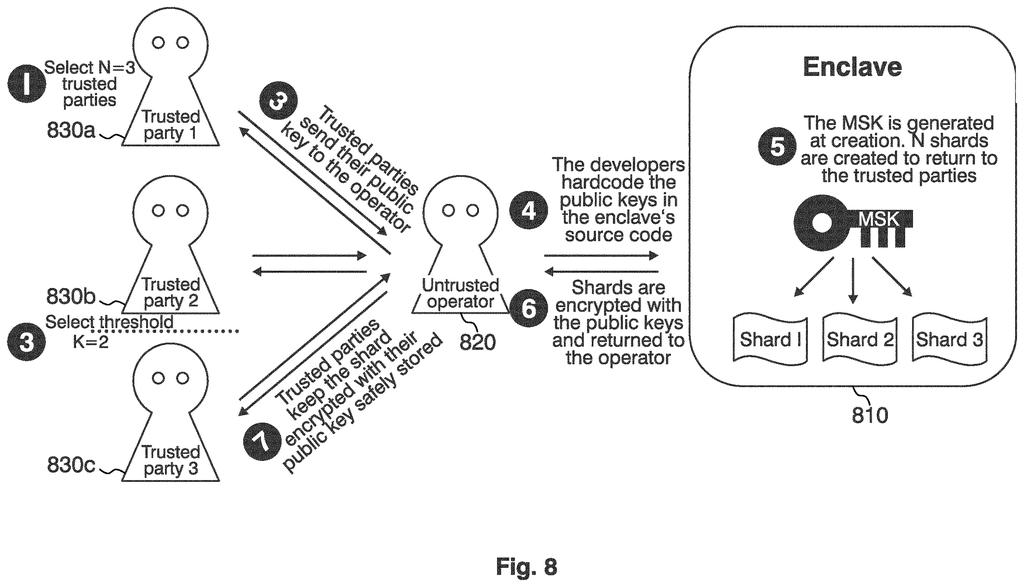
How Sony's key-splitting backup system actually works
Imagine your safe has one master combination, and you store that combination in a single place. If someone steals it, everything inside is exposed. Sony's patent solves this by cutting that combination into several pieces called "shards" and distributing them to different trusted holders.
The clever part is a rule called a threshold: you don't need all the pieces to reconstruct the original combination, just a minimum number of them. So if you split the key into five shards and set the threshold at three, any three of the five holders can work together to recover your data, even if two of them are unavailable.
Each shard is also individually locked using a key that belongs specifically to its intended recipient, so only the right holder can use their piece. Sony is describing this as a way to protect the backup of a private memory region, a secure, isolated part of a device that stores sensitive data.
… generating a plurality of shards based on the master key, wherein a predefined number of the shards, which is lower or equal to a number of shards in the plurality, form an information basis for reconstructing the master secret key; …
Translation: The system breaks a master key into pieces so that only a set number are needed to rebuild it.
How the enclave splits, encrypts, and distributes each shard
The patent describes a system built around two types of actors: an enclave entity (a secure, isolated computing environment inside a device) and a set of trusted entities (external parties authorized to hold pieces of the key).
Here is the process the enclave follows:
- It generates a master secret key that protects a backup of a private memory region.
- It uses a secret-sharing scheme (a cryptographic method, similar to Shamir's Secret Sharing, that breaks a secret into parts where only a subset is needed to reconstruct the whole) to split that key into multiple shards.
- It collects a public key from each trusted entity, then encrypts each shard with the corresponding entity's key so only that entity can decrypt its piece.
- It sends each encrypted shard to its intended trusted entity for storage.
Recovery works in reverse: a minimum number of trusted entities decrypt their shards and contribute them, allowing the master key to be reconstructed and the private memory region restored. The threshold is set so that a single compromised or unresponsive party cannot block recovery or gain access on their own.
… encrypting the plurality of shards individually using the key information from the plurality of trusted entities to obtain a plurality of encrypted shards; and providing the plurality of encrypted shards to the plurality of trusted entities.
Translation: Each piece is scrambled with help from different trusted parties and then sent back to them for safekeeping.
What this means for device security and data recovery
The threat model here is real. A private memory region (also called a Trusted Execution Environment or secure enclave) is where devices store things like cryptographic credentials, biometric data, and payment tokens. If that region is wiped, corrupted, or the device is replaced, the data inside can be permanently lost because it was never meant to leave. Backups of such regions require extreme care because the backup itself is as sensitive as the original.
By distributing trust across multiple parties and requiring only a threshold to recover (not all of them), Sony's approach balances security with practicality. It means no single server, no single employee, and no single point of failure can either expose or permanently lock out your most sensitive data.
This is a solid, well-established cryptographic idea (threshold secret sharing) applied to a genuinely hard problem: how do you back up data that was deliberately designed never to leave a secure enclave? Sony isn't inventing new math here, but the patent's value is in the specific architecture for device-level enclaves. It's a quiet but meaningful piece of security infrastructure that could matter a lot if Sony is building hardware with serious on-device security ambitions.
There are more where this came from
We read every patent application Big Tech publishes and send you the ones worth knowing. Plain English, free, every week.
The drawings
10 drawing sheets from US 2026/0230308 A1 · click any drawing to enlarge


Want this weekly breakdown for a company we don't cover? Patentlyze Pro →
Be the first to weigh in