
Samsung Patents a System That Controls 5G Network Access Based on User Permissions
Samsung has filed a patent for a way to lock down communication between services inside a 5G network, so that only the right components, with the right credentials, can decrypt each other's messages.
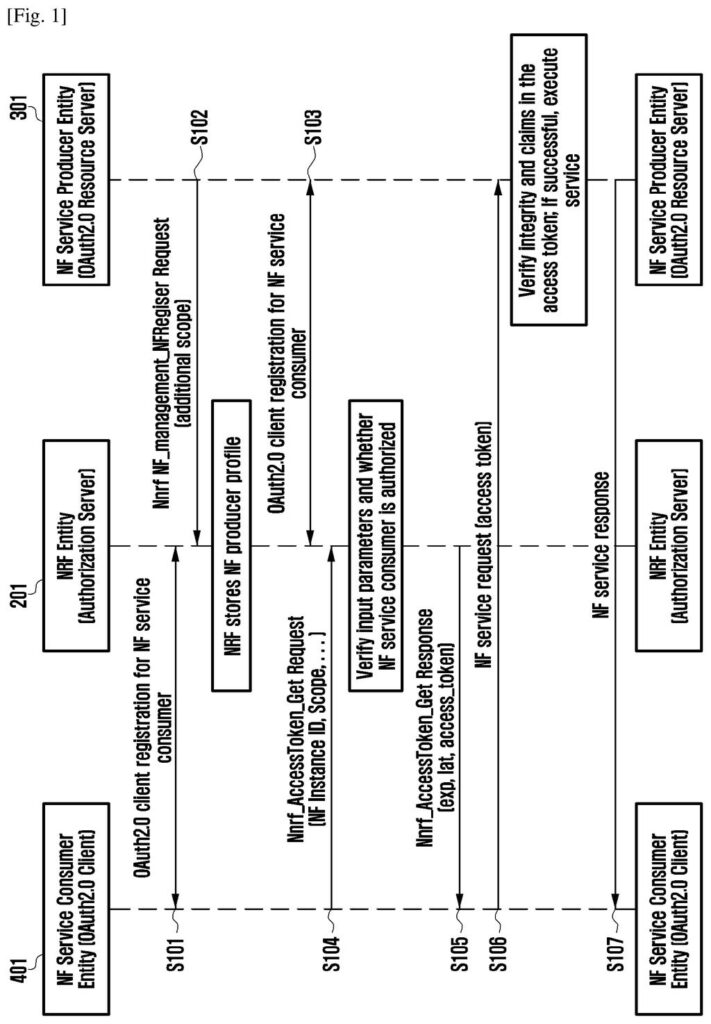
How Samsung's 5G encryption key system works
You're an operator running a 5G mobile network, and dozens of software services inside that network constantly talk to each other: one handles billing, another manages device connections, another routes emergency calls. Right now, access control between those services is mostly a yes-or-no gate. Samsung's patent describes a finer-grained lock.
The idea is called attribute-based encryption. Instead of handing a service a simple password, the system issues it a key that only works if the service meets a specific set of conditions, like being a certain type of service, run by a certain operator, in a certain region. A message encrypted under those conditions can only be decrypted by a service that matches all of them.
A central directory called the NRF acts as the key authority. It knows which services are producers (the ones offering data) and which are consumers (the ones requesting it). When a consumer wants to talk to a producer, the NRF checks whether it qualifies, then issues it a tailored key. If it doesn't qualify, it gets nothing.
… determining whether the NF service consumer entity is authorized based on an attribute criterion, wherein the attribute criteria comprises a set of attributes and their corresponding values; generating a secret key based on the set of attributes with corresponding values and the master secret key, when the NF service consumer entity is authorized for the attribute criteria; …
Translation: The system checks user permissions and creates a secret key if the criteria are met.
How the NRF hands out keys based on attributes
The patent centers on a Network Repository Function (NRF), which is an existing 5G component that acts as a service registry, like a phone book for all the software functions inside a carrier's core network.
Samsung's system adds a CP-ABE support controller to the NRF. CP-ABE stands for Ciphertext Policy Attribute-Based Encryption, a cryptographic technique where the encryption policy is baked directly into the encrypted data itself. A message can say, in effect, "only decrypt me if you are a billing service, in region X, authorized for tier 2 access." Any key that doesn't match all those attributes fails to open it.
Here is how the flow works:
- The NRF generates a master public key and a master secret key using a separate key management server.
- The master public key goes to every service producer, which uses it to encrypt its data under a policy it defines.
- When a service consumer wants access, it sends a request to the NRF.
- The NRF checks the consumer's attributes against the policy criteria.
- If the consumer qualifies, the NRF generates a tailored secret key derived from the master secret key and the consumer's specific attributes, then sends it back.
The consumer uses that tailored key to decrypt the producer's data. A consumer with the wrong attributes receives a key that simply does not work, even if it intercepts the encrypted traffic.
The disclosure relates to a 5G or 6G communication system for supporting a higher data transmission rate.
Translation: This technology improves data speeds in modern mobile networks.
What this means for 5G network security in practice
Inside a 5G core network, software services are increasingly modular and independently deployed, which means the attack surface between them grows. A compromised service that holds a simple shared credential can potentially impersonate any other service. Attribute-based encryption raises that bar considerably: even a stolen key only works for the specific set of attributes it was issued for.
For carriers and enterprise 5G operators, this kind of fine-grained access control matters most in multi-tenant or network-slicing scenarios, where different customers share the same physical infrastructure but must be kept strictly separate. This patent describes the key distribution mechanism that would make such separation cryptographically enforced, not just policy-enforced.
Samsung's 79th filing we've tracked since May in our 5G and network work follows cleaning wireless signals with AI and moving AI data across networks.
Getting this into a real network requires no new hardware at all. The system Samsung is modifying, the piece of 5G infrastructure that acts as a directory for network services, already lives in every carrier's core software stack.
The shortest path to shipping this is a standards body blessing and a software update pushed to carriers, which is a long road measured in years, not quarters.
The actual technical claim is narrow: taking an established academic encryption method and wiring it into one specific part of the 5G architecture. That narrowness makes implementation more realistic, but it also means the novelty is thin, and whether this survives a patent review will depend heavily on how much similar thinking already exists in public 5G specification documents.
There are more where this came from
We read every patent application Big Tech publishes and send you the ones worth knowing. Plain English, free, every week.
The drawings
10 drawing sheets from US 2026/0291728 A1 · click any drawing to enlarge


Want this weekly breakdown for a company we don't cover? Patentlyze Pro →
Be the first to weigh in