
Microsoft Patents Technology to Identify Who Is Behind a Cyberattack
Every cyberattack leaves a pattern, and Microsoft wants to turn that pattern into a fingerprint that security teams can search, compare, and trace back to the same bad actors.
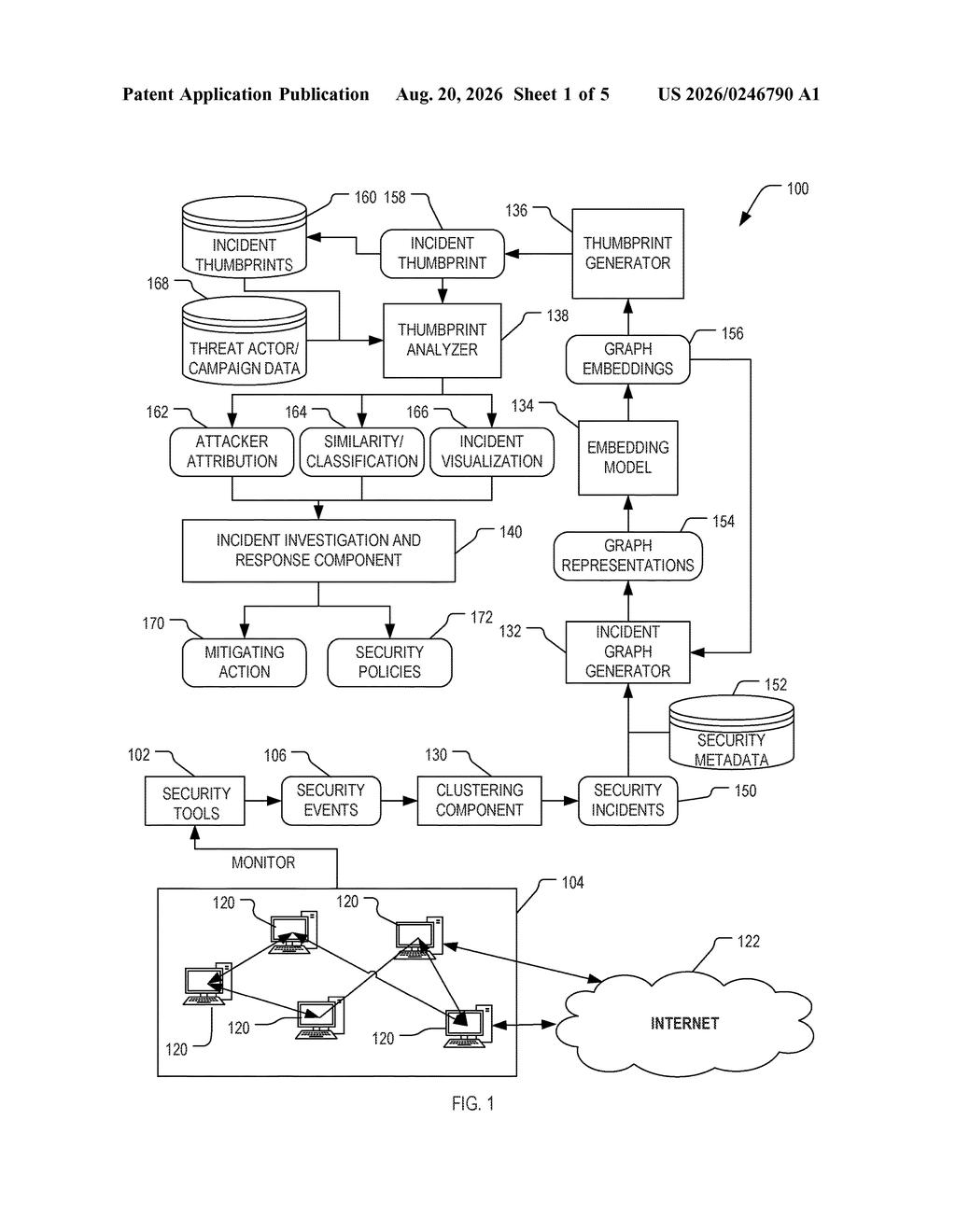
How Microsoft's attack fingerprinting actually works
You're a security analyst and your dashboard just lit up with dozens of alerts across your company's network. Are these separate problems, or one coordinated attack? And did the same group of hackers do something like this to your organization six months ago?
That's the problem Microsoft is tackling here. This patent describes a system that takes all the related alerts from a single incident, maps out how they connect to each other, and compresses that whole picture into a compact digital fingerprint, the patent calls it a thumbprint. Think of it like a fingerprint for the attack's signature, not just its individual parts.
Once you have that thumbprint, you can compare it against a library of past incidents. If the pattern matches something your team has seen before, or something another organization reported, you're much closer to knowing who's behind it and what they're likely to do next.
… generating a thumbprint representation of the security incident from the graph embedding vectors of the nodes; and determining a mitigating action based in part on the thumbprint representation of the incident.
Translation: It builds a digital fingerprint of the attack to decide how to respond.
How graph embeddings turn incidents into searchable thumbprints
The system starts by detecting security events across a computer network, things like failed login attempts, unusual file access, or suspicious outbound connections. It then groups related events into a single security incident by looking at correlations between their attributes (timing, IP addresses, affected accounts, and so on).
Each incident is then converted into a graph, a mathematical structure made of nodes and edges. Each security event becomes a node. Edges connect events that are related. Additional nodes and data labels carry metadata like the type of device involved or the time of day the event occurred. This graph captures not just what happened, but how events relate to each other.
Next, an embedding model (a type of machine-learning system that converts complex structures into lists of numbers) processes the graph and produces a vector for each node. A vector here is just a compact, math-friendly summary of that node's meaning within the graph. Those individual vectors are then combined into a single thumbprint vector that represents the entire incident.
- The thumbprint can be compared against past incidents to spot recurring attack patterns.
- Similar thumbprints can flag the same threat actor attacking different targets.
- The system uses the thumbprint to help decide on a mitigating action, such as blocking a user account or isolating a machine.
… graph-based techniques may be employed to generate “thumbprints” of security incidents, which may thereafter be used, e.g., for threat actor attribution or the identification of similar incidents.
Translation: The system creates unique signatures of attacks to trace who launched them and spot matching past events.
What this means for enterprise security teams
For security teams, the real cost of a cyberattack often isn't the first hit; it's failing to recognize the second one. When attackers reuse the same tactics or tools, defenders who can match new incidents to old patterns can respond much faster and with more confidence. A thumbprint system like this could let a security platform automatically flag that today's breach looks like the one from last quarter, pointing the team toward known remedies instead of starting from scratch.
Enterprise security software is one of the areas where the latest Big Tech patents are clustering heavily right now, and Microsoft's graph-embedding approach reflects a broader push to bring structured machine learning into threat detection rather than relying on simple rule matching. Whether this ends up powering Microsoft Sentinel or another product in its security portfolio, the underlying idea, giving every attack a reusable, searchable signature, addresses a real gap that security operations centers deal with daily.
Microsoft's 319th filing among the patents we've tracked since May joins earlier work on custom OS builds and split AI inferencing in our Microsoft coverage.
An analyst who once spent hours manually comparing incidents now gets an automatic summary that does the matching for them. The comparison can be checked and explained later, so it is not just one person's memory or gut feeling.
The real gain shows up when teams try to pin an attack on a specific group. Instead of a hunch, the analyst has a structured snapshot of the attack, who was involved, and how everything connected, giving them solid ground to stand on. That means fewer attacks get mislabeled, and the response follows from evidence, not guesswork.
Get our take in your Top Stories
Liked this breakdown? Add Patentlyze as a preferred source on Google, and our plain-English take shows up more often in your Top Stories the next time Microsoft patent news breaks.
There are more where this came from
We read every patent application Big Tech publishes and send you the ones worth knowing. Plain English, free, every week.
The drawings
5 drawing sheets from US 2026/0246790 A1 · click any drawing to enlarge


Want this weekly breakdown for a company we don't cover? Patentlyze Pro →
Be the first to weigh in