
Apple Patents a 5G Signal System That Feeds Data Directly to AI Models
Apple has filed a patent for a system that repurposes standard 5G diagnostic signals into a dedicated data pipeline for training AI models, turning every phone measurement into a potential lesson for the network.
What Apple's AI-targeted 5G signal collection actually does
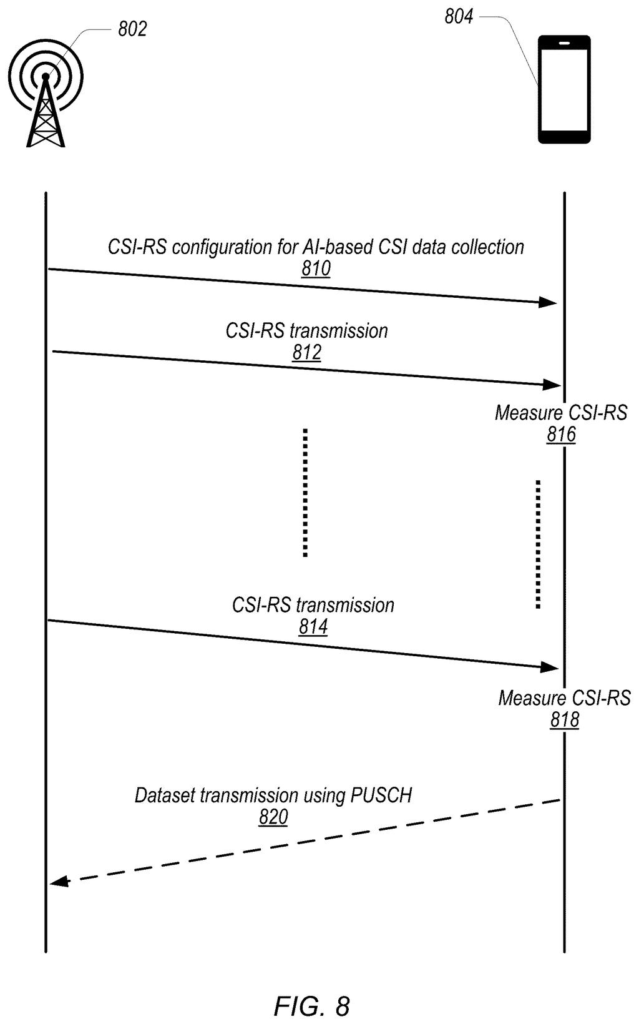
Your phone and a cell tower are always exchanging tiny diagnostic signals called reference signals. Normally these just help the tower figure out how strong your connection is. Apple's patent describes a way to reconfigure those signals specifically to gather training data for AI models, rather than just checking signal strength in the usual way.
The idea is that your phone receives a special set of instructions telling it to measure the channel in a way that's useful for AI, not just standard network management. It then sends those measurements back to the tower, which feeds them into AI model training, testing, and monitoring.
In plain terms: instead of the tower learning just enough to keep your call from dropping, it's building a much richer picture of how radio signals travel in your environment, which could eventually help the network make smarter decisions about how it handles your connection.
receiving, by a device from a base station, CSI-RS configuration information specific to artificial intelligence based (AI-based) CSI data collection; …
Translation: The phone gets special instructions designed strictly for feeding cellular data to artificial intelligence.
How the base station configures and collects AI training data
The patent describes a protocol where a base station sends a phone (called a UE, or user equipment, in standards terminology) a special configuration message called CSI-RS configuration information (CCI). CSI-RS stands for Channel State Information Reference Signal, a type of known test signal the tower transmits so devices can measure channel conditions.
What's different here is that the CCI is explicitly flagged as being for AI-based data collection, not ordinary network operation. The configuration can be cell-specific (just one tower), site-specific (a cluster of towers), or tied to a particular network setup. This lets operators run targeted data-gathering campaigns without disrupting regular traffic.
The phone takes its measurements on those specially configured reference signals and packages them into datasets, which it transmits back to the base station. The base station then uses those datasets for:
- Training new AI models for channel estimation or compression
- Running inference (applying a trained model to live conditions)
- Updating existing models as conditions change
- Monitoring model performance over time
The configuration messages ride over Radio Resource Control (RRC) signaling, the standard control channel between a phone and a tower, which the patent proposes extending with new AI-specific information elements to carry the extra instructions.
The base station may use the one or more datasets for AI model training, inference, update, and monitoring.
Translation: The cellular tower uses your phone's measurements to train and run its artificial intelligence models.
What this means for AI-driven 5G network optimization
5G networks are increasingly being designed around AI models that compress, predict, and optimize how radio signals are handled. For those models to work well, they need training data that reflects real-world channel conditions, not just lab simulations. This patent gives Apple a stake in how that data gets collected at the protocol level, which is the kind of foundational infrastructure work that shapes how the whole industry builds AI into cellular standards.
For you as a user, the near-term impact is indirect: better AI-trained networks could mean more reliable connections in crowded places or at the edge of coverage. The longer-term angle is that Apple is positioning itself to influence 5G and 6G standardization bodies, where this kind of protocol-layer IP carries real weight.
This is a standards-layer patent, not a consumer feature, so it won't show up in an iOS release note. But Apple's cellular modem ambitions make this filing meaningful: if Apple wants its own chips to participate in AI-optimized 5G networks, it needs protocol IP like this in its portfolio. Worth tracking as a signal of how seriously Apple is taking in-house modem development.
There are more where this came from
We read every patent application Big Tech publishes and send you the ones worth knowing. Plain English, free, every week.
The drawings
9 drawing sheets from US 2026/0230139 A1 · click any drawing to enlarge


Want this weekly breakdown for a company we don't cover? Patentlyze Pro →
Be the first to weigh in