
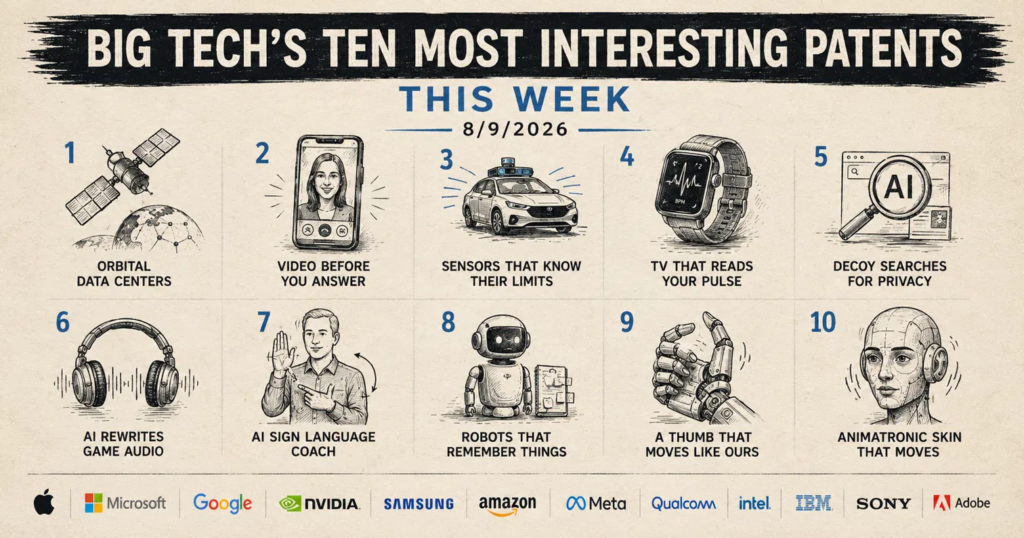
A weekly read of what the world’s biggest technology companies just told the U.S. patent office.
Every Thursday, the U.S. Patent and Trademark Office publishes a fresh batch of patent applications. Most are paperwork: defensive filings, incremental tweaks, claims written to be forgotten. But a patent application is still one of the most honest documents a company produces. Nobody files one for marketing reasons, and the claims go public years before the products do.
This week the 17 companies we cover had another heavy drop. We wrote up 258 filings, with Samsung out front at 43, then Qualcomm with 36, Nvidia with 31, and Apple with 28. The full run lives under this week’s Big Tech patents; these ten stood out.
1. Intel puts the data center in orbit
Satellite internet has a commute problem. The satellites that carry your connection fly low and fast, and almost everything they collect gets shipped back down to ground stations for processing before it can be useful. Intel’s answer is blunt: put the data centers in space too.
The filing describes satellites in higher orbits acting as computing hubs for the low-orbit constellations below them, an org chart in the sky where the workers fly low and management hovers above. Processing up there cuts the round trip to the ground, and with it the delay and cost that pile up as constellations grow into the thousands.
Set against the rest of Intel’s recent filings, it reads like a company deciding where the workloads go next. The cloud, one layer higher.
2. Apple shows you the caller before you pick up
Apple has filed for a video calling system where the other person’s camera feed starts playing on your screen before you answer: a video peephole for incoming calls.
Your device would keep connection details for people you know on file, so there is no setup delay when a call arrives. The caller’s feed streams one way while you decide; the two-way conversation only starts if you join. Seeing your mom on her porch before you tap answer sounds warm. Seeing your boss’s conference room does the opposite.
Either way, the ring becomes a preview, and declining gets a little more informed.
3. Waymo’s cars learn to notice their own failing eyesight
A self-driving car that can’t see well is dangerous. One that doesn’t know it can’t see well is catastrophic. Waymo’s latest filing goes straight at that second problem: laser sensors that continuously test their own vision.
The cars carry a reference map of how strongly laser pulses should bounce back in fair weather. When fog, rain, dust, or a dirty lens starts eating the signal, the system compares live returns against that baseline, recalculates how far the car can actually see right now, and drives accordingly. Today most automated systems rely on fixed safety buffers that assume the sensors are fine.
Machines that know their own limits: still rarer than they should be. This one joins the self-driving sensing race, which picks up a new entry most weeks.
4. Samsung’s TV takes your pulse and changes the show
Samsung is exploring a screen that watches you back. Its filing covers video that adjusts to your body’s physical reactions, read from sensors like the heart rate and stress readings a Galaxy Watch already collects.
The mechanics are stranger than the pitch: when your measured state shifts past a threshold, the system slips new frames in between the frames of whatever you were watching, nudging the picture calmer or sharper to match your body. Your watch tells your TV how you are doing, and the TV edits itself in response.
Whether that lands as caring or creepy will depend entirely on who controls the dial.
5. IBM hides your real searches in a crowd of fakes
Your search history reads like a diary: health scares, money stress, quiet plans. IBM’s filing describes an AI that surrounds your real searches with convincing decoys, fake queries fired off alongside yours so profilers can’t tell which thread is you.
The clever part is that the decoys aren’t random noise, which is statistically easy to filter out. The system tracks how your real queries move through meaning-space, then generates fakes that drift the same way, plausible search journeys that go somewhere you never went.
Privacy by chaff. If you can’t stop the tracking, flood it.
6. Microsoft lets you fire the sound designer
One shrieking enemy, one grating gun crack, and a game you love becomes a game you mute. Microsoft has filed for a system that lets you swap any in-game sound using AI, no cooperation from the game required.
A generative audio pipeline sits between the game and your headset. You hand it a few examples of the sound you hate, tell it what you want instead, and it rewrites that sound class across the live audio stream, in every game. For players with auditory sensitivities, PTSD triggers, or hearing impairments, this is less a novelty than a missing accessibility layer finally showing up.
Volume sliders, meet surgery.
7. Nvidia built a sign language coach that watches your hands
Small differences in hand shape change meaning entirely in sign language, which is why practicing alone barely works. Nvidia’s filing describes an AI coach that corrects a signer’s hand positions in real time.
A camera tracks dozens of points on your joints, knuckles, and wrists, works out which sign you attempted, compares your positions against a reference, and tells you what to fix while you practice. Sign instruction has always depended on access to fluent teachers; a tireless one that lives in your laptop changes who gets to learn.
8. Amazon’s robot remembers where you left your keys
The difference between a robot that navigates your house and a robot that helps you is memory. Amazon’s filing gives home robots a spatial memory for tracking your belongings: one short-term memory for what it saw recently, one long-term memory for what it has learned over months.
Ask for your medication and the robot checks both, reasoning about where the bottle probably is rather than staring blankly because it isn’t where it was last programmed to look. With Astro already in living rooms, this is Amazon writing the spec for the thing that would make a home robot worth owning.
9. Sony finally gets the thumb right
Watch your own hand pick up a cup: four fingers curl, and the thumb swings in from a different angle entirely to lock the grip. That crossing motion is most of what makes hands useful, and most of what makes robot hands hard. Sony’s filing breaks the problem into three rotation points, with one dedicated to the thumb’s swing across the palm.
Two shafts handle the four-finger curl; the third gives the thumb its opposing arc. Most commercial grippers are fixed claws or expensive approximations. A clean mechanical answer is the kind that eventually gets manufactured, and it files in beside a steady run of grasping work on the teaching robots to grasp and move watchlist.
10. Disney’s robot faces grow real wrinkles
Animatronic faces are expressive but frozen: sculpted once, then stuck. Projected faces can show anything but look flat. Disney’s filing merges the two, describing robot skin that physically shifts in sync with the expressions projected onto it.
A flexible skin stretched over a rigid shell doubles as a projection surface, bulging and creasing in time with the imagery painted on top. The projector supplies the smile; the skin supplies the wrinkle. Puppetry and projection mapping, finally on speaking terms.
Nobody else files patents like this, and the parks are better for it.
What ties them together
Read in one sitting, this week’s standouts are less about machines getting more powerful and more about machines getting more attentive. A TV reading your pulse. A video call showing you the room before you commit. A coach watching your knuckles. A robot keeping track of your keys. A car checking its own eyesight. Even Disney’s contribution is a machine learning to hold an expression.
The industry spent decades building machines that demand attention. The filings suggest the next decade goes the other way: machines that pay it. That shift will raise real questions about what all this attentiveness costs, IBM’s decoy-search filing being the rare entry pointed at the bill. But if you want to know what the products of 2028 will feel like, this is the tell.
Patentlyze reads every new patent application that Apple, Google, Microsoft, Meta, Nvidia, Samsung, OpenAI, Qualcomm, Sony, Intel, AMD, IBM, Adobe, Salesforce, Tesla, Amazon, and Disney file at the USPTO, and writes a plain-English breakdown of the ones that say something about where products are heading. New filings drop every Thursday. The full archive lives in our patent library.
Get lists like this in your inbox
We read every patent application Big Tech publishes and send you the ones worth knowing. Plain English, free, every week.