
Intel Patent Describes Orbital Data Centers Designed to Manage Satellite Networks
Instead of routing satellite data back down to Earth for processing, Intel wants to handle it all up in space, using satellites in higher orbits as floating data centers that manage the ones closer to the ground.
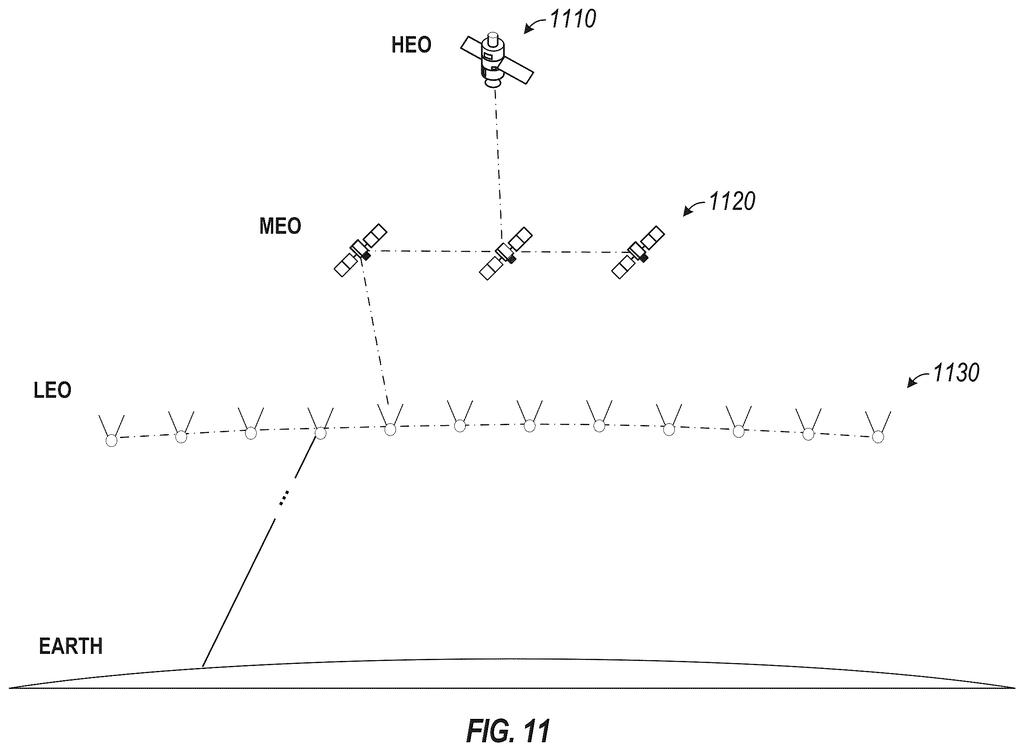
What Intel's orbital data center actually does
Imagine a chain of managers at a company. The workers on the ground floor handle the day-to-day tasks, but decisions get escalated up to a central office. Intel's patent applies that same idea to satellites.
Low-Earth orbit (LEO) satellites, like the ones powering Starlink, fly close to Earth and handle your internet connection. But all that data has to go somewhere for processing. Right now, it typically bounces back down to ground stations. Intel's idea is to skip the trip down and process it on higher-orbiting satellites instead, ones sitting in middle, geosynchronous, or high elliptical orbits that can "see" large chunks of the LEO network at once.
Think of those higher satellites as a control tower watching over a busy airspace below. They'd coordinate traffic, process data, and manage the whole LEO constellation without constantly needing to phone home to Earth.
… a data center located at one or more satellites operating in a middle Earth orbit (MEO) plane, geosynchronous orbit (GEO) plane, or high-Earth elliptical orbit (HEO) plane, may be used to provide network and data processing operations for a low-Earth orbit (LEO) constellation.
Translation: High altitude satellites will run data centers to manage lower orbit satellite networks.
How higher-orbit satellites manage the LEO layer below
The patent describes a system where satellites operating in medium Earth orbit (MEO), geosynchronous orbit (GEO), or high Earth elliptical orbit (HEO) serve as airborne data centers for constellations of low Earth orbit (LEO) satellites below them.
LEO satellites are the workhorses of modern satellite internet, but they move fast and have limited onboard computing power. The patent proposes offloading the heavy lifting, things like network routing decisions, data processing, and inter-satellite communication coordination, to satellites in higher, more stable orbits that can maintain a consistent view of a large portion of the LEO network at once.
- Compute processing: Running the calculations that LEO satellites don't have the capacity to handle themselves
- Network operation processing: Managing how data flows across the constellation
- Inter-satellite communication coordination: Directing how satellites in different orbital layers talk to each other
The system is designed to work across one or multiple non-terrestrial networks (NTNs), the industry term for communication systems that operate outside the Earth's surface, meaning it could span different satellite operators or orbital configurations.
What this means for the future of satellite internet
Satellite internet is growing fast, and the bottleneck is increasingly not the satellites themselves but the infrastructure needed to manage them. Every time data has to loop back down to a ground station for processing, you add delay and cost. Doing that processing in a higher orbit cuts out the round trip and could make the whole system faster and more reliable, especially for users in remote areas without nearby ground infrastructure.
For Intel, this is a bet that the next big market for its data center chips isn't just on Earth. If satellite operators eventually need onboard processors capable of running serious workloads, Intel wants to have already staked out the architecture for how that works.
This is a genuinely interesting long-term infrastructure play from Intel, one that takes the established concept of cloud computing and tries to push it into orbit. The immediate practical challenge is enormous, space-hardened processors that can run data center workloads are a serious engineering problem, and the first independent claim being canceled is a yellow flag for how this application is maturing. But the underlying idea is sound, and someone is going to build this eventually.
There are more where this came from
We read every patent application Big Tech publishes and send you the ones worth knowing. Plain English, free, every week.
The drawings
26 drawing sheets from US 2026/0230175 A1 · click any drawing to enlarge


Want this weekly breakdown for a company we don't cover? Patentlyze Pro →
Be the first to weigh in