
Samsung Patents a Cross-OS Screen Sharing System for Virtualized Apps
Samsung is patenting a way for an app running inside a virtualized guest OS to trigger a screen share of the entire host OS display — a surprisingly tricky problem when two operating systems are layered on one device.
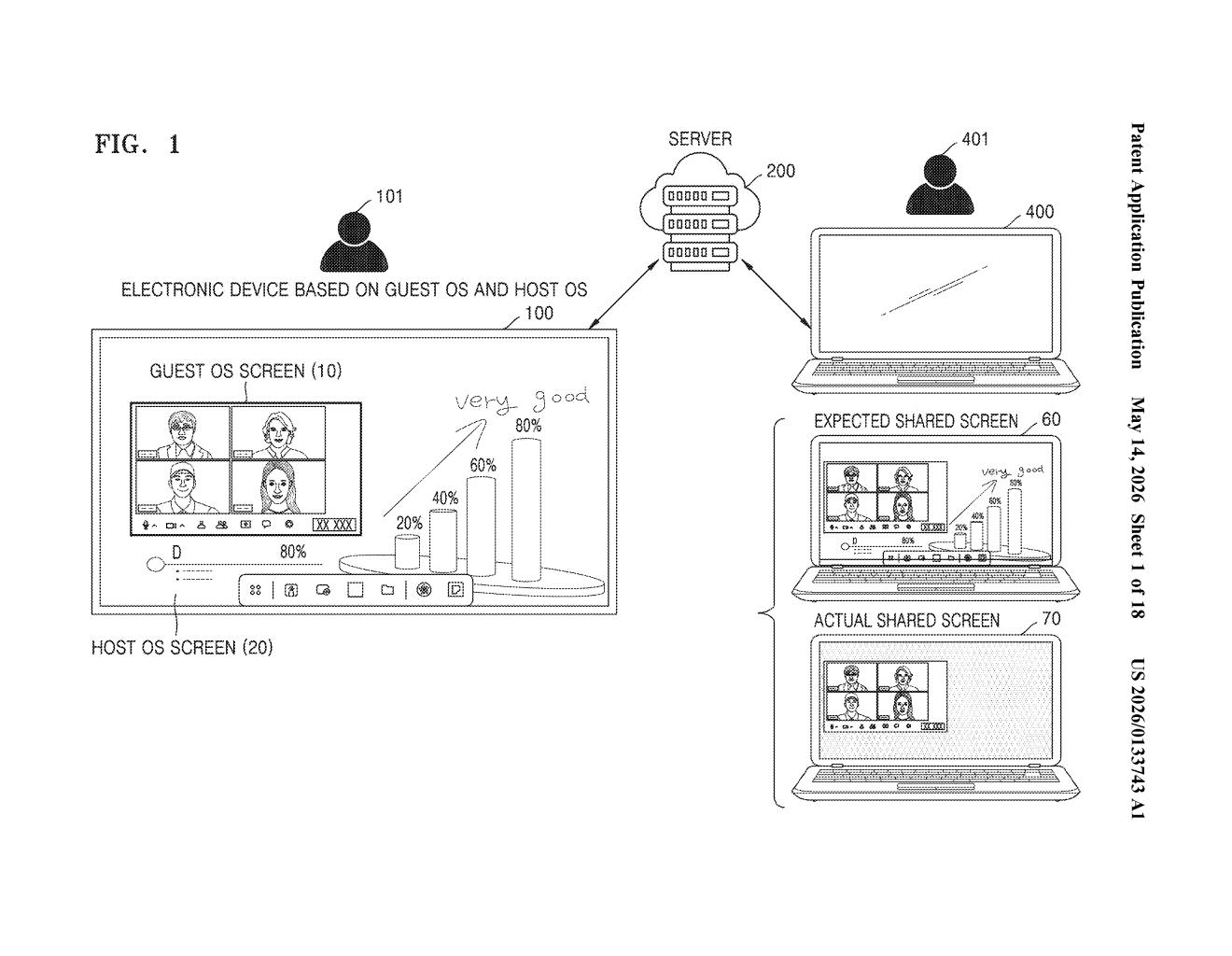
What Samsung's guest-OS screen sharing actually does
Imagine you're running a work app inside a virtual Android environment on your Samsung phone or PC, and you want to share your screen during a video call. Normally, that app only 'sees' its own little virtual world — it has no idea what the surrounding host operating system is showing.
Samsung's patent solves this by letting the guest app send a screen-sharing request that punches through to the host OS. The host OS then captures its own full screen — which already includes the guest app's window — and sends that combined image off to a remote server for sharing.
The result: your colleague on the other end sees everything on your screen, even though the sharing was triggered from inside a sandboxed virtual environment. It keeps the guest app's experience intact while giving you a seamless, unified sharing workflow.
How the host OS captures and transmits the guest OS screen
The patent describes a device architecture where a guest OS (a secondary operating system, like a virtualized Android instance) runs on top of a host OS (the primary OS managing the actual hardware). The guest OS renders its own screen, and that screen is embedded as a window or overlay within the host OS's display.
When a user triggers screen sharing inside a guest application (an app running in the guest OS), the system intercepts that request and routes it to the host OS rather than letting the guest OS handle it independently. The host OS then performs a full-screen capture of its own display — which already includes the guest OS window embedded within it.
That captured image is then transmitted to a remote server for screen sharing, so remote viewers see the complete host OS context, not just an isolated guest app view.
Key components the patent covers:
- Display layering: the guest OS screen rendered within the host OS UI
- Request interception: the guest app's share request is caught and escalated to the host OS
- Host-level capture: the host OS owns the screenshot, not the guest
- Server transmission: the unified image is sent to a sharing server
What this means for Samsung's DeX and virtualization strategy
Samsung has been steadily building out its virtualization story — DeX, its desktop-mode platform, and its work-profile separation on Galaxy devices both rely on layered OS environments. A smooth screen-sharing experience across those layers is a real usability gap today, and this patent addresses it directly.
For enterprise users especially, the inability to share a clean, unified screen from a virtualized work environment is a friction point in video calls and remote support sessions. If Samsung ships this, it could make Galaxy devices more competitive in the corporate market where split work/personal OS environments are increasingly common.
This is a quiet but genuinely useful patent. It solves a real, specific problem — cross-OS screen sharing — that anyone who has tried to demo a virtualized app on a call has probably run into. It's not flashy AI or sensor magic, but it's exactly the kind of plumbing work that separates polished platform experiences from clunky ones. Worth watching for DeX users.
There are more where this came from
We read every patent application Big Tech publishes and send you the ones worth knowing. Plain English, free, every week.
Want this weekly breakdown for a company we don't cover? Patentlyze Pro →