
Google Patents a Way to Teach AI Image Generators From Photo Examples
Google has filed a patent for an AI image generator that learns what a subject looks like from a handful of example photos, then draws that same subject doing anything you describe in text.
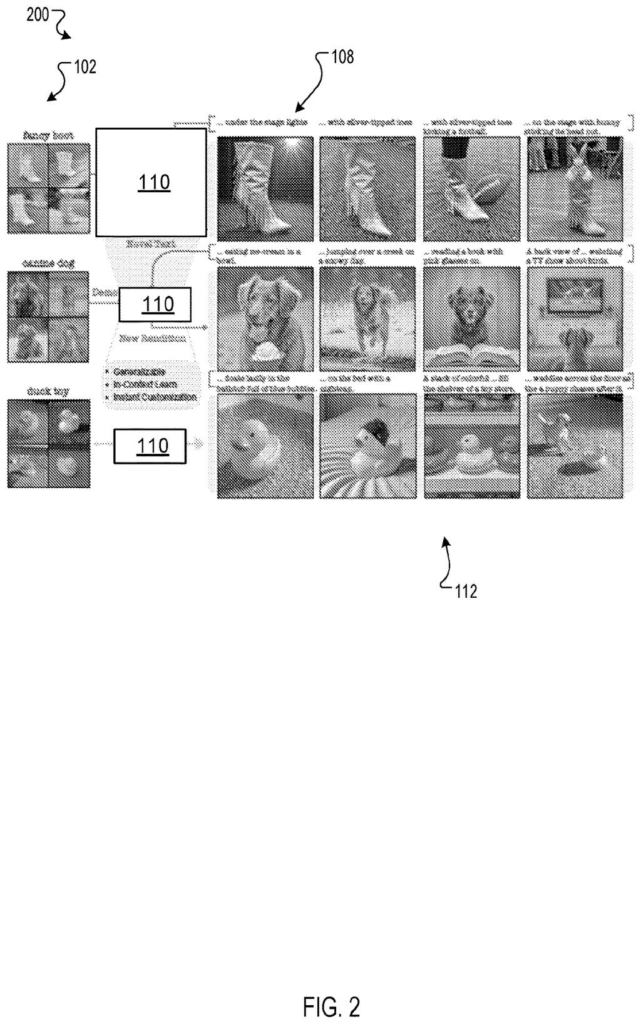
How Google's example-driven image AI actually works
Every time a photo app tries to recognize your face and edit it, it already has thousands of training images to work from. The hard part is getting an AI to understand a brand-new subject it has never seen before, using only the few photos you hand it right now.
Google's patent tackles that directly. You give the AI a small set of paired examples: a photo of your subject alongside a sentence describing what is happening in that photo. Then you write a new description of what you want the AI to draw. The system uses all of those inputs together to produce a fresh image that matches your description, while still looking like the same subject from your example photos.
Think of it like briefing an illustrator. You show them a few reference shots and say "this is who we are drawing," then hand them a script for a new scene. The patent is about automating that whole briefing and drawing process inside an AI.
receiving a plurality of demonstration pairs, each demonstration pair comprising (i) an image relating to an input subject and (ii) a text description of the image in the demonstration pair; receiving a new text description relating to the input subject; and processing the demonstration pairs and the new text description using a diffusion neural network to generate a new image …
Translation: The system learns by looking at sets of images and their captions to create a brand new picture based on your text prompt.
How the diffusion network reads your photos and prompt
The core mechanism is a diffusion neural network (an AI model that generates images by gradually removing noise from a random starting point, like developing a photograph in reverse) that is conditioned on what Google calls demonstration pairs.
Each demonstration pair consists of:
- An image featuring the subject you care about
- A text caption describing that image
The model receives several of these pairs at once, along with a brand-new text description of a scene you want generated. By processing the examples and the new prompt together in a single forward pass, the network learns what the subject looks like from the reference images and then synthesizes a new image that satisfies the new description.
The key distinction from standard text-to-image systems is the in-context conditioning step. Rather than fine-tuning the model's weights on your specific subject (which is slow and expensive), the network reads your example pairs dynamically, the way a person glances at reference photos before sketching. The claim language covers any diffusion-based system that ingests multiple image-text demonstration pairs plus a new text description to produce a new image, which is a fairly broad description of the inference-time personalization approach.
Methods, systems, and apparatus, including computer programs encoded on computer storage media, for generating images of a new subject using a diffusion neural network.
Translation: This patent covers the software and hardware tools used to train AI models to create images of specific new subjects.
What this means for personalized AI image tools
For everyday users, this kind of system would make it possible to generate consistent images of a specific person, pet, product, or location without uploading thousands of training photos or waiting for a custom model to be built. A few reference shots plus a text prompt could be enough to get a coherent result, which is a meaningful step toward AI image tools that feel personal rather than generic.
The claim Google has written is broad: it covers any method where a diffusion network takes in multiple image-text pairs and a new prompt to produce a new image, with no restriction on the specific architecture or the number of examples required. If granted in that form, it could create friction for competitors building similar few-shot image generation features, since the approach is increasingly common across the industry. Google's personalized image generation filing sits among the interesting tech patents reshaping what AI creative tools can do with minimal user input.
Claim 1 is strikingly broad. It covers any diffusion network that processes multiple image-text pairs alongside a new text description to produce a new image, with no architectural specifics at all. That breadth is exactly what makes this filing consequential: it attempts to stake out the general concept of few-shot, in-context personalization for diffusion models, which is a direction nearly every major AI image platform is moving toward. Whether the USPTO awards a claim that wide, given how much prior art exists in this space, is the real question, but the attempt itself signals how seriously Google is taking ownership of the personalization layer in AI image generation.
There are more where this came from
We read every patent application Big Tech publishes and send you the ones worth knowing. Plain English, free, every week.
The drawings
6 drawing sheets from US 2026/0237019 A1 · click any drawing to enlarge


Want this weekly breakdown for a company we don't cover? Patentlyze Pro →
Be the first to weigh in