
Samsung Patents a Training Trick That Teaches AI to Restore Photos From the Background Out
Most AI photo-restoration tools treat every part of an image equally. Samsung's new patent flips that assumption, training its model on the boring background first and the important subject second.
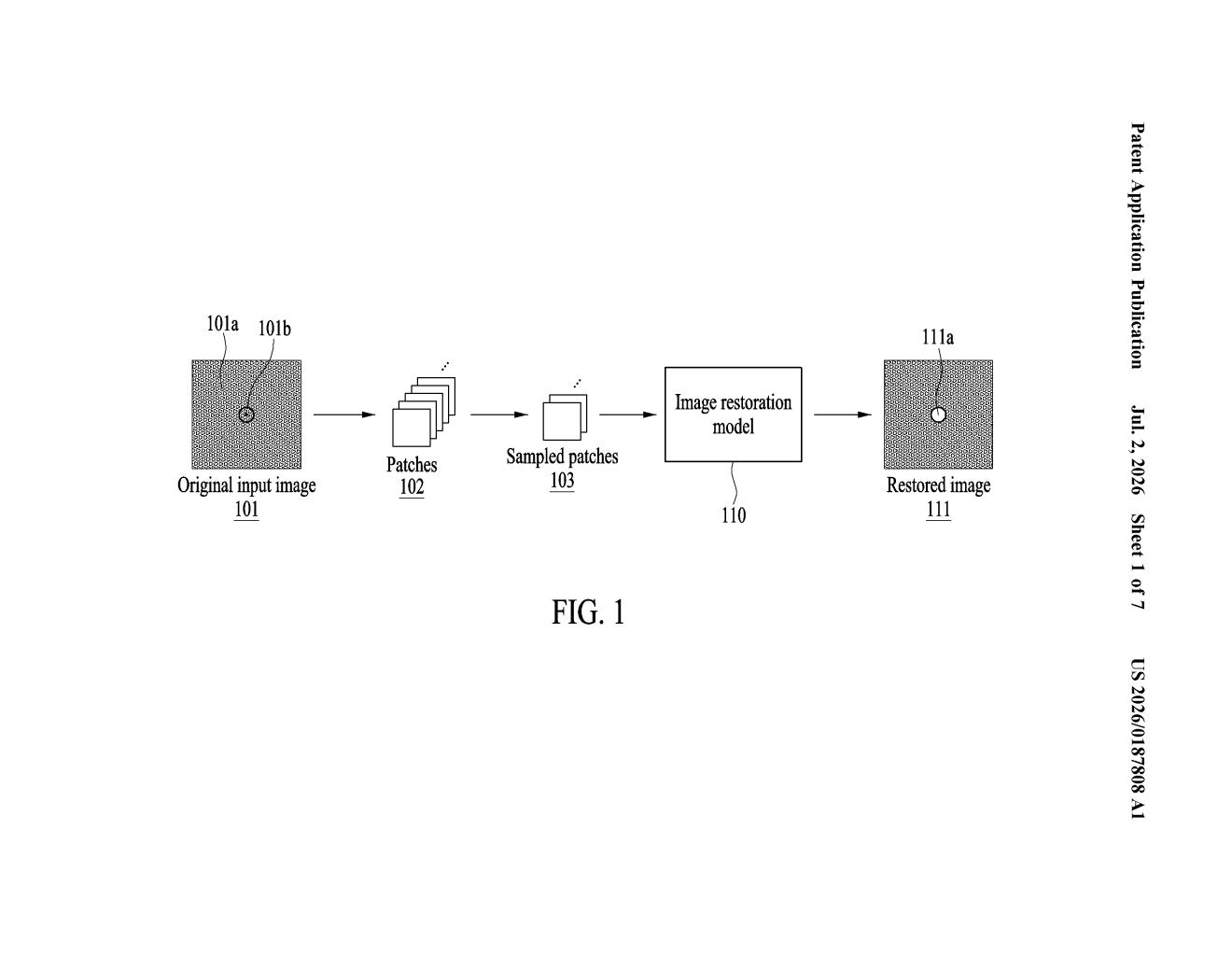
What Samsung's background-first image fix actually does
Imagine you're restoring an old, blurry photo. A smart approach might be to first fill in the plain sky and walls before tackling the faces, because the background gives the AI a reliable foundation to work from. That's essentially the idea behind this Samsung patent.
Samsung's system chops an image into small tiles called patches. When training its AI to reconstruct a damaged or degraded photo, it deliberately feeds the model more background tiles than subject tiles early on. The idea is that backgrounds are more uniform and predictable, so the AI builds its "understanding" of the scene on solid ground before dealing with the tricky details of a face, hand, or object.
The model then compares its reconstructed image to the original and adjusts itself to close the gap. Over time, this sampling strategy is meant to produce a more accurate restoration than treating every tile the same.
How the patch-sampling order shapes the restoration model
The patent describes a training pipeline for an image restoration model, meaning AI software designed to reconstruct a high-quality image from a degraded, noisy, or compressed one.
The core mechanism works in four steps:
- The system takes an input image and divides it into small equal-sized tiles called patches.
- It classifies each patch as either a background patch (sky, walls, flat surfaces) or a feature patch (faces, objects, areas of visual interest).
- During training, it samples background patches at a higher rate than feature patches, so the model sees proportionally more background examples when learning to reconstruct images.
- The model generates a restored image from those sampled patches, then calculates the difference between its output and the original and updates its internal weights to shrink that gap.
The intuition is that background regions are statistically simpler and more consistent, making them easier reference points for the model to anchor its reconstruction on. By over-representing them during training, Samsung aims to stabilize the learning process before the model has to handle the harder, detail-rich subject regions.
What this means for Samsung's camera AI pipeline
For Samsung, whose camera software is a primary selling point across the Galaxy lineup, any improvement in AI-based photo restoration feeds directly into features like night-mode processing, zoom enhancement, and video upscaling. A more stably trained restoration model could mean sharper results in low-light or high-compression scenarios where current approaches leave visible artifacts.
The broader implication is about training efficiency. If this sampling strategy genuinely speeds up convergence or improves accuracy, it could reduce the compute cost of training future camera AI models, which matters as Samsung pushes more on-device processing into its chips. That said, the patent covers the training method itself, not a finished product, so real-world impact depends on how well the idea holds up in practice.
This is a focused, methodical patent about training strategy rather than a flashy new product feature. It's the kind of incremental improvement that raises the floor on photo quality rather than announcing a new capability. Worth watching if you follow Samsung's camera AI closely, but not a headline moment.
Get our take in your Top Stories
Liked this breakdown? Add Patentlyze as a preferred source on Google, and our plain-English take shows up more often in your Top Stories the next time Samsung patent news breaks.
There are more where this came from
We read every patent application Big Tech publishes and send you the ones worth knowing. Plain English, free, every week.
Want this weekly breakdown for a company we don't cover? Patentlyze Pro →