
IBM Patents a Flux-Tunable Superconducting Switch for Quantum Signal Routing
Routing signals inside a quantum computer is one of the messiest unsolved problems in the field — and IBM thinks a tiny tunable superconducting switch might be part of the answer.
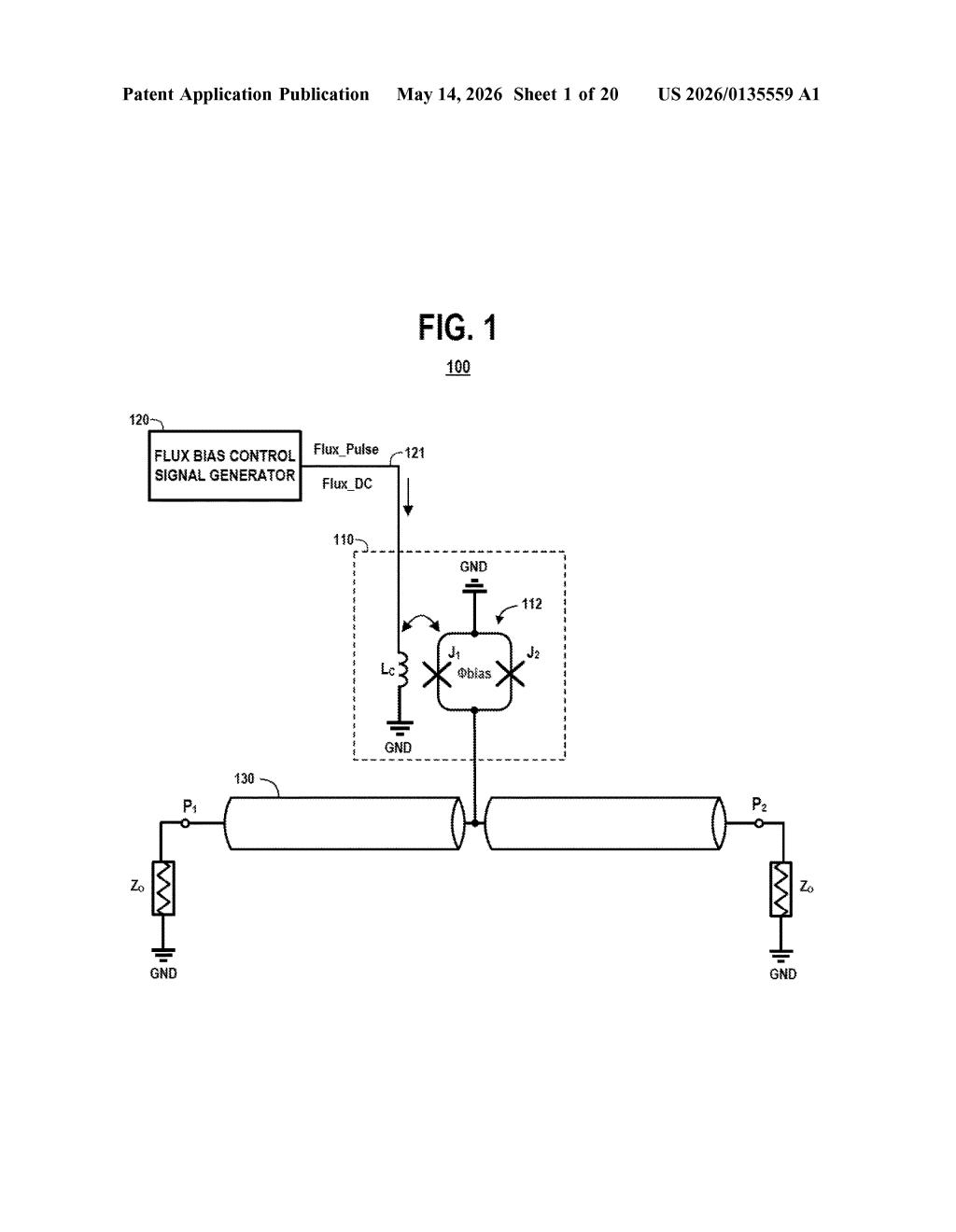
What IBM's superconducting signal switch actually does
Imagine trying to control traffic on a highway where every on-ramp and off-ramp has to be opened or closed without any moving parts — and where the slightest disruption destroys the cargo. That's roughly the challenge of routing signals inside a quantum computer, which operates near absolute zero.
IBM's patent describes a switch made from superconducting materials that can flip between "open" and "closed" states by applying a tiny magnetic field. When the switch is "closed" (letting a signal through), it's carefully tuned to match the electrical characteristics of the wires on either side, so the signal travels cleanly. When it's "open" (blocking a signal), it deliberately mismatches those characteristics, scattering the signal before it gets anywhere.
The key ingredient is a Josephson junction — a nanoscale quantum device that's already a workhorse of superconducting quantum computing. Here, it's used not as a qubit but as a tunable impedance element, essentially a controllable electrical resistance that works at cryogenic temperatures without dissipating heat.
How flux tuning flips IBM's Josephson junction switch
The core device is a superconducting switch built around a transmission line — think of it as a tiny coaxial cable on a chip — that connects two ports with matched impedances (meaning their electrical resistance characteristics are identical, so signals flow without reflection).
Coupled between that transmission line and ground is an impedance tunable element: a superconducting loop containing at least one Josephson junction (a quantum mechanical tunneling device made from two superconductors separated by a thin barrier). The loop's impedance — how much it resists or passes alternating current — can be changed by threading magnetic flux through it, a technique called flux tuning.
The switch operates in two states:
- First impedance state (blocking): The element presents an impedance that breaks the match between the two ports, causing signal energy to scatter to ground rather than travel through.
- Second impedance state (passing): The element's impedance is tuned to preserve the impedance match, making it essentially invisible to the signal, which flows through undisturbed.
Because the switching is done magnetically — not electronically with transistors — there's no need for components that would generate heat or noise inside the cryogenic environment a quantum processor requires.
What this means for scaling quantum processor wiring
Quantum processors are exquisitely sensitive to heat and electrical noise, which means every component inside a dilution refrigerator has to earn its place. Classical electronic switches leak too much heat; optical switches don't work at those temperatures. A superconducting switch that flips states with just a magnetic field pulse, and that's inherently compatible with the same Josephson junction fabrication processes used to make qubits, is a natural fit for on-chip signal routing in large quantum systems.
As IBM and others push toward quantum processors with hundreds or thousands of qubits, the wiring and control overhead becomes a serious bottleneck. Compact, low-loss switches like this one could help route control signals and readout tones on-chip rather than running individual coaxial lines for every qubit — which is simply not scalable. This is infrastructure work, but it's the kind of infrastructure that makes everything else possible.
This is a focused, technically specific patent aimed squarely at the quantum computing wiring problem — not flashy, but genuinely relevant. IBM's quantum hardware roadmap depends on solving exactly this kind of low-level signal plumbing, and a Josephson junction-based switch that doesn't require new materials or exotic fabrication steps is exactly the kind of incremental-but-necessary advance that shows up in real systems a few years later.
There are more where this came from
We read every patent application Big Tech publishes and send you the ones worth knowing. Plain English, free, every week.
Want this weekly breakdown for a company we don't cover? Patentlyze Pro →