
Google Patent Targets Location-Based Ads Without Revealing Where Users Are
Google has filed a patent that figures out which ads to show you based on where you are, without any single server ever learning your actual location. It's a mathematical trick that could reshape how location-based advertising works.
How Google targets ads by location without learning it
Imagine an app shows you ads for nearby restaurants. To do that, it normally has to know exactly where you are, which means some server somewhere has your location on file. That feels like a fair trade until you think about what else that location data reveals: your home, your doctor's office, your political meetings.
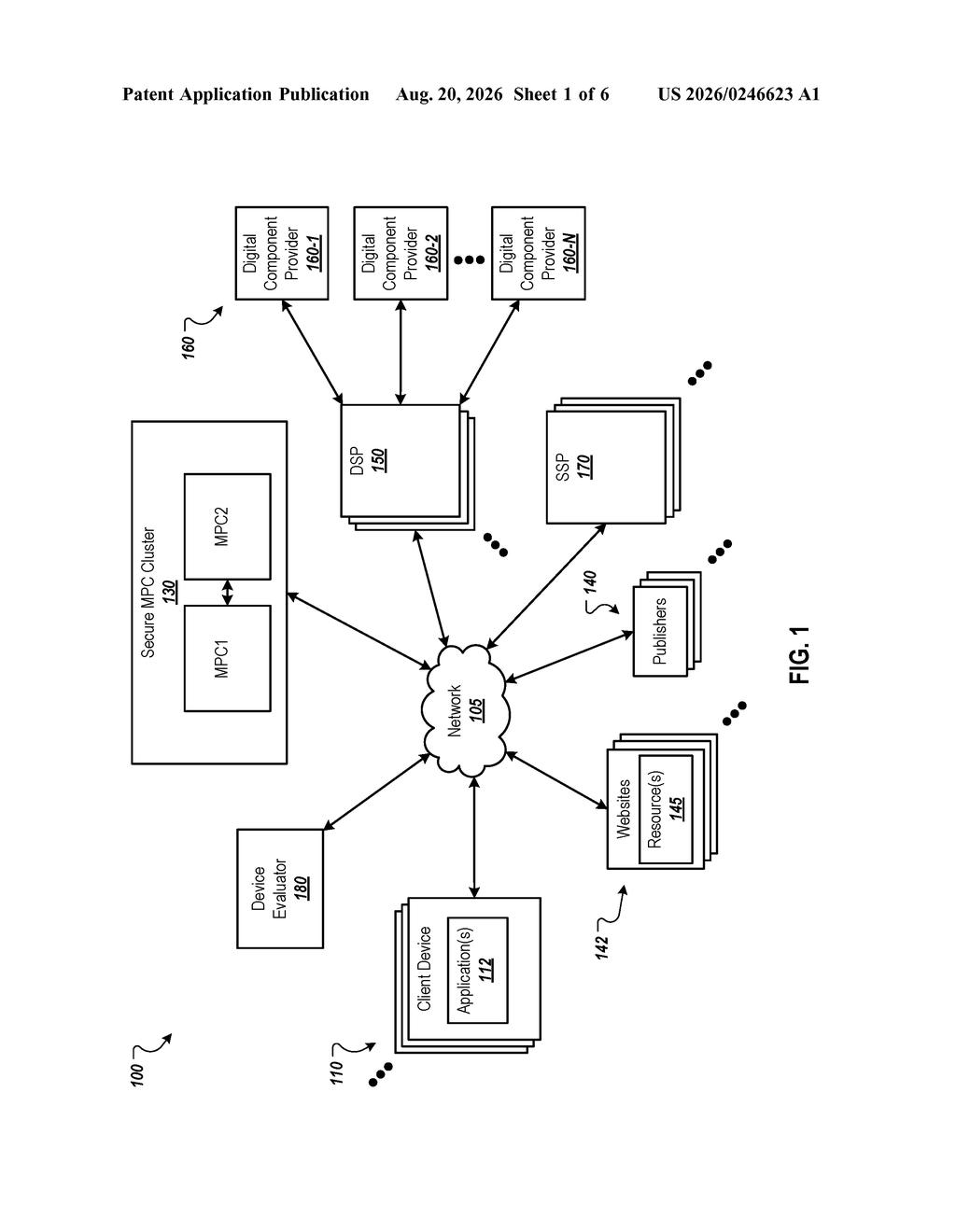
Google's patent describes a way to target those same location-based ads without any one computer ever seeing your full location. Instead, your location gets split into scrambled pieces and sent to different computers in a network. They calculate which ad fits you by doing math on the scrambled pieces, then combine their results at the end. Nobody along the way ever holds the full picture.
The system is built on a well-established cryptographic idea called multi-party computation, which lets multiple parties jointly solve a problem without revealing their private inputs to each other. Google is applying it specifically to the ad-selection pipeline, where location data is both valuable and sensitive.
… receiving, by an MPC computer of a group of MPC computers configured to perform computations of a secure MPC protocol to select digital components for distribution to client devices, a first secret share of location information indicating a location of a client device.
Translation: A network of computers uses encrypted data fragments to pick ads for your device without ever seeing your actual location.
How the secret-share system picks ads without full location data
The patent centers on a technique called secure multi-party computation (MPC), a branch of cryptography that allows a group of computers to jointly compute an answer without any single computer seeing the full input. Think of it like splitting a recipe among three chefs so that no individual chef can reproduce the dish on their own.
Here's how the system works in sequence:
- A client device (your phone or browser) encodes its location as a secret share, meaning it splits the location value into multiple pieces, each of which looks random on its own.
- Different pieces go to different computers in the MPC group. Each computer processes only its piece, using the secure protocol to do partial calculations.
- The MPC computers collaborate to evaluate which ad candidates qualify based on location criteria, all while each machine sees only its own encrypted fragment.
- The group produces a selection result identifying the winning ad, which is then sent back to the client device.
The privacy benefit is structural, not policy-based: even if one of the MPC computers were compromised, the attacker would only have a meaningless fragment of the location. The full location is never assembled in one place during the computation.
The patent also claims improved computational efficiency compared to naive encryption approaches, though the specific mechanism for that efficiency gain is described at a high level in the published abstract.
What this means for privacy in Google's ad business
Location data is some of the most sensitive information your phone generates, and it sits at the center of a large portion of digital advertising revenue. Right now, most ad systems require a trusted server to see your location in full and match it against geographic targeting rules. This patent describes an architecture where that trust requirement is distributed, so no single party needs to be fully trusted with your whereabouts. For users in jurisdictions with strict privacy laws, that architectural shift matters more than any policy promise.
For Google specifically, this is a way to keep location-based ad targeting viable as regulators and privacy-focused browsers put tighter restrictions on raw location collection. The MPC approach could let the company argue, with technical backing, that its ad systems don't process personal location data in the traditional sense. Ad tech patents like this one sit alongside a broader wave of latest Big Tech patents rethinking how behavioral signals flow through advertising infrastructure under growing legal pressure.
Google's 39th filing we've tracked since May in our on-device AI privacy watchlist builds on earlier applications like stripping data before the cloud and splitting protection across servers.
The system costs more to run than a simple database check. Google needs several servers working in sync, and each ad request takes more computing power as a result.
Google is betting that this extra cost buys a privacy protection that regulators may force on the industry anyway. Whether the math works at Google's traffic volume is unclear. The patent's published summary leaves that question unanswered.
There are more where this came from
We read every patent application Big Tech publishes and send you the ones worth knowing. Plain English, free, every week.
The drawings
6 drawing sheets from US 2026/0246623 A1 · click any drawing to enlarge


Want this weekly breakdown for a company we don't cover? Patentlyze Pro →
Be the first to weigh in