
Google Patents a Way to Split Privacy Protection Across Multiple Servers
When one system controls all the privacy protection on sensitive data, a single bad actor can undo it. Google's new patent spreads that responsibility across multiple independent machines so no single point of failure can compromise the math.
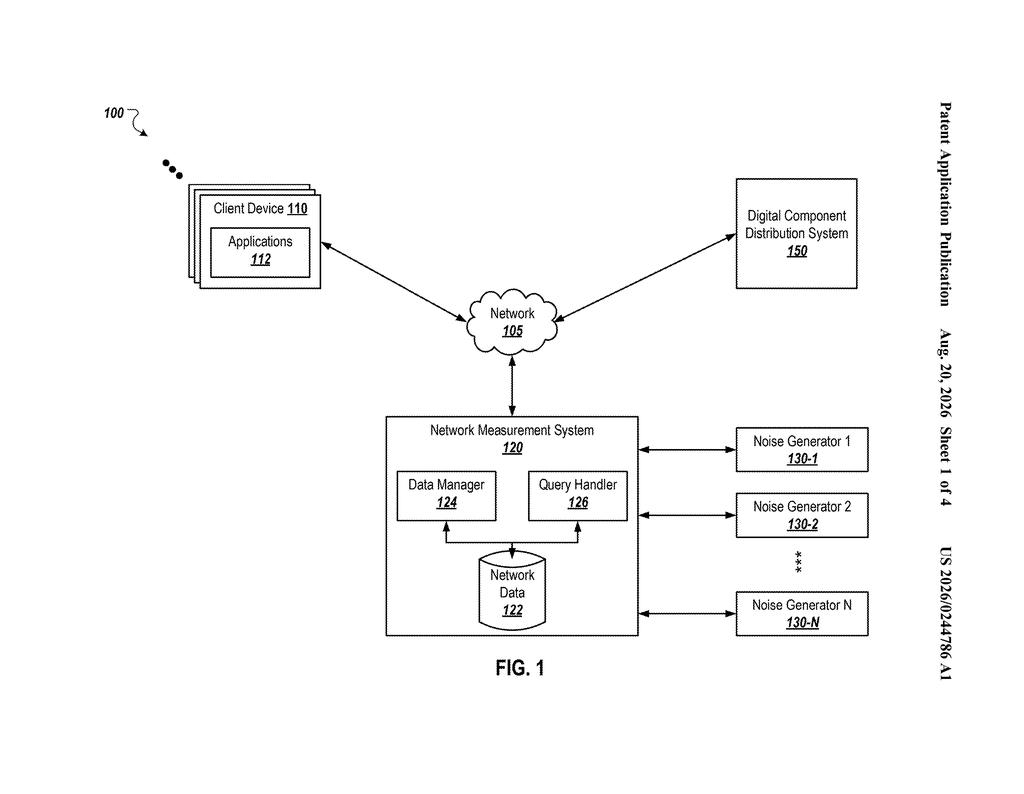
How Google's split-noise privacy system actually works
Every time a company analyzes data about millions of people, someone has to add a layer of deliberate fuzziness to the numbers so that no individual person's information leaks out. That fuzziness is called differential privacy noise, and right now it typically comes from one trusted place.
The problem is that if that one place is compromised, or if the people running it decide to cheat, all the privacy protection disappears. Google's patent proposes splitting the job across several independent noise generators. Each one produces its own chunk of randomness, and only when all those chunks are added together do you get the full protective layer applied to the data.
The key detail is how each chunk is calculated: every generator uses a specific statistical formula tied to how many generators are involved, so the combined result still matches exactly what a single trusted system would have produced. You get the same privacy guarantee, but now multiple parties would all have to collude to undermine it.
… receiving, from two or more of the noise generators, a share of differential privacy noise generated based on the noise generation data, wherein the share of the differential privacy noise is generated by obtaining multiple subsamples from a negative binomial distribution …
Translation: Google collects partial pieces of privacy protection from multiple different servers.
How the negative binomial shares combine into total noise
The system works by distributing the noise-generation task across what the patent calls noise generators, which are separate computing nodes or services. A coordinating system sends each generator the same set of differential privacy parameters (the rules that define how much fuzz to add) along with the total count of generators participating.
Each generator then independently draws multiple random samples from a negative binomial distribution (a standard statistical tool for generating count-based randomness) using input parameters that include a ratio: the usual scaling factor divided by the number of generators. This division is the core trick. It ensures that each generator produces a smaller, proportional slice of the total noise rather than the full amount.
The coordinating system collects a share of differential privacy noise from at least two generators, then combines them through simple addition to produce the total noise. That total is mathematically equivalent to what a single centralized system would have generated, so the privacy guarantee is preserved without weakening it.
The practical result:
- No single generator sees or controls the full noise value
- An attacker or corrupt operator would need to compromise all participating generators simultaneously
- The statistical properties required by differential privacy are maintained across the split
Each share of the differential privacy noise is generated by obtaining multiple subsamples from a negative binomial distribution using input parameters comprising a ratio between a scaling factor and the number of noise generators.
Translation: Each server calculates its piece of the privacy shield using a specific math formula and ratio.
What this means for trustworthy private data analysis
Differential privacy is the main tool that major tech companies use to analyze aggregate data (ad performance, health trends, usage statistics) without exposing individual users. The weakness has always been that it requires trusting whoever runs the noise generator. If that entity is hacked, pressured, or simply dishonest, the privacy math breaks down silently and users have no way to know.
This approach moves differential privacy closer to a multi-party trust model, the same principle used in secure financial systems where multiple independent parties must all sign off before a transaction clears. For Google, which processes personal data at enormous scale across Search, Ads, and cloud services, building distrust-tolerant privacy infrastructure is a meaningful engineering investment. Privacy-focused patent filings like this one sit alongside the latest Big Tech patents in data security and privacy-preserving computation, a category that has grown steadily as regulatory scrutiny of data practices increases worldwide.
Google's 37th filing we've tracked since May in our on-device AI privacy work continues a pattern that includes a preference-learning without personal data and anonymous app traffic measuring.
The problem this patent solves is real and overlooked. When one system alone is responsible for scrambling your data to protect your privacy, you have to trust that system completely, and no amount of outside checking fully fixes that weak spot.
Splitting the scrambling job across several independent parties is a fair and practical answer to an actual trust problem. The specific math mechanism this patent proposes can be tested and proven, which makes it a solid technical contribution, not just a vague idea.
There are more where this came from
We read every patent application Big Tech publishes and send you the ones worth knowing. Plain English, free, every week.
The drawings
4 drawing sheets from US 2026/0244786 A1 · click any drawing to enlarge


Want this weekly breakdown for a company we don't cover? Patentlyze Pro →
Be the first to weigh in