
Apple Patents a Way to Add Cards to Your Wallet by Tapping the Physical Card
Setting up a new credit card on your phone could be as simple as tapping the physical card against it, with Apple's secure chip taking over the process so that the app requesting your card details never actually sees them.
How Apple's tap-to-provision idea actually works
You're trying to add a new loyalty card or credit card inside a retailer's app, and the app asks you to scan or type in your card number. It's a clunky step, and it hands sensitive data to an app that may not need it.
Apple's patent describes a different approach: the app asks to add a credential (a card, a pass, a ticket), and at that moment a separate Apple-controlled screen slides in front of the app's interface. You tap your physical card against your phone, the phone reads the card's data, and the secure chip on your device handles everything. The retailer's app gets only an encrypted package it can use to complete the setup, not the raw card numbers.
The key detail is what the retailer's app is blocked from seeing. While that Apple-controlled screen is up, the app cannot read any data coming into your phone. Your card details go straight to the secure chip, which decides what to pass along and in what form.
… displaying, by a second application corresponding to a secure element of the user device, a user interface element over a user interface of the first application, the second application preventing the first application from accessing at least a portion of data received by the user device while the user interface element is displayed over the user interface …
Translation: A secure popup blocks the main app from seeing sensitive data.
How the secure element locks out the requesting app
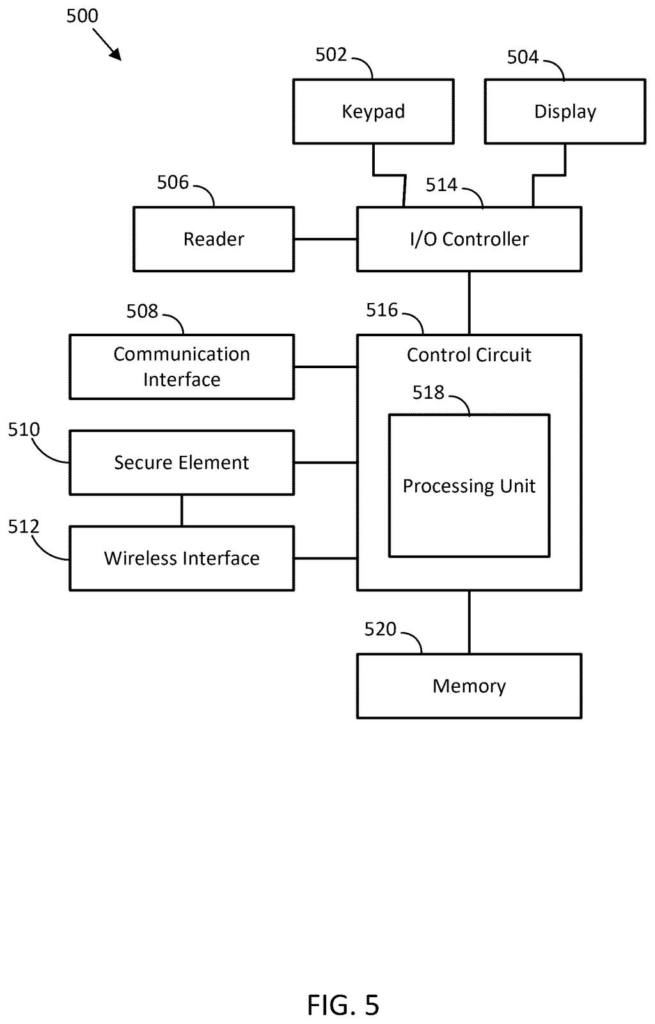
The patent covers a proximity-based credential provisioning system built around three layers working together.
- The requesting app (a retailer's app, a transit app, anything built by a third party) kicks off the process by signaling that it needs a credential added.
- A second Apple-controlled application, tied directly to the device's secure element (a dedicated chip that stores payment and identity data, separate from the main processor), draws a user interface overlay on top of the first app. While that overlay is visible, the first app is technically blocked from reading incoming data.
- The secure element itself reads the physical object (a credit card, ID, transit pass) when it comes within range, converts that raw data into an encrypted representation, and hands only that encrypted package back to the requesting app.
The proximity detection likely refers to NFC (Near Field Communication, the same short-range radio used for tap-to-pay). The physical card or object would need to be held close to the phone, triggering the secure element's reader during the brief window when the Apple overlay is active.
The result is a clean separation: the third-party app orchestrates the flow but is architecturally prevented from intercepting the sensitive credential data at the moment it enters the device.
… a physical object corresponding to the credential may be detected within a proximity of the user device for provisioning of the credential.
Translation: You can add a card to your digital wallet just by holding the physical card near your phone.
What this means for mobile payments and card setup
For everyday users, this matters because it changes who handles your card data during setup. Today, adding a card inside a third-party app usually means typing numbers into a form that the app can read and transmit. This approach routes the sensitive step through hardware Apple controls, so the app gets a token it can use rather than the underlying account details.
For Apple, the patent extends the reach of its secure element into third-party app flows without giving those apps any new access to raw credential data. That is a meaningful line to draw: it lets Apple position itself as the security layer for card provisioning across the entire App Store ecosystem, not just inside Apple Wallet. Apple's push to make the secure element a shared utility across newest Big Tech patents in the payments and identity space shows how seriously the company is treating hardware-level data isolation as a product feature.
Apple's fourth filing we've tracked since July in our on-device AI privacy watchlist builds on earlier applications covering managing AI models across devices and feeding 5G data to AI.
Claim 1 is written broadly enough to cover any app, any physical object, and any credential type, not just payment cards. The mechanism it claims (a second app overlaying and blocking the first, the secure element reading and encrypting the object, the encrypted result returned to the first app) is specific enough to be defensible but wide enough to apply to transit passes, hotel keys, event tickets, and digital IDs. If granted as written, this claim could give Apple significant leverage over how any third-party iOS app handles tap-based credential setup. The practical effect would be that any developer wanting to offer this kind of tap-to-add feature would need to route through Apple's secure element stack, on Apple's terms.
There are more where this came from
We read every patent application Big Tech publishes and send you the ones worth knowing. Plain English, free, every week.
The drawings
8 drawing sheets from US 2026/0246633 A1 · click any drawing to enlarge


Want this weekly breakdown for a company we don't cover? Patentlyze Pro →
Be the first to weigh in