
Sony Patents a Metamaterial Optical Layer That Boosts Display Brightness
Sony's semiconductor division has filed a patent for a display architecture that sandwiches a metamaterial layer above light-emitting pixels to redirect scattered light straight at your eyes — potentially making screens look dramatically brighter without using more power.
What Sony's metamaterial brightness trick actually does
Imagine a flashlight that wastes most of its light by shining sideways instead of forward. That's roughly what happens inside a display — a lot of light gets lost bouncing around rather than reaching your eyes directly. Sony's patent tackles this by adding a specially engineered layer above the pixels to redirect that wasted light.
The key ingredient is a metamaterial — an artificially structured material designed to manipulate light in ways natural materials can't. Between the pixel array and this metamaterial sits an optical control layer that acts like a traffic cop for photons, steering them toward you rather than off to the sides.
The clever part is a specific spacing rule: the distance between the pixels and the metamaterial, divided by the pixel size, must fall between 0.2 and 1.8. That precise ratio is what makes the whole system work — too close or too far and the optical magic breaks down.
How the L/D ratio controls Sony's optical layer spacing
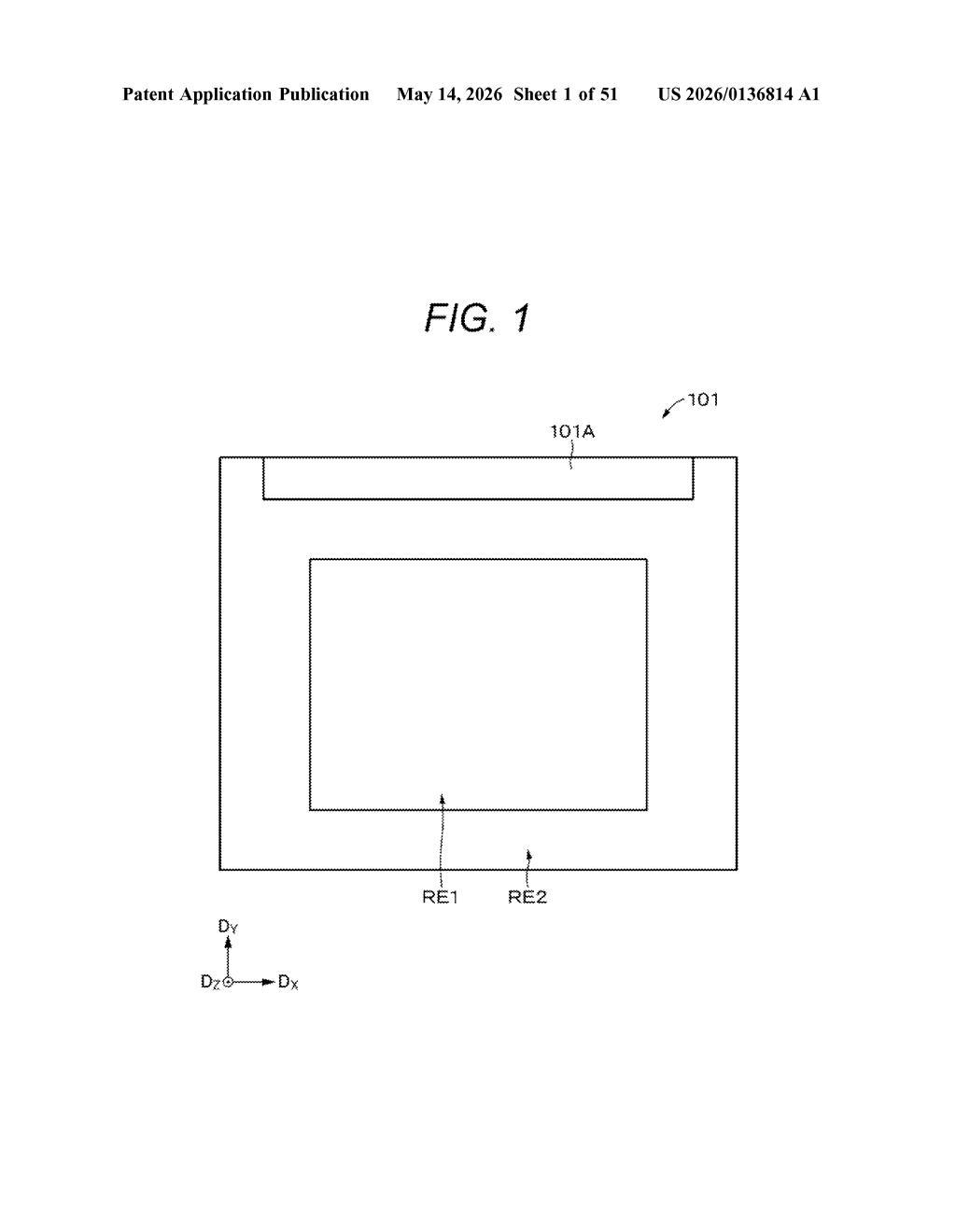
The patent describes a display stack with three key components arranged in order: a two-dimensional array of light-emitting elements (think individual pixels in an OLED or microLED panel), an optical control layer sitting above them, and a metamaterial on top of that.
Metamaterials are engineered structures — often periodic arrays of sub-wavelength features — whose optical properties come from their geometry rather than their chemical composition. They can bend, focus, or redirect light in ways that ordinary glass or plastic cannot. Here, the metamaterial is tuned to collimate light (i.e., gather diverging rays and point them in the same direction — forward).
The optical control layer between the pixels and the metamaterial is the precision spacer that makes the system work. The patent's central claim is a specific geometric constraint: the ratio L/D — where L is the physical gap between the light-emitting surface and the metamaterial, and D is the pixel pitch (size of one pixel) — must be between 0.2 and 1.8.
This ratio essentially governs how well the metamaterial can "see" each individual pixel and redirect its light cone. Stay within the window and frontal luminance improves measurably. Stray outside it and crosstalk between adjacent pixels or poor collimation degrades the effect.
What this means for Sony's next OLED or microLED displays
For Sony, which competes in premium TV panels, professional monitors, and VR/AR displays, frontal luminance is a core spec — it's what makes HDR pop and colors look vivid in bright rooms. If a metamaterial layer can deliver meaningfully brighter perceived images without increasing power draw, that's a real competitive advantage in a market where every nit counts.
The approach also has implications for microLED displays, where individual pixels are tiny and light extraction efficiency is a known challenge. A manufacturable metamaterial layer with a well-defined spacing rule could be a practical engineering path rather than a lab curiosity — assuming Sony can hit the tolerances at scale.
This is a focused, well-scoped engineering patent rather than a grand platform play — Sony has identified a specific optical inefficiency and proposed a quantified geometric fix. The L/D ratio constraint is the kind of concrete, testable claim that suggests real lab work behind it, not just a defensive filing. Display engineers will find this worth reading; everyone else can file it under 'Sony is serious about panel brightness.'
There are more where this came from
We read every patent application Big Tech publishes and send you the ones worth knowing. Plain English, free, every week.
Want this weekly breakdown for a company we don't cover? Patentlyze Pro →