
Sony
Sony · Audio · Filed Nov 13, 2024 · USPTO published May 14, 2026 · May 14 release
Sony Patents a Microphone That Automatically Amplifies Whoever Is Speaking
Sony Interactive Entertainment is patenting a microphone system that automatically amplifies whoever is speaking in a group — so nobody has to awkwardly pass around a mic or shove it in their face to be heard.
- Publication number
- US 2026/0134879 A1(US20260134879A1)
- Applicant
- Sony Interactive Entertainment Inc.
- Filed · Published
- Nov 13, 2024 · May 14, 2026
- Inventors
- Oliver Capio
- Status when we published
- Waiting for an examiner
- Document
- 20 claims
- US classification
- 704/225
- Examiner
- FOSTER JR., MICHAEL ALAN (Art Unit 2654)
What Sony's auto-gain microphone system actually does
Imagine a group of friends sitting around a TV, trying to talk to people online during a gaming session. Someone speaks up, but they're three feet from the mic — and nobody can hear them. The usual fix? Pass the mic around, or have everyone crowd in. Sony wants to skip that entirely.
This patent describes a smart microphone system that detects incoming speech energy, figures out how loud (or quiet) the speaker is relative to the mic, and automatically adjusts the gain — essentially turning up the volume on that person's voice — so the output always hits a minimum usable amplitude.
The system also factors in the physical position of the microphone and can layer in noise cancellation to clean up the result. The goal is a shared mic that just works for everyone in the room, without anyone having to awkwardly reposition themselves or the device.
How the processor adjusts gain based on input energy
At its core, the patent describes an apparatus built around at least one processor that watches incoming audio energy from a microphone and dynamically adjusts gain (amplification level) to ensure the output always meets or exceeds a predetermined amplitude threshold — a minimum loudness floor.
The key inputs to the system include:
- Input energy — the raw speech signal picked up by the mic
- Microphone position — spatial data used to calibrate how much amplification is needed
- Noise cancellation — filtering to clean up background sound before or after gain is applied
The processor compares the incoming signal level against the target amplitude and applies a gain adjustment to bring soft or distant speech up to a usable level. This is essentially a dynamic automatic gain control (AGC) system — a well-known audio technique — but the patent's emphasis is on doing this in a group-aware, position-informed way rather than just a flat volume boost.
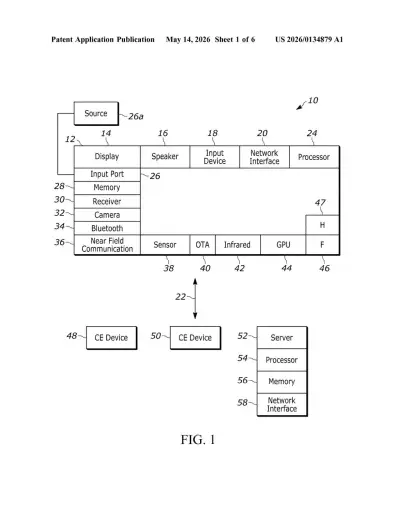
The filing also references a broader device ecosystem including a network input, display, camera, Bluetooth, and Near Field sensor, suggesting this isn't just a standalone mic concept but something designed to integrate into a larger entertainment or gaming device.
What this means for PlayStation party chat and social gaming
For Sony Interactive Entertainment specifically, this fits neatly into the PlayStation social gaming space — think living room co-op, party chat, or any scenario where multiple people share a single microphone input. Right now, shared-mic situations often produce inconsistent audio quality that puts the burden on the user to compensate. A system that handles gain automatically would make group communication feel more polished without requiring extra hardware per person.
More broadly, automatic gain control tied to spatial mic positioning could show up in PlayStation peripherals, smart speakers, or even PlayStation VR accessories — anywhere Sony wants hands-free, frictionless voice interaction in shared physical spaces.
Source: US 2026/0134879 A1 at the USPTO (PDF). Full patent text and figures are in the official publication.
Get our take in your Top Stories
Liked this breakdown? Add Patentlyze as a preferred source on Google, and our plain-English take shows up more often in your Top Stories the next time Sony patent news breaks.
Add Patentlyze on Google
One click.
There are more where this came from
We read the new patents from Big Tech, carmakers and more and send you the ones worth knowing. Plain English, free, every week.
More from Sony
All 722 Sony patents →
More in Audio
All 97 Audio patents →
Samsung
Samsung Patents Audio Cleanup That Evens Out Sound From Narrow Speaker Grilles Across a Room
Apple
Apple Patent: Mic Listens to Room Noise to Keep Dialogue Audible
Samsung
Samsung Patent Tailors 3D Audio Signals to Each User's Unique Ear Shape
Samsung