
Google Patent Reveals Hubs Pushing AI-Derived Insights Directly to Smart Home Devices
Google has patented a way for a home hub to act as a local translator between a cloud AI service and the smart devices on your network, so your lights or thermostat can react to AI-generated insights without every gadget needing its own cloud connection.
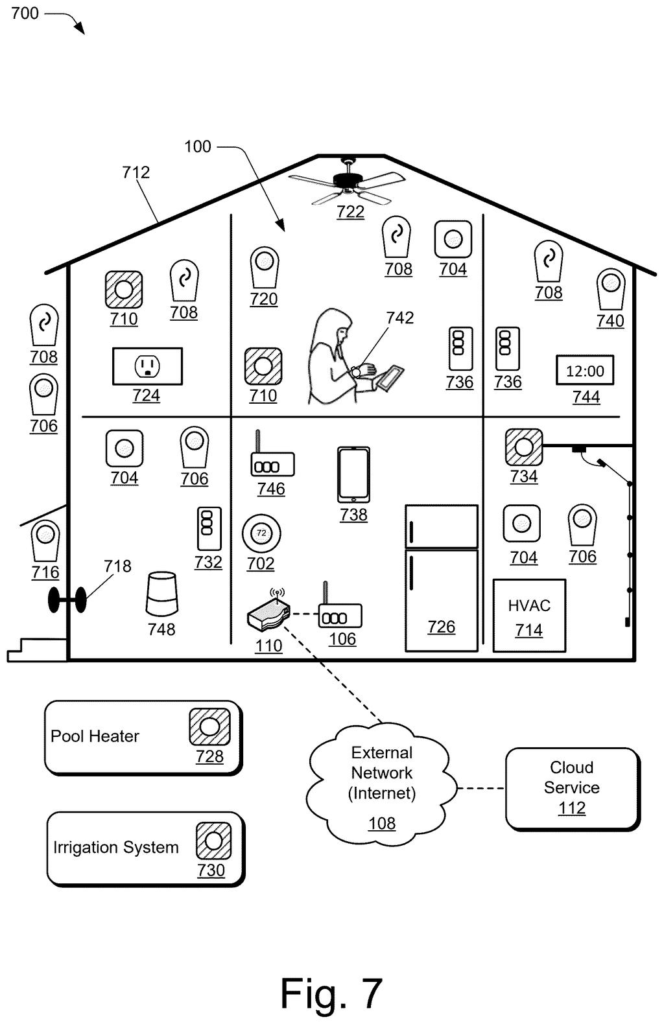
How Google's hub pushes AI data to your smart gadgets
Imagine your Google Nest hub notices, via an AI service, that your household's usual morning routine has started early. Instead of each smart device on your network having to call out to the internet to learn that, the hub absorbs that insight and broadcasts it locally, like a neighborhood bulletin board that every device can read.
That's essentially what this patent covers. The hub pretends to be a virtual device on your home network, advertising a set of data slots (called clusters). Your smart thermostat, lights, or locks can subscribe to those slots. When the AI sends an update, the hub fills in the slot and each subscribing device decides on its own whether to do something about it.
The result is that AI-aware behavior can spread across your smart home without each device needing its own cloud account or internet access. Your gadgets get the intelligence without the round-trip delay.
exposing a virtual device on the home network, the virtual device including one or more clusters; receiving, from a partner device, a request to subscribe to a cluster of the one or more clusters …
Translation: The central hub creates a fake smart device that other gadgets in the house can connect to.
How the hub exposes clusters and publishes attributes
The patent describes a hub (think a Google Nest device or similar home gateway) that acts as a local go-between for an intelligence service (a cloud-based AI that might analyze occupancy patterns, energy use, time of day, or similar signals) and the individual gadgets on your home network.
The hub creates a virtual device, a software construct that sits on the local network and looks, to other devices, like a real piece of hardware. That virtual device contains one or more clusters, which are standardized data containers borrowed from the Matter/Thread smart home protocol world. Each cluster holds attributes, essentially named variables that other devices can read.
When a partner device (a smart plug, thermostat, or lock) wants AI-derived context, it sends a subscribe request to the relevant cluster. The hub receives state updates from the cloud AI, writes them into the cluster attribute, and then publishes the update to every subscribed device. Each device then makes its own local decision about whether to act. No cloud call required at decision time.
The patent also covers a reverse path: a partner device can advertise a custom cluster it has installed, and the hub pushes state information to that custom cluster via a direct command, instead of waiting for a subscription request. Both directions use the same underlying idea of the hub as a local AI-state broadcaster.
What this means for your smart home's offline smarts
For you as a smart home owner, the immediate payoff is faster, more reliable automation. If your internet drops, devices that have already received the hub's latest AI state can still act on it locally. There's no spinner, no delayed response, no "device unavailable" message because one gadget couldn't reach a server.
Google's pattern of home-intelligence filings points toward a world where Nest hubs do a lot more than relay commands. If this system ships, the hub becomes the brain of the house, not just the speaker on your counter. That shifts meaningful AI processing closer to your home and away from Google's servers, which has privacy upsides too, since the raw sensor data may never need to leave your network.
Google's 41st filing we've tracked since May in our on-device AI privacy push watchlist builds on earlier applications like ads hiding your full profile and location ads without user whereabouts.
Claim 1 covers any hub that puts AI-generated information onto a home network as a subscribable data point, lets other devices sign up to receive it, and then pushes updates whenever that information changes. That is a very wide net. It does not require a specific AI model, a specific device brand, or a specific type of smart home gadget on the receiving end.
If granted in its current form, the claim would give Google legal standing over any competing hub that relays AI-derived status information to partner devices using a publish-and-subscribe pattern, which is exactly how modern smart home standards already expect devices to share data.
The practical stakes are real: whoever owns this claim controls the architecture by which AI judgment enters your home network and tells your lights, locks, and thermostats what to do.
Get our take in your Top Stories
Liked this breakdown? Add Patentlyze as a preferred source on Google, and our plain-English take shows up more often in your Top Stories the next time Google patent news breaks.
There are more where this came from
We read every patent application Big Tech publishes and send you the ones worth knowing. Plain English, free, every week.
The drawings
9 drawing sheets from US 2026/0261448 A1 · click any drawing to enlarge


Show the other 1 sheets

Want this weekly breakdown for a company we don't cover? Patentlyze Pro →
Be the first to weigh in