
Google Patents an On-Device AI That Writes Your Emergency Message For You
When you're panicking, clear thinking is the first thing to go. Google is patenting a system that lets an AI on your phone turn frantic, jumbled words into a structured emergency message, even when your signal is barely there.
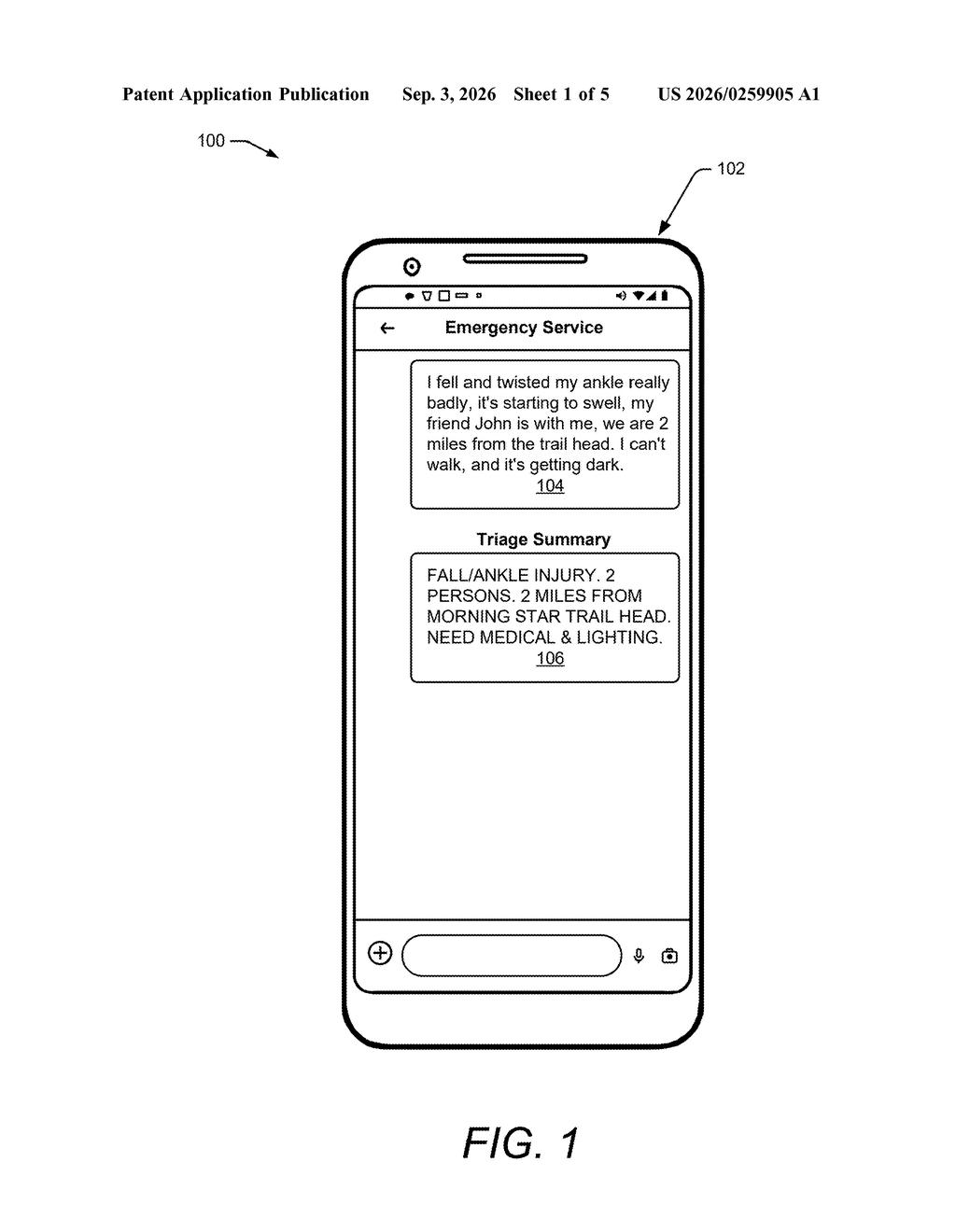
What Google's AI emergency texting system actually does
Every time someone dials 911 or fires off an SOS text in a real emergency, they're expected to stay calm and give precise details under the worst possible pressure. Most people can't do that reliably, and the result is garbled, incomplete information reaching first responders.
Google's patent describes a tool built into your phone that listens to or reads whatever you manage to type or say, then uses an AI to pull out the critical details and write a clean, structured emergency message on your behalf. You might say something like "I fell hiking, my ankle, I can't move, near the waterfall trail," and the AI turns that into a properly formatted distress alert.
The system also handles poor connectivity. If you're on a satellite link, where every byte counts, the AI compresses the message before sending it. The AI runs on your device, so it doesn't need a strong internet connection to do its job.
… extracting, with a large language model (LLM), one or more relevant details of the emergency event from the free-form input; generating, by the LLM, an emergency message based on the one or more relevant details; …
Translation: The AI reads your messy description and pulls out the key facts to build a formal alert.
How the on-device LLM compresses and sends distress messages
The patent describes a method where a user's phone presents an emergency interface that accepts free-form input, meaning you can type, speak, or use natural language without worrying about following a form or template. The user doesn't have to stay calm or be precise; the system is designed to handle the noise.
A large language model (LLM), the same class of AI that powers chatbots like Gemini, runs at least partially on the device itself. It reads or transcribes the input and extracts what it judges to be the most relevant emergency details: location, nature of the incident, injuries, and so on. It then generates a structured emergency message from those details.
- Input types supported: typed text, spoken voice, or general natural language
- The LLM extracts key facts and filters out panic-driven noise
- A final message is assembled and sent through an emergency messaging session
- Before sending, the LLM can compress the message for bandwidth-constrained networks (networks with limited data capacity), such as satellite communications
The satellite compression piece is notable. Current satellite SOS systems, like those built into recent smartphones, are limited to short, pre-set messages. An LLM that can shrink a detailed natural-language alert down to its essential bytes could make those connections carry far more useful information.
… compress the emergency message prior to the providing of the emergency message over a bandwidth-constrained network or a latency-constrained network, such as a satellite communication network.
Translation: It shrinks the text so it can easily go through a slow satellite connection when cell towers are down.
What this means for satellite SOS and crisis communication
For everyday users, this could mean the difference between a rescue team arriving with accurate information and showing up with almost none. Satellite emergency features are already in phones from several manufacturers, but they're constrained by how much text they can transmit. An AI that compresses your message intelligently rather than just truncating it is a real upgrade to what those systems can do.
Google's recent push into on-device AI makes this filing fit a clear pattern: keep sensitive processing on the hardware so it works without a data connection. In an emergency, that offline capability isn't a nice-to-have, it's the whole point. If this system reaches a shipping product, the people most likely to benefit are hikers, drivers in remote areas, and anyone whose emergency happens somewhere a cell tower can't reach.
Google files its 42nd patent we've tracked since May in the on-device AI privacy watchlist, adding to earlier applications like one keeping ad profiles off servers and AI insights to home devices.
Claim 1 covers any method that takes a free-form description of an emergency, runs it through a large language model to pull out the relevant details, and sends the result as an emergency message. There is no restriction on device type, network, or which AI model does the work.
That scope is wide enough to reach almost any "describe your emergency in your own words" feature built on top of AI, whether it lives on a phone, a car dashboard, or a wearable. A developer adding a conversational emergency input to their app would need to reckon with this claim.
The real test at the patent office will be whether "emergency context" is enough to distinguish this from years of prior work in voice-to-form and AI-assisted data extraction. That is a genuine legal question, and the answer will determine how much practical weight this patent carries.
Get our take in your Top Stories
Liked this breakdown? Add Patentlyze as a preferred source on Google, and our plain-English take shows up more often in your Top Stories the next time Google patent news breaks.
There are more where this came from
We read every patent application Big Tech publishes and send you the ones worth knowing. Plain English, free, every week.
The drawings
5 drawing sheets from US 2026/0259905 A1 · click any drawing to enlarge


Want this weekly breakdown for a company we don't cover? Patentlyze Pro →
Be the first to weigh in