
IBM Patents Technology That Reconstructs Complete Images From Incomplete Fragments
Show a neural network half a photo and it can fill in the rest from memory. IBM's new patent describes exactly that system, using a class of AI model originally inspired by how human memory recalls complete experiences from partial cues.
How IBM's image-completion memory network works
Imagine you tear a photograph in half and hand someone only the left side. If they've seen enough photos like it before, they can make a pretty good guess at what the missing half looks like. IBM's patent describes software that does the same thing automatically.
You feed the system a cropped or incomplete image, and it searches its learned memory for the closest match, then fills in what's missing to produce a complete picture. The system was trained on large sets of images beforehand, so it already "knows" what many kinds of images look like in full.
The twist is what's doing the remembering. IBM uses a type of AI called a Modern Hopfield Network, which is specifically designed to store and retrieve patterns, much like how your brain can reconstruct a full song from hearing just the first few notes. The result is an AI that doesn't just guess randomly but converges on a complete, coherent image step by step.
… receiving a partial query for a complete image of a first image, wherein the partial query includes the first image displaying fifty percent or less of the complete image; …
Translation: The system takes in a picture that is missing more than half of its visual data.
Inside IBM's encoder-Hopfield-decoder pipeline
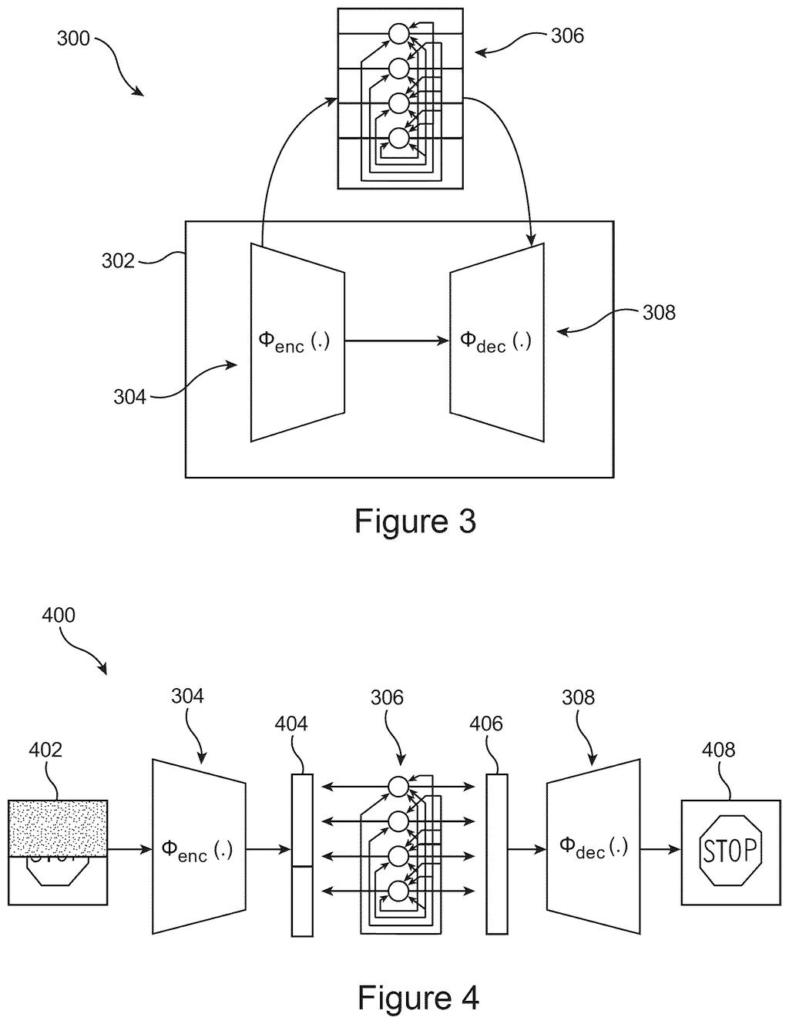
The system IBM describes is a three-stage pipeline built around a specialized neural network called a Modern Hopfield Network (MHN), an architecture known for its ability to store a large number of patterns and recall them reliably when given a partial input.
Here's how the process flows:
- Encoding: A partial image (the patent specifies it must show 50% or less of the full picture) is passed through an image encoder, which compresses it into a compact mathematical representation called a latent space vector (think of it as a highly condensed fingerprint of the image's content).
- Hopfield retrieval: That fingerprint is fed into the MHN as a "retrieval cue." The network iteratively refines the fingerprint, nudging it toward the closest complete pattern it learned during training, until it stabilizes on a full representation.
- Decoding: The completed fingerprint is passed through an image decoder, which translates it back into actual pixel data and outputs the reconstructed image.
The key property here is the iterative update loop inside the MHN. Unlike a one-shot prediction, the network keeps adjusting its answer until it converges, which in theory produces more stable and coherent completions than a single forward pass through a standard model.
The patent covers training the MHN on image datasets first, so the stored patterns are learned rather than hand-coded. The architecture is described as the Hopfield Encoding Network (HEN), combining the encoder, MHN, and decoder into one end-to-end system.
… iteratively update the latent space neural encoded representation until a corresponding comprehensive latent space neural encoded representation is formed; …
Translation: The AI repeatedly refines its internal data until the missing parts are fully restored.
What this means for medical imaging and AI search
The most obvious application is anywhere you routinely deal with incomplete images: medical scans where part of the image is obscured or corrupted, satellite imagery with cloud cover, archival photos that are damaged or partially cropped. In those fields, having a system that can reconstruct a plausible complete image from a fragment could speed up workflows or fill gaps that currently require manual intervention.
From a patent-strategy angle, claim 1 is written fairly broadly. It covers any method that combines an encoder, a Modern Hopfield Network used as a retrieval loop, and a decoder to complete a partial image. That scope could give IBM a blocking position over a recognizable class of image-reconstruction systems if the patent is granted, which puts it squarely in the ongoing race among IBM and other large AI labs to stake out foundational positions in neural memory retrieval. IBM's memory-network filing sits alongside this week's Big Tech patents in AI retrieval, an area drawing more filings as generative AI tools increasingly need to pull structured knowledge from learned weights rather than external databases.
That makes this IBM's 25th filing we've tracked in AI assistant & agent coverage since May, a group that includes one on sorting records via text prediction and one on compressing AI text output.
Claim 1 covers any system that takes a partial image (defined in the claim as 50% or less of the full picture), runs it through an encoder, uses a Modern Hopfield network loop to fill in the missing representation, and decodes the result back into a complete image. The claim does not restrict the subject matter of the images, the internal design of the encoder or decoder, or the specific flavor of Hopfield architecture used. That scope is wide.
Any encoder-Hopfield-decoder pipeline built for image completion would need to clear this claim, regardless of whether the images are medical scans, satellite photos, or consumer snapshots. The one concrete boundary the claim draws is that 50% threshold for how incomplete the input can be, which gives the claim a defined edge that courts can apply to real products.
Everything within that boundary, across domains and network designs, falls inside what IBM is seeking to own here.
Get our take in your Top Stories
Liked this breakdown? Add Patentlyze as a preferred source on Google, and our plain-English take shows up more often in your Top Stories the next time IBM patent news breaks.
There are more where this came from
We read every patent application Big Tech publishes and send you the ones worth knowing. Plain English, free, every week.
The drawings
3 drawing sheets from US 2026/0252622 A1 · click any drawing to enlarge


Want this weekly breakdown for a company we don't cover? Patentlyze Pro →
Be the first to weigh in