
Google Patents a Way to Etch Deeper, More Precise Light Guides for AR Glasses
Getting light to travel through a thin piece of glass and land exactly where your eye needs it is one of the hardest manufacturing problems in AR hardware, and Google just filed a patent for a technique that uses a quirk of the etching process itself to solve part of it.
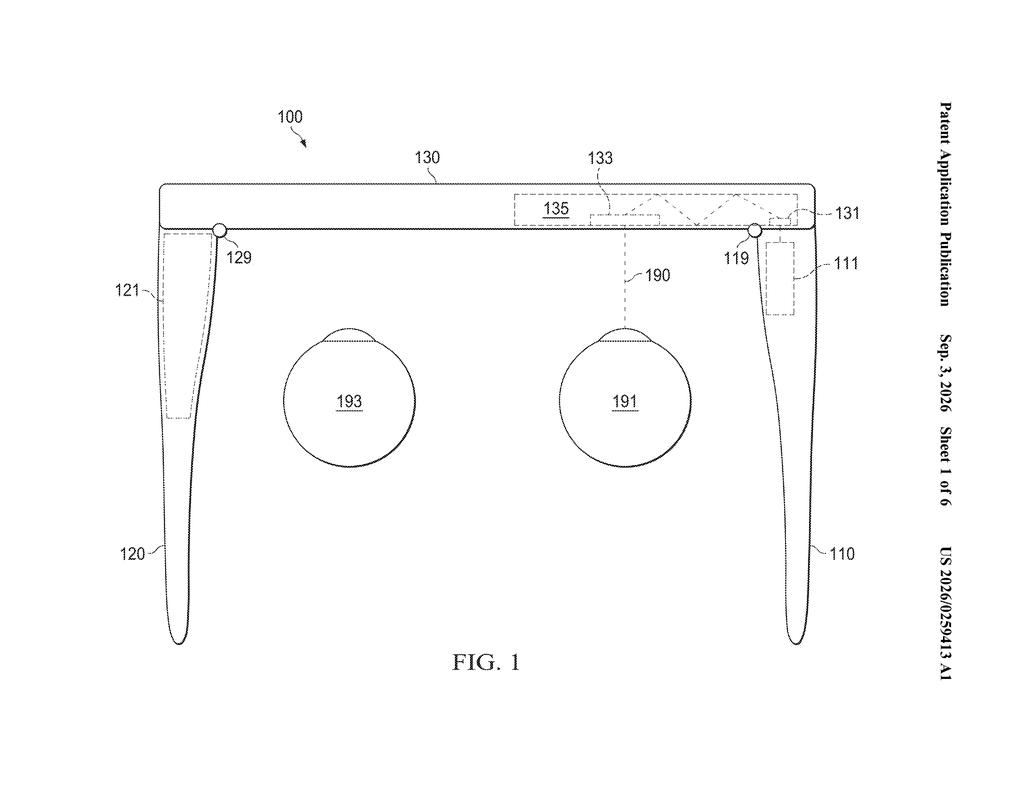
What Google's AR lens etching patent actually does
You're wearing a pair of AR glasses, and the directions floating in your field of view look crisp and bright no matter where you glance. That effect depends on microscopic grooves etched into a sliver of glass called a waveguide, which steers light toward your eye. Getting those grooves right is brutally hard.
Google's patent covers a manufacturing trick that controls how deep each groove is cut into the glass, groove by groove. Instead of fighting a natural side effect of the etching process, Google's approach uses it. When a groove is very narrow, the etching chemistry can't reach the bottom as easily, so it stays shallower. By carefully sizing each groove's width, engineers can dial in the exact depth they want without any extra steps.
The payoff is a waveguide where the grooves vary in both depth and shape across the surface, which lets the glass spread light more evenly and brightly from edge to edge. That translates directly to a better-looking image in a pair of AR glasses.
… modulating a respective etch depth of each grating trench of the series of grating trenches along a first dimension.
Translation: Adjusting how deep each microscopic groove is carved across the surface.
How groove width controls etch depth automatically
The patent targets a fabrication problem specific to waveguide gratings, the arrays of microscopic trenches cut into optical glass that make AR headsets work. These gratings steer incoming laser or LED light so it bounces through the waveguide and exits toward your eye. The challenge is that light coupling efficiency varies across the lens, so engineers need trenches with slightly different profiles in different zones.
Normally, controlling trench depth across a wafer requires multiple separate etching steps or masks, which adds cost and risk. This patent flips the problem by exploiting inverse aspect-ratio dependent etching (ARDE), a well-known physics quirk where narrower trenches etch more slowly than wide ones because etchant gas molecules have a harder time reaching the bottom. The narrower the trench, the shallower the final cut.
By deliberately varying the width of each trench across the grating series, Google's method produces a gradient of etch depths in a single etching pass. The result is dual modulation: both the depth of each groove and its filling factor (the ratio of groove width to the pitch between grooves) change together in a controlled way across the waveguide surface.
This tuned variation lets optical designers shape how much light couples out at each point along the waveguide, which is the key to achieving uniform brightness across the full field of view in an AR display.
Inverse aspect-ratio dependent etching (ARDE) effects are utilized to produce grating structures with modulation of etch depth and/or grating filling factor.
Translation: Using specialized chemical etching tricks to precisely control the depth and spacing of tiny optical grooves.
What this means for AR glasses display quality
Uneven brightness is one of the most visible quality problems in modern AR waveguide displays. Regions near the light source look bright while the edges fade. The ability to tune groove depth and shape across the lens in a single manufacturing step is a direct path to fixing that, without multiplying production costs.
Google's run of AR waveguide filings points to active work on display optics. This patent sits squarely in the fabrication layer, meaning it has to exist before better display hardware can ship. For anyone watching AR glasses development, improvements at this manufacturing level are a prerequisite to everything else.
Google's 38th entry we've tracked in our smart glasses display watchlist since May ties to earlier work like one cleaning up AR head-tracking data and keeping phone cameras sharp.
This patent describes a manufacturing trick, not a finished product. It covers a way to etch the tiny light-bending grooves inside augmented reality lenses more efficiently, using a known chemical behavior where narrow cuts naturally end up shallower than wide ones.
Getting from this idea to a wearable device requires proving the technique works consistently at factory scale, confirming the resulting lenses meet real display-quality standards, and fitting the process into an existing lens production line. None of that is shown here, and all of it takes years.
The shortest path to a product runs through Google's own lens manufacturing partners, who would need to validate that a single etching pass produces good-enough results without adding new failure modes. If that bar gets cleared, the payoff is quieter than a new feature but still real: cheaper, simpler lenses that nobody wearing the glasses would ever think to notice.
Get our take in your Top Stories
Liked this breakdown? Add Patentlyze as a preferred source on Google, and our plain-English take shows up more often in your Top Stories the next time Google patent news breaks.
There are more where this came from
We read every patent application Big Tech publishes and send you the ones worth knowing. Plain English, free, every week.
The drawings
6 drawing sheets from US 2026/0259413 A1 · click any drawing to enlarge


Want this weekly breakdown for a company we don't cover? Patentlyze Pro →
Be the first to weigh in