
Tesla Patents a High-Power Emergency Alert System for Self-Driving Cars
When a self-driving car's sensor spots danger, waiting in line to report it could cost precious milliseconds. Tesla's new patent describes a system where a sensor can jump the queue and broadcast an emergency alert at boosted power, so the car's main brain hears it immediately.
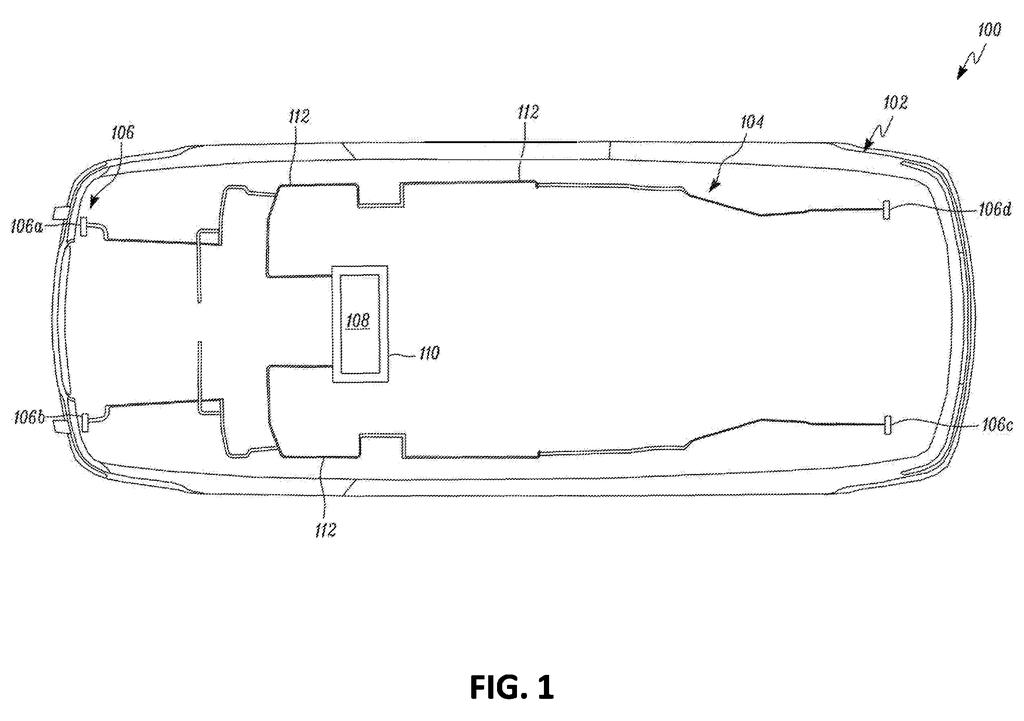
How Tesla's self-driving sensors shout over each other in a crisis
You're riding in a self-driving car, hands off the wheel, trusting dozens of sensors to keep you safe. Normally those sensors take turns sending their data to the car's central computer, one at a time, in an orderly schedule. That works fine until one sensor spots something urgent, like an obstacle appearing from nowhere, and has to wait its turn before warning the computer.
Tesla's patent fixes that by letting any sensor break from the normal schedule and transmit an emergency message right away, at a higher signal strength than usual. Think of it like a radio station cutting in with a breaking news bulletin instead of waiting for the top of the hour. The boosted power level makes the alert harder to miss, even if other signals are competing for attention on the same line.
The idea is to shave off the tiny delays that add up in a fast-moving emergency. Every fraction of a second the car's brain hears about a problem sooner is a fraction of a second earlier it can hit the brakes or steer away.
… transmit an AD emergency message on the TDM bus in a non-assigned time slot and at a second power level that exceeds the first power level.
Translation: Emergency signals interrupt normal traffic on the data bus by broadcasting at a much higher power level.
How the TDM bus and power boost work together
Tesla's design centers on a time division multiplexed (TDM) bus, which is essentially a shared communication highway inside the car. Sensors take turns using it: each one gets an assigned time slot to send its data to the central autonomous driving (AD) controller. Under normal conditions this is efficient, because the slots are small and the rotation is fast.
The new element is an emergency override. When a sensor detects what the patent calls an AD emergency event, it is allowed to transmit outside its assigned slot, in a non-assigned time slot. That message also goes out at a second, higher power level than the routine data stream, making it stand out on the shared bus.
The patent adds a finer detail: the emergency message can be placed in a specific sub-slot within the non-assigned time slot. That sub-slot structure suggests multiple sensors could potentially signal emergencies around the same moment without completely colliding, giving the system some order even in chaos.
- Routine sensor data: assigned slot, standard power
- Emergency alert: non-assigned slot, elevated power
- Sub-slot targeting: reduces collisions when multiple sensors raise alarms simultaneously
What faster in-car alerts mean for autonomous vehicle safety
Inside a self-driving car, the difference between a safe stop and a collision can come down to how fast the central computer learns about a hazard. A system where sensors must wait their turn, no matter what, has a built-in delay ceiling. This patent tries to remove that ceiling for the cases that matter most, letting critical information arrive ahead of schedule.
For passengers and regulators, the relevant question is how reliably an autonomous vehicle responds to sudden, unexpected events. Tesla's steady investment in autonomous system architecture suggests the company is treating the internal communication layer, not just the sensors or AI models, as a safety-critical variable worth patenting in detail.
That makes this Tesla's ninth filing we've tracked since May, joining earlier applications like one that reads road via suspension and one mimicking costly sensors cheaply, in our self-driving sensing race.
The design makes a deliberate bet: when a sensor detects danger, it breaks the orderly turn-taking of the communication system and broadcasts loudly over everyone else. The cost is that if two sensors spot the same emergency simultaneously, their overlapping shouts can garble the message rather than clarify it.
Tesla's answer is to give each sensor its own reserved fraction of a crisis moment to speak in, which limits the collision risk. Whether that solution holds depends entirely on how many sensors could reasonably panic at once, and the patent does not say.
The louder signal is a reasonable price to pay when danger is real, but a disruptive one when a sensor triggers falsely, briefly scrambling normal traffic across the whole system for nothing. That tradeoff reads as worth it for a safety-critical vehicle, where missing a genuine emergency carries consequences far heavier than a momentary blip in sensor communication.
There are more where this came from
We read every patent application Big Tech publishes and send you the ones worth knowing. Plain English, free, every week.
The drawings
16 drawing sheets from US 2026/0264609 A1 · click any drawing to enlarge


Want this weekly breakdown for a company we don't cover? Patentlyze Pro →