
Adobe Patents a Three-Step Process That Converts AI Music Into Full Two-Channel Audio
Most AI music tools hand you a flat, mono-sounding result and call it done. Adobe is patenting a pipeline that systematically upgrades generated audio from a rough sketch all the way to full, wide stereo sound.
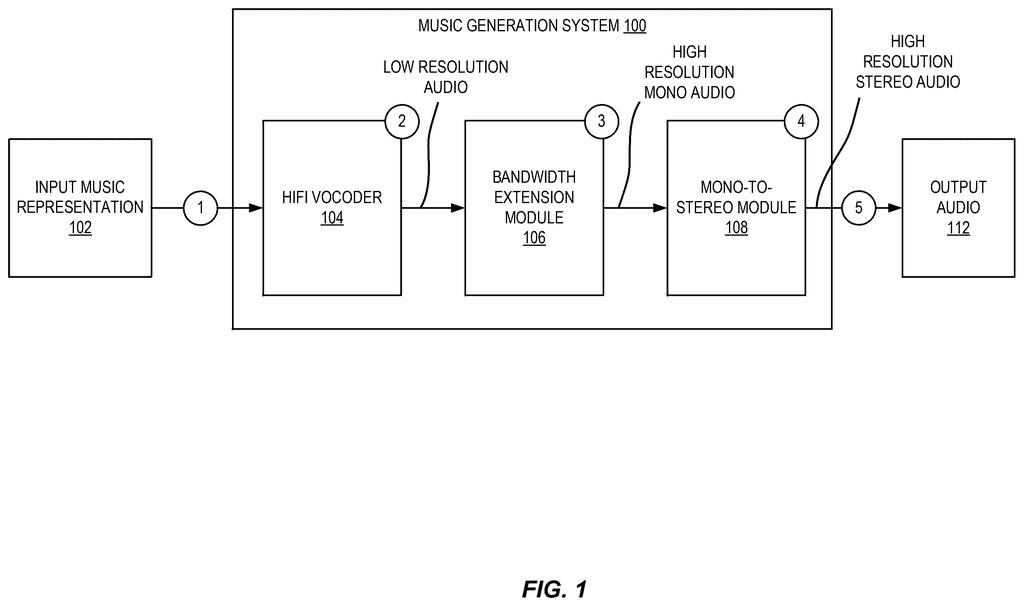
How Adobe's AI music tool builds stereo sound from scratch
You're listening to a song that was generated entirely by AI, and it sounds thin, like it's coming from a single speaker in the center of the room. That's a real limitation of many current AI music tools, and Adobe has filed a patent for a system designed to fix it.
The patent describes a three-stage process. First, an AI model called a vocoder takes a music "representation" (basically a compact description of the music) and turns it into a rough audio file. Then a second module fills in the missing high-frequency detail, the crispness you hear in cymbals or vocal consonants. Finally, a third module converts that detailed but single-channel audio into proper stereo, with sound spread across left and right channels.
The goal is music that doesn't just exist as audio, but actually sounds produced, with the depth and width listeners expect from real recordings.
… generating, by a bandwidth extension module, high-resolution monophonic audio data based on the low-resolution audio data and the music representation; …
Translation: The system adds clarity to create a single-channel high-quality track.
Inside the vocoder, bandwidth extension, and stereo stages
The patent describes a modular audio generation pipeline with three discrete stages, each handling a specific quality problem.
Stage 1, Vocoder: A high-fidelity vocoder takes a music representation (a structured, compressed encoding of musical content, think of it as a blueprint) and generates an initial audio waveform. This output is described as "low-resolution," meaning it's intelligible but lacks fine detail.
Stage 2, Bandwidth Extension: A separate module takes that low-resolution audio and the original music representation together, then reconstructs the high-frequency content that was absent. This step is called bandwidth extension, a technique that infers and synthesizes the upper frequency range (above roughly 8 kHz) that gives audio its clarity and air. Using both the original representation and the low-res audio gives the module more information to work with than the audio alone would provide.
Stage 3, Mono-to-Stereo: The final module converts high-resolution single-channel (monophonic) audio into stereophonic audio, creating distinct left and right channels. The patent does not specify a particular stereo-widening algorithm, framing this as a dedicated module within the pipeline.
The modular design means each stage can, in principle, be trained or improved independently.
A mono-to-stereo module generates high-resolution stereophonic audio data based on the high-resolution monophonic audio data.
Translation: A final module splits the single audio track into a two-speaker stereo sound.
What this means for AI-generated music quality
AI-generated music has a well-known quality ceiling: outputs often sound flat or muffled compared to professionally produced tracks. Adobe's approach attacks that ceiling in layers rather than trying to solve everything in one model, which generally produces cleaner results at each stage.
For anyone using Adobe's creative tools, like Adobe Firefly or audio features inside Premiere and Audition, this kind of pipeline would matter the moment AI music generation becomes part of the workflow. If the system works as described, you'd get stereo audio you could drop into a video project without spending time manually widening or sweetening it afterward.
This is the 16th Adobe filing in our Enterprise AI coverage since May, adding to work like one that fixes glass reflections and one that debugs its own code.
The modular design here is a real engineering choice with a real cost: three separate models mean three points of failure, three sets of training data to manage, and latency that compounds at each stage. A single end-to-end model trained to output high-resolution stereo directly might, in theory, learn the relationships between all three tasks simultaneously. Adobe is betting that the cleaner results from specialization outweigh the overhead.
That bet is defensible. Bandwidth extension and mono-to-stereo conversion are both well-studied problems with dedicated research behind them, so plugging proven modules into a pipeline makes more sense than retraining a giant model to handle everything at once.
The part worth scrutinizing is the mono-to-stereo stage. Stereo "widening" can easily produce audio that sounds artificially spread or phase-incoherent, particularly on headphones. The patent doesn't describe how that module actually places sound in the stereo field, which is where the quality of the final output will ultimately be decided.
There are more where this came from
We read every patent application Big Tech publishes and send you the ones worth knowing. Plain English, free, every week.
The drawings
9 drawing sheets from US 2026/0279319 A1 · click any drawing to enlarge


Want this weekly breakdown for a company we don't cover? Patentlyze Pro →