
Adobe Patents an AI That Scores How Well a Video Edit Flows
Adobe has filed a patent for a machine learning system that watches a sequence of video clips and hands back a single number telling editors how well the whole edit hangs together. The goal is to automate a judgment call that currently lives entirely inside a human editor's gut.
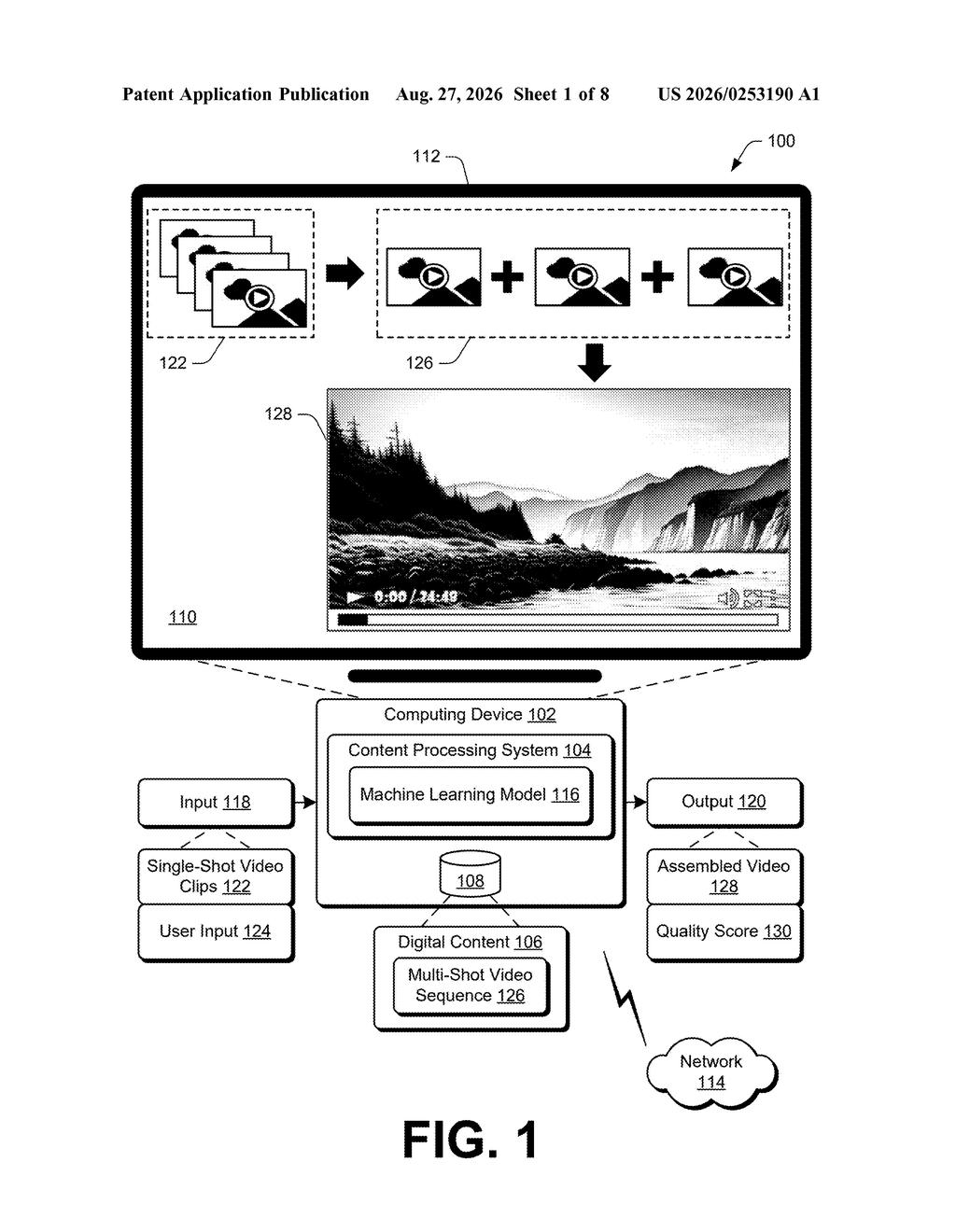
What Adobe's automatic video-edit scorer actually does
A film student spends three hours cutting together a highlight reel, then shows it to a professor who says the pacing feels off in the middle. That feedback is real, but it arrives late and costs time.
Adobe's patent describes a system that could deliver that kind of judgment automatically, before any human watches. You feed it a set of individual video clips, the AI analyzes each one, then figures out how the clips work together as a sequence, and spits out a score measuring how well the whole assembly flows.
The score isn't a vague thumbs-up. It's a learned quality score, meaning the model was trained on examples of good and bad edits until it could predict what a skilled editor would think. The idea is to give video creators a fast, cheap first opinion on whether their clip order makes sense, before investing time in polishing a cut that doesn't hold together.
… determining, by the processing device, a learned quality score of a multi-shot video sequence assembled from the single-shot video clips by processing the video representation through a regression layer of the machine learning model …
Translation: The software uses a machine learning layer to calculate a numerical grade for how well your video clips fit together.
How the model turns raw clips into a single quality score
The system takes a set of individual, single-shot video clips and runs each one through a machine learning model that converts each clip into an embedding (a compact list of numbers that captures the clip's visual and motion content, the way a fingerprint captures a person's identity without storing a full photo).
Those per-clip embeddings are then combined into a single video representation that reflects the sequence as a whole, not just its parts in isolation. This is where the model reasons about how clips relate to each other: does the mood match across cuts? Does the pacing make sense?
Finally, that combined representation passes through a regression layer (a mathematical stage that converts the model's internal state into a single continuous number rather than a yes/no answer). The output is the learned quality score.
The key design choice is that the model is trained end-to-end, meaning the scoring behavior is learned from data rather than hand-coded with rules like "cuts over three seconds are bad." That lets it pick up on subtler patterns a fixed rule set would miss, though it also means the model is only as good as the training data used to teach it.
Techniques for learning based assessment of clip assemblies for multi-shot videos are described. In an example, a processing device is operable to receive a plurality of single-shot video clips and generate embeddings of each of the single-shot video clips using a machine learning model.
Translation: The system analyzes individual video clips by converting them into mathematical data points that the computer can understand.
What this means for AI-assisted video editing tools
For everyday video creators, this kind of automated scoring could show up in tools like Adobe Premiere or Express as a background check that flags awkward edits before export. Professionals might use it to quickly test multiple assembly options without watching every version themselves.
Adobe has been steadily building AI into its creative suite, and this patent fits that direction: offloading the repetitive evaluation work so editors can focus on creative decisions. Video-editing AI is one of the more active areas among the latest Big Tech patents, and Adobe's angle here is specifically about judgment quality rather than just automation speed.
This is the 24th Adobe filing we've tracked since May in AI photo editing, following work like double color check fill and multi-level object cutout.
The core tradeoff here is that the system replaces a human opinion with a model trained on past human opinions. That's fine when those past opinions are consistent and well-labeled, but editorial judgment about video pacing is notoriously personal. What scores a 9 for one editor might score a 6 for another, and training data that reflects only a narrow slice of editing styles could produce a scorer that confidently rewards conventional cuts and penalizes anything experimental.
The regression approach also collapses the entire assembly into one number, which makes the score easy to compare but strips away detail. A low score tells you the edit is off somewhere; it doesn't tell you whether the problem is the opening cut, the middle transition, or the final shot. That limits how useful the score is as a diagnostic tool versus a simple pass/fail gate.
Still, the filing is a real bet on a problem that matters. Teaching a model to evaluate sequences, not just individual clips, is harder than it sounds, and getting that working well would save genuine time in high-volume production environments like social media or ad agencies. Whether the training data is good enough to make the score trustworthy in practice is the question the patent can't answer.
Get our take in your Top Stories
Liked this breakdown? Add Patentlyze as a preferred source on Google, and our plain-English take shows up more often in your Top Stories the next time Adobe patent news breaks.
There are more where this came from
We read every patent application Big Tech publishes and send you the ones worth knowing. Plain English, free, every week.
The drawings
8 drawing sheets from US 2026/0253190 A1 · click any drawing to enlarge


Want this weekly breakdown for a company we don't cover? Patentlyze Pro →
Be the first to weigh in