
Red Hat Patents a Method to Lock AI Responses Inside Secure Isolated Environments
When an AI model hands back an answer, that answer has to travel somewhere, and Red Hat wants to control exactly what kind of secure box it travels in.
What Red Hat's AI response packaging actually does
Ever tried to share a sensitive document and wondered whether email was really the right channel? Red Hat's patent tackles a version of that problem for AI systems. When a program asks an AI model a question, the model's answer has to get back to whoever asked, and that trip can be a security weak spot.
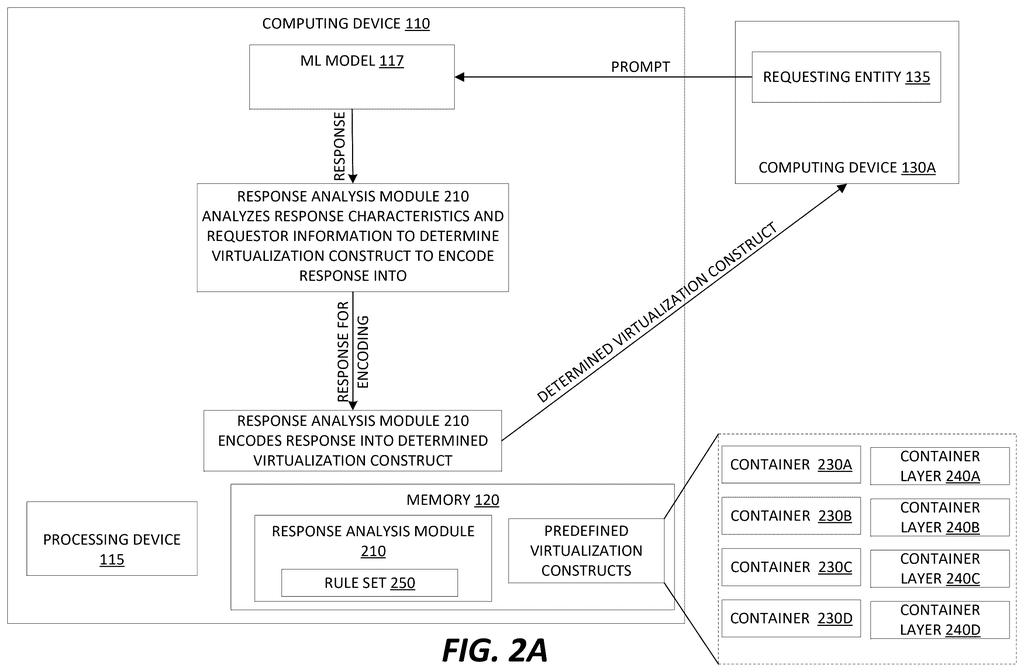
Red Hat's idea is to wrap the AI's response in a virtualization construct (think of it as a sealed digital container, like a lightweight virtual machine or a sandboxed environment) before sending it anywhere. The system looks at the response, figures out what kind of container is the right fit based on a set of rules, then delivers the whole package to the requester.
The goal is to make sure the response can't be tampered with or intercepted in transit, and that whoever receives it only gets it in a form that's appropriate for them. It's a security handshake baked into the delivery step itself.
… analyzing, by a processing device, the response to determine a virtualization construct to embed the response into; embedding the response in the virtualization construct …
Translation: The system studies the AI's answer and places it inside a secure digital container before sending it out.
How the system picks the right virtual container for each answer
The patent describes a pipeline with four steps. First, something (a program, a service, a user) sends a prompt to an ML model. The model generates a response. So far, that's standard AI plumbing.
The new part is what happens next. A processing layer analyzes the response to decide which virtualization construct to use. A virtualization construct here means an isolated compute environment, could be a container (a lightweight, self-contained software package), a virtual machine (a simulated computer running inside a real one), or something similar. The choice is driven by a ruleset that weighs characteristics of the response itself and information about who or what is asking for it.
Once the right container type is chosen, the response is embedded inside it. The requester then receives the container, not a raw text payload. The container acts as both a delivery vehicle and a security envelope.
- Prompt received from a requesting entity
- ML model generates a response
- Ruleset analyzes response and requester profile to pick a container type
- Response is embedded in that container and sent
A set of rules for determining a virtualization construct may be used to analyze response characteristics and requesting entity information to determine the virtualization construct to embed the response into.
Translation: Specific guidelines examine the nature of the answer and who asked for it to pick the right security bubble.
What this means for businesses running AI on shared infrastructure
For companies running AI on shared or cloud infrastructure, the gap between generating an answer and delivering it securely is a real operational headache. If different teams, clients, or applications are all querying the same model, you need some guarantee that each response ends up in the right hands in the right form. Red Hat's approach bakes that control into the delivery layer rather than leaving it to the application developer to sort out.
Red Hat's steady investment in enterprise AI infrastructure is visible here. This isn't a consumer product play, it's aimed squarely at the enterprise and cloud operators who run OpenShift, Kubernetes clusters, and other containerized workloads. If this approach gets adopted, it could push AI response handling toward a more standardized, auditable delivery model.
This is the 47th IBM filing we've tracked since May in the AI safety guardrails race, building on earlier work like spotting scams in calls and messages and showing which pixels guided an AI.
Claim 1 covers any method that takes an AI model's response, analyzes it to choose a secure delivery wrapper, embeds the response inside that wrapper, and sends it to whoever asked. The claim places no limits on which AI model, which wrapper technology, or what the rules for choosing a wrapper look like. That is a very wide perimeter.
In practice, any enterprise software that routes AI-generated answers through secured, isolated environments before delivery could fall inside that perimeter. The ruleset driving the wrapper choice is defined only as "a set of rules," which means nearly any decision logic qualifies.
The filing's strength and its vulnerability are the same thing: the core idea, pick a secure container based on what the AI said and who is asking, is simple enough to state in one sentence. That simplicity makes the claim powerful if granted, and easy to argue against during review.
There are more where this came from
We read every patent application Big Tech publishes and send you the ones worth knowing. Plain English, free, every week.
The drawings
7 drawing sheets from US 2026/0268208 A1 · click any drawing to enlarge


Want this weekly breakdown for a company we don't cover? Patentlyze Pro →