
Disney Patents a Self-Leveling Platform That Keeps Objects Flat on a Tilting Ride
Ever wished you could carry a drink, a camera, or a mobility aid onto a theme park ride without everything sliding around? Disney has filed a patent for a platform built into ride vehicles that automatically stays flat, even as the vehicle tilts and rocks.
What Disney's self-leveling ride tray actually does
You're seated in a theme park ride vehicle, the kind that sways or tilts as it moves through water or over a track. You've got something resting on a surface in front of you, maybe a cup, a bag, or a piece of assistive equipment, and it keeps sliding as the car lurches through turns and dips.
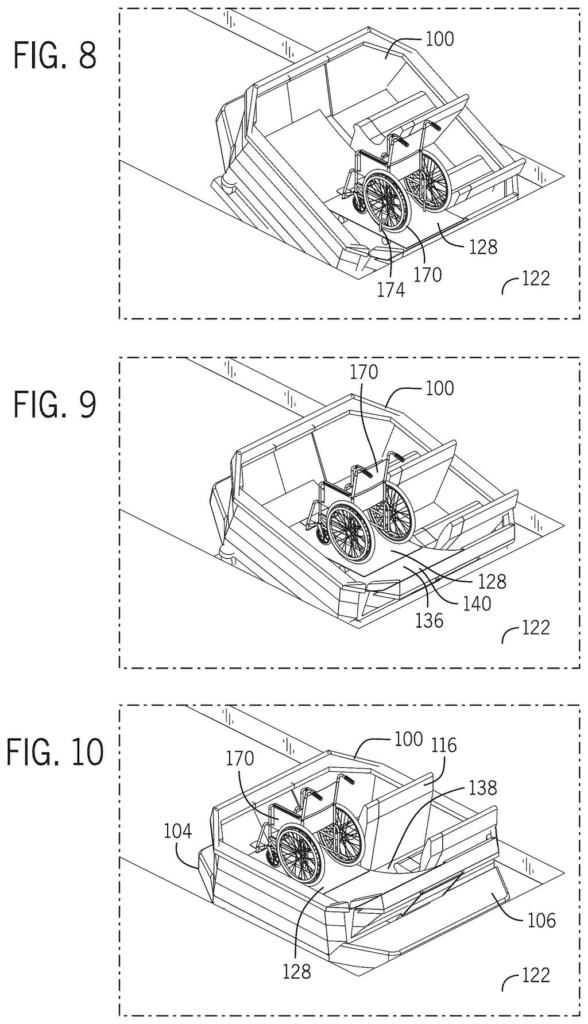
Disney's new patent describes a built-in platform that solves this by moving in the opposite direction of the vehicle. When the ride tilts left, the platform adjusts right, keeping whatever is on it level relative to the ground or water below. Think of it like a ship's gyroscopic table that keeps a candle from tipping over during rough seas, just scaled down for a theme park ride car.
The patent doesn't name a specific ride or product, but the language covers both water-based and land-based vehicles, so the idea could apply broadly. The filing specifically mentions transporting an object in a flat orientation, language that leaves room for assistive devices, food and drink, or guest belongings.
… move in response to a tilting motion of the ride vehicle to transport the object on the moveable platform in a flat orientation with respect to a water or ground surface.
Translation: The platform shifts as the ride tilts so items stay level with the ground.
How the platform counters the ride vehicle's tilt
The core invention is a movable platform mounted inside a ride vehicle. The platform is mechanically or electronically linked to the vehicle's own motion, so that when the vehicle tilts or rocks, the platform compensates by tilting in the opposite direction.
The patent describes two related versions:
- Motion-reactive platform: The platform responds directly to a tilting motion of the ride vehicle, adjusting its angle to stay flat relative to the ground or water surface beneath.
- Load surface variant: The platform is described as a load surface configured to receive an object, and it continuously corrects its angle as the vehicle moves, not just during sharp tilts but throughout the ride's motion profile.
The reference to both water and ground surfaces suggests the mechanism is designed to work in boat-style rides (which rock on water currents) as well as wheeled or tracked vehicles (which tilt through turns and over terrain). The claim is broad enough that the platform could be actuated mechanically through linkages that passively follow gravity, or actively through sensors and small motors, though the patent doesn't lock in a single method.
The inventor, Kristopher M. Laffin, filed this with Disney Enterprises in March 2025. The USPC classification (414/467) covers loading and unloading mechanisms, which situates this more as a material-handling invention than a pure safety device.
What this means for theme park accessibility and comfort
For theme parks, this kind of feature has two obvious audiences. The first is guests who want to carry something fragile or spillable through a ride without a struggle. The second, and arguably more important, is guests who use assistive devices. If a wheelchair, a medical bag, or an adaptive piece of equipment can sit on a stable platform during a ride, that opens experiences to people who might otherwise have to leave their equipment behind.
Disney has been filing around accessible and inclusive ride design for some time now, and this filing fits that pattern. The tradeoff is mechanical complexity: any system that moves counter to the vehicle adds weight, potential failure points, and maintenance overhead. Whether that cost is acceptable depends entirely on how the platform is actuated and how reliable it proves over thousands of ride cycles.
That makes this the second camera patent from Disney we've tracked since July, following one on smart shot timing.
Adding a moving platform to cancel out the ride's own movement is a reasonable idea that contains its own problem: you've introduced a new mechanical part that has to work correctly every single time, across hundreds of ride cycles per day, for years. That's a real cost, and in a theme park environment, moving parts fail.
The accessibility argument makes that cost look worth paying. Guests who can't simply grip a handlebar and brace have historically had fewer options, and a surface that stays level while the vehicle tilts around it is a practical, physical answer to a real limitation, not a workaround.
The remaining design question is calibration. A platform that over-corrects or moves too visibly could create its own discomfort, so the engineering has to be subtle enough that the compensation feels like stillness rather than a second motion layered on top of the first.
There are more where this came from
We read every patent application Big Tech publishes and send you the ones worth knowing. Plain English, free, every week.
The drawings
5 drawing sheets from US 2026/0272736 A1 · click any drawing to enlarge


Want this weekly breakdown for a company we don't cover? Patentlyze Pro →
Be the first to weigh in