
Nvidia Patents Technology to Reuse How Light Bounces Are Calculated Across 3D Scenes
Rendering realistic light in a 3D scene means simulating millions of individual rays bouncing off surfaces, and doing that math fresh for every pixel on every frame is brutally expensive. Nvidia's new patent describes a smarter bookkeeping system: nearby rays share the lighting work they've already done.
How Nvidia's shared lighting cache actually works
Imagine you're watching a video game where sunlight pours through a window and bounces around a room in real time. Every beam of light has to be calculated, traced as it ricochets off walls, floors, and furniture. That's called path tracing, and it produces stunning visuals, but it also demands an enormous amount of computation for every single frame.
Nvidia's patent tackles this by letting nearby light rays share their results. Instead of each ray doing the full lighting calculation on its own, rays that hit roughly the same spot can look up what a neighboring ray already figured out and use that answer instead. The shared results are stored in small regional buckets tied to specific areas of the scene, and those buckets can carry over information from one frame to the next.
The practical goal is to cut redundant work without making the image look blurry or wrong. If the system over-shares, you get smeared, mushy lighting. Nvidia's approach tries to find the right balance by carefully controlling which rays are similar enough to share data.
selecting, based at least on at least one characteristic of a first ray interaction in a virtual environment, a cache from a plurality of caches that correspond to a location of the first ray interaction and respective spatial regions in the virtual environment; …
Translation: The system picks a specific memory cache to store light data based on where a light ray hits an object.
How the cache selects, stores, and replays lighting data
Path tracing works by firing rays from the camera into a scene, bouncing them off surfaces (called interactions or bounces), and computing how much light reaches each bounce point. Each bounce can spawn additional secondary rays. The problem: adjacent bounces often land in nearly identical spots and would compute nearly identical lighting answers independently.
Nvidia's method introduces a set of shared caches, each tied to a spatial region of the virtual scene (mapped to a texel on a texture, meaning a tiny tile on the surface of an object). When a ray hits a surface, the system looks at that hit's characteristics, such as its position and surface properties, and routes it to the matching cache for that region.
Lighting contributions are accumulated into the cache both spatially (from nearby hits in the same frame) and temporally (from previous frames), then combined into a single estimate of how much light is present at that location. A second ray hitting close by can simply read from that cache instead of running the full calculation again.
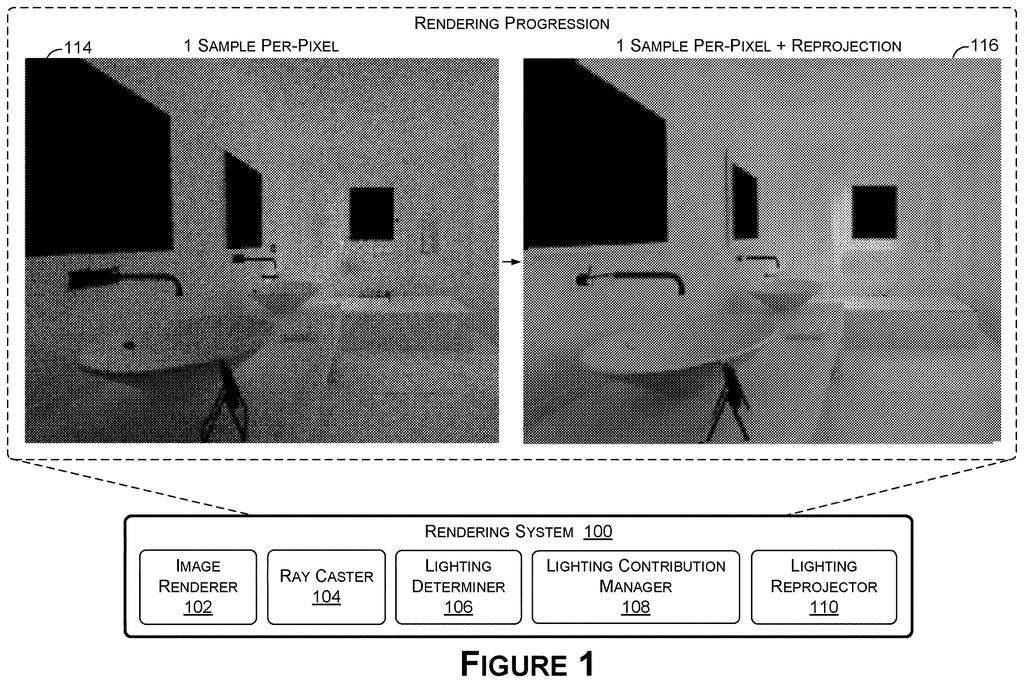
The patent also describes a reprojection step for secondary bounces: instead of blending lighting data only at the 3D surface, it projects the results back onto screen pixels. This helps share lighting data from deeper bounces while reducing the risk of over-blurring, where too much sharing smears detail across surfaces that shouldn't look similar.
Approaches are also provided for reprojecting lighting contributions of interactions to pixels to share lighting contribution data from secondary bounces of light transport paths while avoiding potential over blurring.
Translation: It reuses light bounce data across different pixels while preventing the image from becoming too blurry.
What this means for real-time ray tracing in games and tools
Path tracing is the gold standard for realistic lighting in games and visual-effects software, but it has historically required either enormous compute budgets or accepting noisy, grainy images at real-time frame rates. Techniques that cut the per-frame workload without degrading image quality are central to making path tracing practical on consumer hardware.
For you as a player or creator, this kind of approach is what sits behind features like ray reconstruction and similar noise-reduction tools in modern GPU drivers. Nvidia's track record in path-tracing patents shows a sustained focus on exactly this trade-off: keeping images clean while reducing the raw number of rays that have to be calculated. Whether this specific caching scheme makes it into a driver update or a future hardware feature is an open question, but the direction is clear.
Nvidia's 28th filing we've tracked since July in the GPU rendering race builds on earlier work covering how AI fills missing frames and slipping in extra frames mid-game.
This is a software-level technique, which means it doesn't require new GPU silicon to ship. The core idea, routing nearby rays to a shared cache and reusing the result, could in principle be implemented as a rendering algorithm update rather than a hardware redesign. That's a shorter path to product than most ray-tracing patents.
The harder part is the tuning. Cache-sharing schemes live or die by their similarity thresholds: too loose and you get blurry, incorrect lighting; too tight and you gain nothing. The patent acknowledges the reprojection step is specifically there to manage that blurring risk, which suggests this is the tricky engineering problem the inventors are actually solving, not the caching idea itself.
For a general reader, the honest assessment is that this is plumbing work inside a rendering pipeline. It won't produce a visible feature name on a spec sheet, but it's exactly the kind of incremental efficiency improvement that makes the difference between a path-traced game running at 30 fps and one running at 60.
There are more where this came from
We read every patent application Big Tech publishes and send you the ones worth knowing. Plain English, free, every week.
The drawings
10 drawing sheets from US 2026/0278915 A1 · click any drawing to enlarge


Want this weekly breakdown for a company we don't cover? Patentlyze Pro →
Be the first to weigh in