
Nvidia Patents a Way to Insert Extra Video Frames Without Touching Your Game
Nvidia's newest patent describes a system that steps in between your game and your display, generating extra frames the game never actually rendered, all without the game knowing it happened.
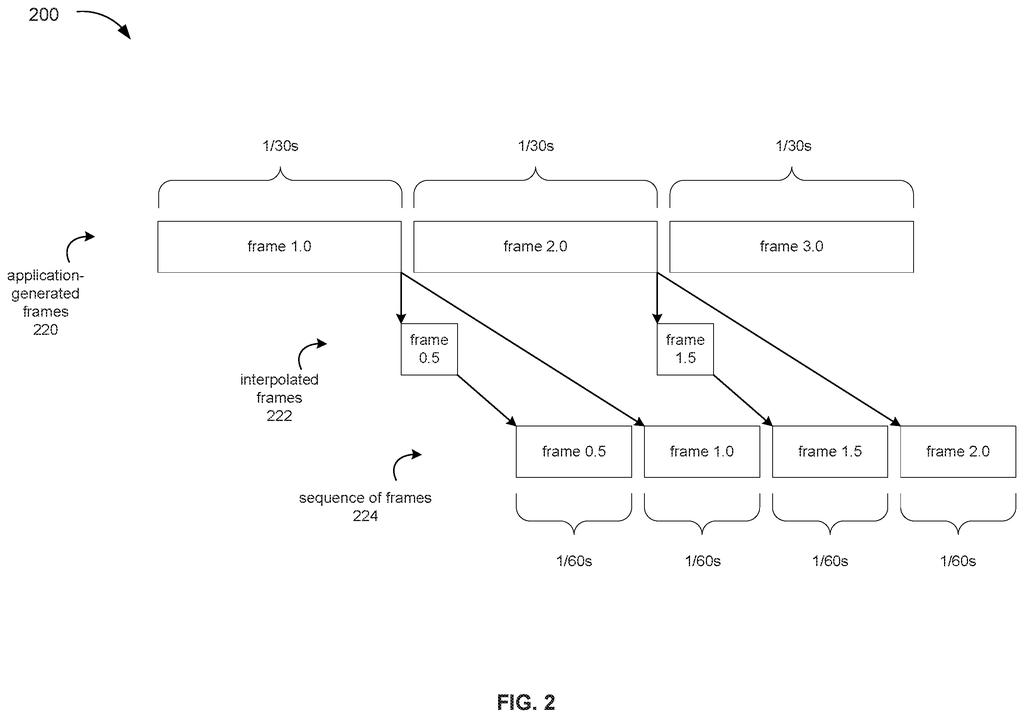
How Nvidia fills in the frames your GPU never drew
A video game renders a new image, sends it to the screen, renders another, sends it again. That cycle, repeated dozens of times per second, is what gives games their sense of motion. When your computer can only manage 40 or 50 of those images per second, movement starts to look uneven.
Nvidia's patent describes a system that intercepts the moment a game hands off a finished frame to the display pipeline. Before that frame ever reaches your screen, the system generates one or more extra frames using the real frame as a reference. Your display then shows the real frame and the generated ones together, so the motion looks far smoother than the game alone could produce.
The clever part is that the game itself never changes. It keeps doing exactly what it was doing. The interpolation happens in a layer the game can't even see, which means any game could potentially benefit without a patch or update from its developer.
circuitry that in response to one or more application programming interface (API) calls to output an application-generated frame is to: store the application-generated frame and one or more interpolated frames generated based at least on the application-generated frame in a first buffer …
Translation: The hardware intercepts game commands to save both the original image and new frames it creates to fill in the gaps.
How the API intercept and swap chain buffers work together
The patent centers on API interception, meaning the system listens for the specific software command (an application programming interface call) that a game sends when it is ready to display a finished frame. Instead of letting that command pass straight through, the system catches it first.
Once the real, application-generated frame is captured, the system produces interpolated frames, synthesized images that estimate what the scene would look like between two real frames. These are stored alongside the original in a first buffer (a temporary holding area in memory).
From there, both the real frame and the generated ones are fed into a swap chain buffer, the standard display pipeline mechanism that controls which image the monitor actually shows next. The display then cycles through all of them in order.
The result is that the display receives frames at a goal rate that is higher than what the game engine is actually producing. The game renders at, say, 45 frames per second; the display shows 90. The key architectural detail is that this entire process is invisible to the application itself, meaning no game-side code changes are required.
… an application programming interface call to output an application-generated frame of computer graphics is intercepted. One or more interpolated frames of computer graphics are generated based on the application-generated frames. The application-generated and interpolated frames are output in accordance with a goal rate.
Translation: The system catches game frames as they are sent to the screen and inserts extra images to hit a specific frame rate target.
What this means for smooth gameplay without faster hardware
Frame rate has a direct effect on how comfortable and responsive a game feels, and hitting high frame rates has always demanded expensive hardware. A system that multiplies effective frame rate at the driver or OS level, without asking anything of the game itself, shifts that equation. Players with mid-range GPUs could see smoother output on games that were never specifically optimized for this kind of boost.
The approach described here fits into a broader pattern of Nvidia doing heavy graphics work below the application layer, where it can apply to everything at once rather than one title at a time. Graphics-pipeline patents like this one are part of this week's Big Tech patents tracked across Nvidia, AMD, and their platform rivals as the industry pushes higher refresh rates into mainstream hardware.
Nvidia's 26th filing we've tracked since July in our GPU rendering race watch builds on earlier applications like hidden character geometry and the two-processor freeze fix.
Choppy frame rates cost players something real: immersion breaks, competitive disadvantage, and the simple frustration of hardware that can almost keep up but doesn't. Intercepting at the API layer means a single mechanism can lift frame rates across a vast library of applications without touching each game individually, which matches the scale of the problem rather than patching it one title at a time. The remaining question is whether interpolated frames hold up under fast motion and hard edges, because artifacts at those moments would undercut the very experience the approach is built to protect.
There are more where this came from
We read every patent application Big Tech publishes and send you the ones worth knowing. Plain English, free, every week.
The drawings
44 drawing sheets from US 2026/0245168 A1 · click any drawing to enlarge


Want this weekly breakdown for a company we don't cover? Patentlyze Pro →
Be the first to weigh in