
Nvidia Patents a Way for Self-Driving Cars to Map Their Own Blind Spots
Every self-driving car has blind spots, areas its sensors simply cannot see because something else is in the way. Nvidia's new patent describes a system that actively maps those invisible zones so a vehicle can factor them into every decision it makes.
How Nvidia's blind-spot mapping actually works for cars
Today's self-driving cars rely on cameras, radar, and lidar to build a picture of the road around them. The problem is that sensors can only see what isn't blocked. A parked truck, a dense hedge, or a blind intersection corner can hide a pedestrian or another car entirely, and the vehicle has no way to know what it's missing.
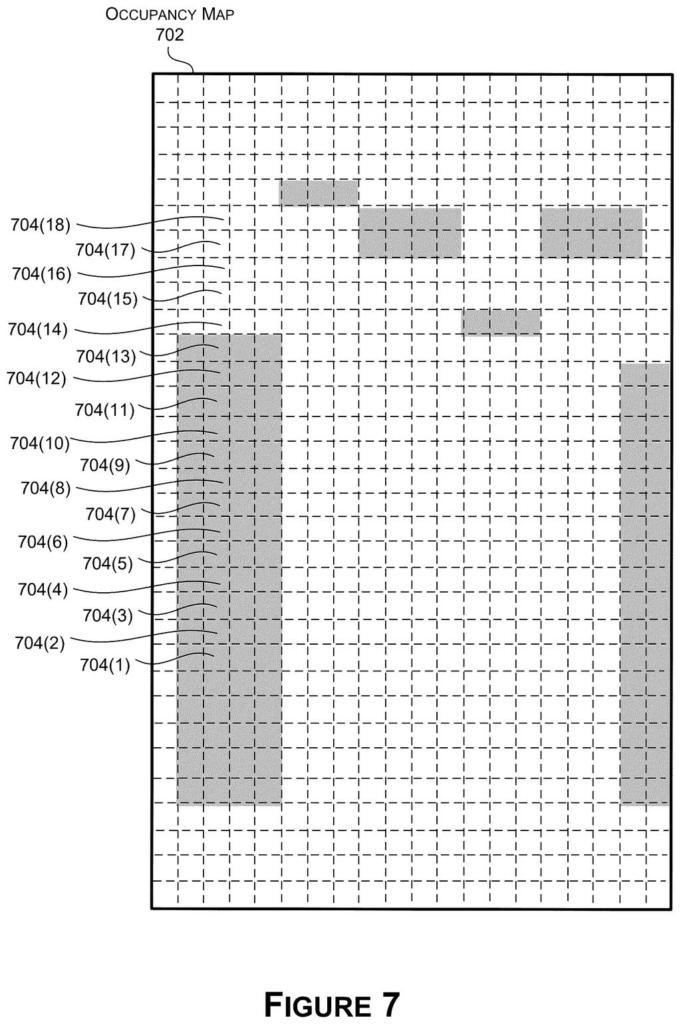
Nvidia's patent describes a method for turning that ignorance into actionable information. The system builds a map of the surrounding environment showing what spots are occupied and then fires virtual "rays" outward from the car's position, the same basic math used in video game graphics, to figure out which areas of the map are hidden behind obstacles.
The result is an occlusion map: a kind of shadow chart that tells the car's planning software not just where objects are, but where there might be objects that sensors cannot reach. That lets the vehicle slow down, steer more carefully, or flag a zone as uncertain when it needs to make a decision near a blind corner.
… determining a first length of a first ray that is projected from a starting point of the occupancy map to a test point of a test area associated with the occupancy map, the starting point of the occupancy map corresponding to a location of the machine within the environment …
Translation: The system measures how far a theoretical line reaches from the vehicle to a specific spot in the area.
How ray tracing finds the gaps in a car's sensor picture
The patent describes a pipeline that starts with fused sensor data, combining camera images with radar returns to build a three-dimensional occupancy map of the environment. An occupancy map is essentially a grid where each cell is labeled "occupied," "empty," or "unknown" based on what sensors have detected.
From the vehicle's own position on that map, the system projects rays (straight lines, calculated mathematically) toward every cell it wants to evaluate. The key comparison is simple: if the distance from the car to a candidate cell is longer than the distance to the nearest obstacle along the same ray, the candidate cell is occluded, meaning something is blocking the sensor's line of sight to it.
- Ray length comparison: the system measures the ray to a test point and compares it to rays pointing at known obstacles along the same direction.
- Occlusion map generation: cells that fail the comparison are flagged as hidden and compiled into a separate occlusion grid.
- Planning integration: the occlusion grid feeds directly into the vehicle's navigation and control stack, so planners know which zones carry hidden-risk uncertainty.
The method works in both 2D grid form (a flat overhead view) and full 3D, and the patent specifically calls out using radar alongside camera data to make the initial occupancy map more reliable in low-visibility conditions.
What this means for self-driving safety decisions
For passengers and pedestrians alike, the danger in autonomous driving is rarely what the car can see. It's what it can't see. A vehicle that knows it has a blind spot can behave conservatively around it. One that doesn't know may proceed as if the area is clear.
This system gives the planning software a formal, structured way to treat uncertainty as a first-class input, not an afterthought. Nvidia has been filing around autonomous-vehicle perception since at least 2020 That has a direct effect on how the car handles everyday high-risk situations like pulling out of a parking garage, crossing a busy intersection with poor sightlines, or merging in heavy traffic.
Nvidia's 63rd filing we've tracked since May in the self-driving sensing race adds to a run that includes one on building training worlds and one on blind-spot vision.
The system described here runs entirely on sensors most self-driving cars already carry: cameras and radar. No new hardware, no retooling the vehicle. That makes the path from patent to shipping product unusually short, assuming the software can run fast enough to keep up with highway driving, which the document does not address.
What the patent actually does is give the car a way to flag the blank spots in its view, the areas behind buildings or parked trucks where something dangerous might be hiding. That output feeds directly into the part of the software that decides how to drive, so it slots into existing systems rather than requiring a redesign.
For a company that sells the computers powering many of these vehicles, owning this method is a practical business move. If it works at speed, it could arrive as a quiet update to existing platforms rather than a splashy new product announcement.
There are more where this came from
We read every patent application Big Tech publishes and send you the ones worth knowing. Plain English, free, every week.
The drawings
27 drawing sheets from US 2026/0278914 A1 · click any drawing to enlarge


Want this weekly breakdown for a company we don't cover? Patentlyze Pro →