
Google Patents a Way to Keep AR Visuals Steady When You Move Your Head
Every augmented reality headset has the same annoying problem: when you move your head quickly, the virtual objects overlaid on the real world wobble, lag, or drift. Google just filed a patent for a system that uses motion-sensor data to fix that in real time.
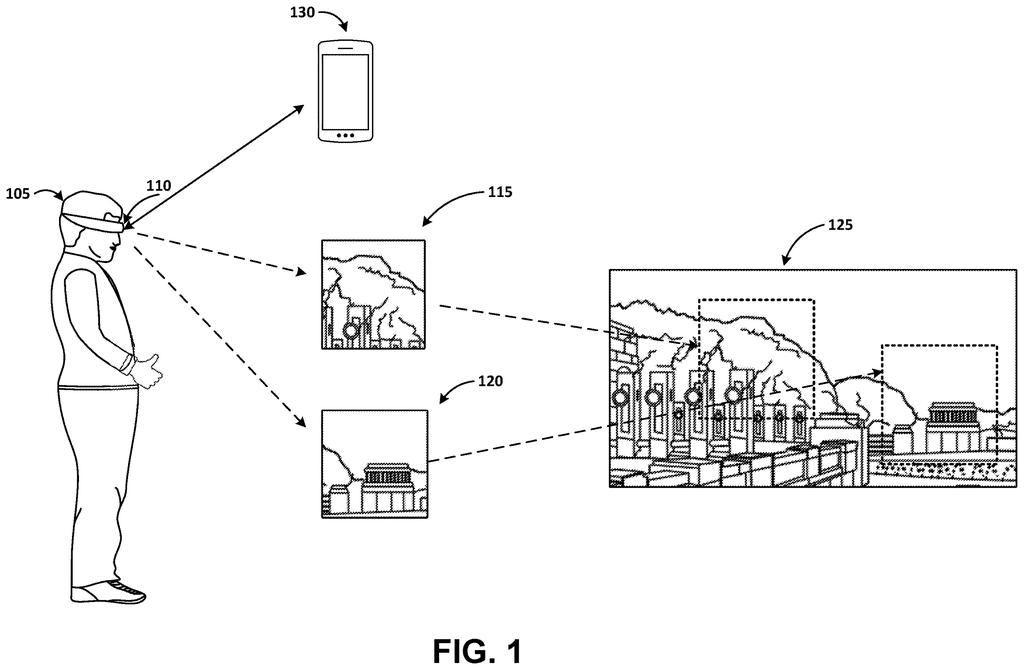
What Google's AR image stabilization actually does
Every time you move your head while wearing a mixed-reality headset, tiny vibrations and sudden jerks travel through the device. The camera captures all that shake, and any virtual objects anchored to the real world can appear to shiver or slide out of place.
Google's patent describes a system that reads data from the headset's built-in motion sensors (the same kind of accelerometers and gyroscopes in your phone) and builds a kind of invisible correction grid called a mesh. That mesh represents exactly how the device moved, and the system uses it to counteract the shake before the final image ever reaches your eyes.
The result is that both the real-world camera feed and the virtual graphics layered on top of it get stabilized together. You would see steadier, more believable AR overlays even if your hand is shaking or you're walking around.
generating a mesh using inertial data, the mesh representing movement associated with a device in at least a portion of a real-world environment; generating stabilized image data based on image data and the mesh; and generating stabilized virtual data based on the stabilized image data.
Translation: The system tracks your head movements to steady both the camera view and the augmented reality graphics.
How motion sensor data gets turned into a correction mesh
The patent describes a three-step pipeline. First, the system reads inertial data from the device's motion sensors (accelerometers and gyroscopes that measure how fast the device is moving and in which direction). That raw sensor data is used to generate a mesh, a mathematical grid that maps the physical movement of the device across at least part of the scene in front of it.
Second, that mesh is applied to the incoming camera image to produce stabilized image data. Think of it like digitally warping the raw camera frame so that the wobble is corrected before anything else happens.
Third, the system takes that already-stabilized camera image and uses it as the foundation for generating stabilized virtual data, meaning the AR graphics (text, 3D objects, UI panels) that sit on top of the real world. Because the virtual layer is built on top of an already-corrected image, the two stay aligned.
The key insight is that stabilizing the real and virtual layers together from a single motion measurement prevents the misalignment that causes AR objects to appear to drift or float independently of the scene.
What this means for Google's augmented reality push
For anyone who has tried a mixed-reality headset and found the experience headache-inducing, this is the kind of fix that makes or breaks the product. AR comfort depends heavily on virtual objects staying locked to real-world surfaces, and motion blur or drift is one of the fastest ways to break the illusion and cause nausea.
Google has been working on AR and mixed-reality hardware for years, and Google's interest in AR stabilization technology shows up repeatedly across its filings. A working, low-latency stabilization layer would be table stakes for any wearable that hopes to compete in the space. Whether this ends up in a future version of Google's headset hardware or feeds into a software stack for Android-based devices, the underlying problem it solves is real and unsolved at the level most consumers would find acceptable.
Google's 42nd filing we've tracked in our smart glasses display watchlist since May builds on work like cutting halo blur from 3D screens and pinning AR images to real world.
The core pieces this patent needs already live in every modern phone and headset: the motion sensors, the cameras, the processing power. This is a software problem, not a hardware shopping list, which makes the path to a real product unusually short.
The one thing the document cannot answer is whether Google has beaten the timing problem. Correcting a shaky image takes a tiny slice of time, and if that slice is even slightly too long, the correction itself can make a viewer feel worse than no correction at all.
A narrow, specific patent claim like this usually means someone has already built a working version and wants to protect exactly how they built it, which makes this feel like protection for real engineering rather than a placeholder for future ambitions.
There are more where this came from
We read every patent application Big Tech publishes and send you the ones worth knowing. Plain English, free, every week.
The drawings
11 drawing sheets from US 2026/0278950 A1 · click any drawing to enlarge


Want this weekly breakdown for a company we don't cover? Patentlyze Pro →
Be the first to weigh in