
Qualcomm Patents a System for Sending Different Picture Quality to Each Person in a Shared AR Scene
Two people sharing the same virtual space don't have to wear identical headsets. Qualcomm is patenting a way for one processor to feed each person's glasses exactly the picture quality their hardware can handle.
What Qualcomm's shared-AR quality trick actually does
A friend is wearing a high-end AR headset while you have a more basic pair. Both of you are looking at the same virtual object floating in the room. Today, shared AR systems often struggle here: they either cap the quality for everyone or send the same image to both headsets regardless of what each can actually show.
Qualcomm's patent describes a processor that first checks what each headset is capable of, then renders a separate picture for each person, tuned to that specific device. So your friend's expensive glasses get a crisp, detailed frame, while your headset gets a lighter version that it can display without stuttering.
The transmission step is key: the processor packages and sends both versions at the same time, letting two people share one extended reality (XR) experience without either device being dragged down by the other.
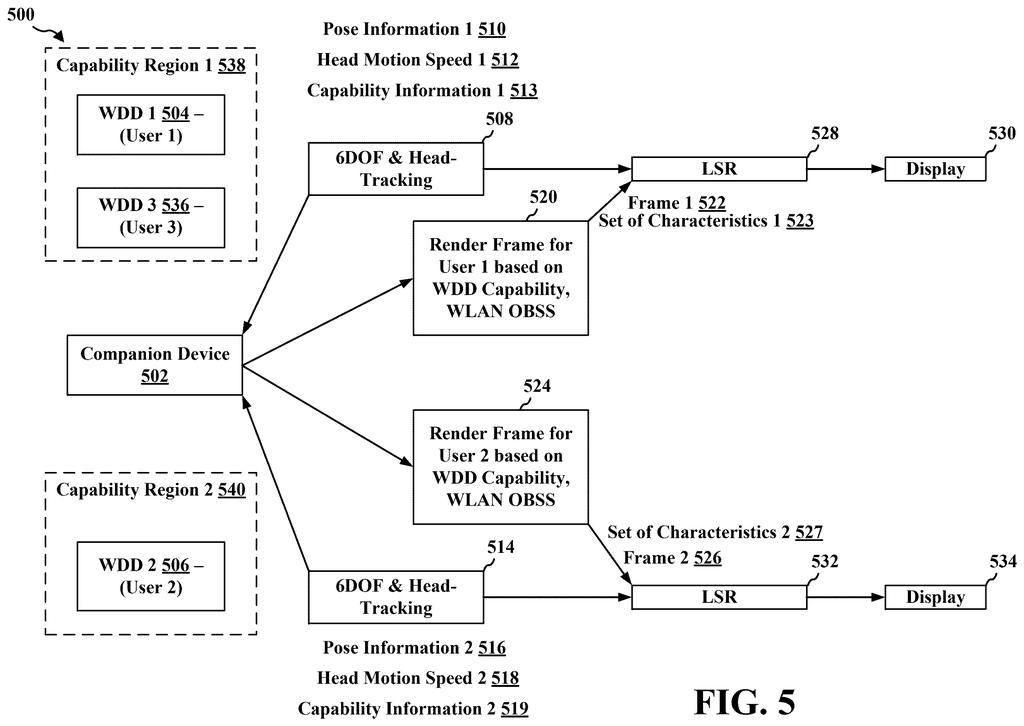
obtain first capability information for a first wearable display device and second capability information for a second wearable display device; render, based on the first capability information, a first frame for the first wearable display device; render, based on the second capability information, a second frame for the second wearable display device; …
Translation: The system checks what each headset can handle and builds a custom video frame for each user.
How the processor tailors each frame to each headset
The patent describes a central processor, likely sitting in a phone or a nearby compute device, that manages the rendering pipeline for multiple wearable displays simultaneously.
Here is the sequence the patent lays out:
- Capability discovery: The processor collects capability information from each headset. This could include screen resolution, refresh rate, available memory, or processing power.
- Per-device rendering: It generates a separate frame for each headset based on those specs. A higher-capability device gets a more detailed render; a lower-capability one gets a lighter version of the same scene.
- Simultaneous transmission: Both rendered frames are sent out to their respective devices at the same time.
The term split XR in the patent title refers to a setup where the heavy rendering work is handled off the headset, usually by a connected phone or edge computer, and the display is just a thin client showing what it receives. By knowing each headset's limits before rendering, the system avoids wasting compute on detail a device cannot show, and avoids under-serving a device that could handle more.
This disclosure provides systems, devices, apparatus, and methods, including computer programs encoded on storage media, for rendering multi-level image quality in multi-user split XR systems.
Translation: Qualcomm patented a method for adjusting graphics quality for multiple people sharing an augmented reality space.
What this means for mixed-reality group experiences
For AR and mixed reality to work as a genuinely shared experience, the hardware everyone brings to the table will never be identical. A system that can tailor output to each person's device, without one person's cheaper headset pulling down the experience for everyone else, is a real step toward making group XR practical rather than a controlled demo.
This also has an obvious relevance to Qualcomm's business: the company makes the chips inside many AR and VR headsets. A patented rendering architecture that requires a Qualcomm-powered central processor to coordinate multi-device sessions gives the company a potential role at the center of any multi-user XR deployment, whether that ends up being consumer entertainment or enterprise training.
Qualcomm's 42nd filing we've tracked since July in our AR glasses race watchlist follows their earlier work on radio-signal AR maps and shifting AR labels aside.
The patent describes software logic running on a shared processor that tailors image quality separately for each person wearing a display in the same session. No new physical hardware is required, which shortens the road to a product considerably.
What the document does not address is how the system learns what each headset can handle, how it keeps both streams in sync without noticeable delay, or what happens when a headset's settings change mid-session. Those gaps are not minor footnotes; they are the parts that determine whether this works in a living room or only in a controlled lab.
The shortest path to a real product runs through solving those coordination problems first, then layering this rendering logic on top. As written, this is a credible piece of a larger system that does not yet fully exist.
There are more where this came from
We read every patent application Big Tech publishes and send you the ones worth knowing. Plain English, free, every week.
The drawings
8 drawing sheets from US 2026/0277522 A1 · click any drawing to enlarge


Want this weekly breakdown for a company we don't cover? Patentlyze Pro →