
Qualcomm Patents a System That Blends Digital Images Into Real-World Lighting
Virtual objects in AR have a habit of looking pasted-on, because they don't react to the actual lighting and textures around them. Qualcomm's latest patent describes a system that reads the real world and adjusts digital content to fit.
What Qualcomm's AR visual-matching system actually does
Ever noticed how a 3D sticker placed over a video looks obviously fake, even when the object itself is well-made? The problem is usually that the digital thing doesn't respond to the light, shadows, and surface textures of the real scene around it.
Qualcomm's patent tackles this by having a device scan the environment in real time, measuring things like brightness, color, and surface detail. It then measures those same qualities in whatever virtual content is being displayed, compares the two, and adjusts the virtual content so it fits in better.
The result is supposed to be AR overlays that feel more like they belong in the space you're looking at, whether that's a living room, a street corner, or a factory floor. Qualcomm's run of AR and XR chip filings suggests this is part of a broader push to make mixed-reality hardware feel credible at the chip level.
process a first measure of a first sensor data representation of an environment to determine a first plurality of characteristics associated with the environment based on at least one of a gradient magnitude, texture, luminance, or color of the environment; …
Translation: The system analyzes real-world lighting, colors, and textures from camera sensors.
How the system compares real scenes to virtual objects
The system works in two parallel tracks. First, it reads a sensor data representation of the environment, which is essentially what the device's cameras or depth sensors see, and extracts a set of characteristics from it.
Those characteristics include:
- Gradient magnitude (how sharply edges and boundaries change in the image, a proxy for surface detail and sharpness)
- Texture (the pattern and roughness of surfaces)
- Luminance (how bright or dark areas are)
- Color (the hue and saturation of the scene)
At the same time, the processor extracts the same four measurements from the virtual content about to be rendered. It then compares the two sets of numbers and uses the gap between them to decide what adjustments to make, producing what the patent calls updated virtual content.
The claim doesn't specify exactly how the adjustment is applied, which keeps the patent broad. It could mean changing brightness, softening edges, shifting color temperature, or some combination, depending on what the comparison shows.
… compare the first measure of the first sensor data representation and the second measure of the characteristics of the virtual content; and adjust the virtual content based on the comparison …
Translation: It matches digital objects to real-world lighting so they blend in naturally.
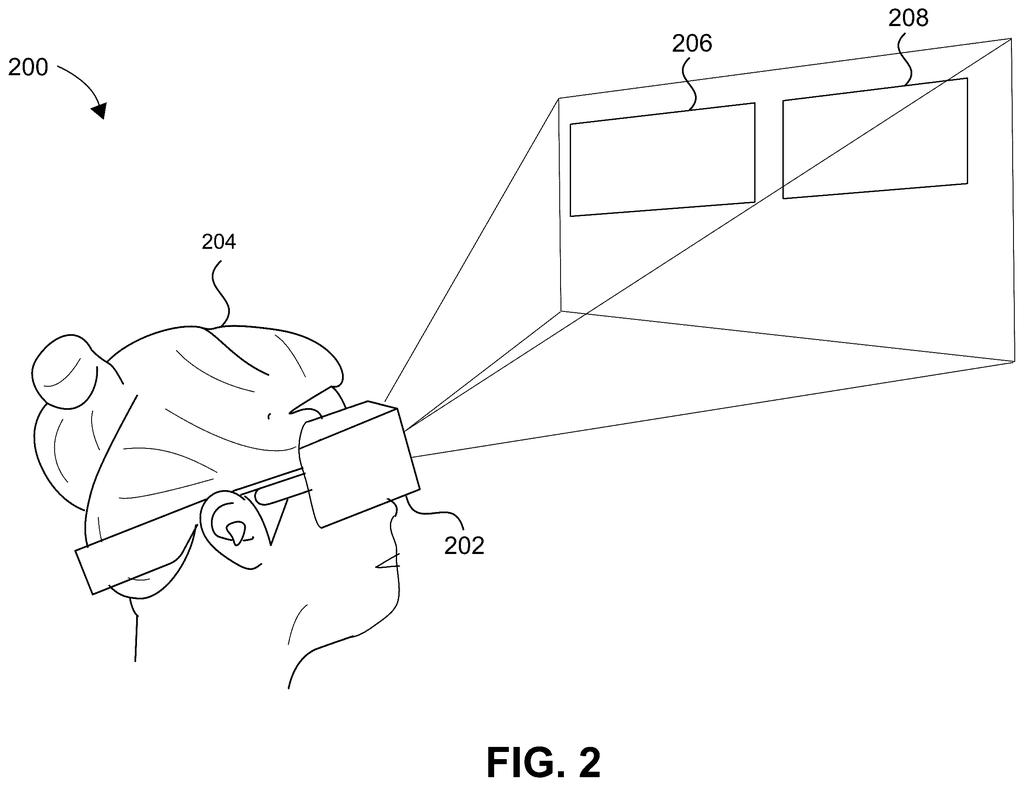
What this means for AR glasses and mixed-reality headsets
For AR glasses and mixed-reality headsets, the biggest barrier to everyday use isn't display resolution or battery life; it's the credibility gap between digital and physical. A virtual object that looks washed out under bright sunlight, or too sharp against a blurry background, immediately breaks the illusion. A chip-level system that corrects for this automatically, without relying on the app developer to do it manually, would make AR feel much less effortful.
Qualcomm's run of AR and XR chip filings points to a strategy where the Snapdragon processor family handles perception tasks that used to require separate software layers. If this approach works in practice, it shifts the burden of visual quality from the developer to the hardware platform itself.
Qualcomm's 33rd filing we've tracked since July in the AR glasses race builds on earlier ideas, including widening the field of view and auto-labeling 3D models.
Blending virtual graphics into a real scene by measuring only four things (brightness, color, texture, and edge sharpness) is a fast, lightweight approach that can run on an ordinary phone, but speed comes at a price.
The price is complex lighting. A room with a warm lamp on one side and cool daylight on the other, or a material like skin that absorbs and scatters light in layered ways, will still look wrong even when all four measurements match perfectly. Those are precisely the situations where virtual graphics look most fake today, and this design leaves them unsolved.
That said, reaching millions of everyday devices with even basic visual matching built in is a real and meaningful step. The tradeoff reads as reasonable for ordinary use, though the harder question of whether it makes AR feel believable in a real living room is one this approach sets aside.
Get our take in your Top Stories
Liked this breakdown? Add Patentlyze as a preferred source on Google, and our plain-English take shows up more often in your Top Stories the next time Qualcomm patent news breaks.
There are more where this came from
We read every patent application Big Tech publishes and send you the ones worth knowing. Plain English, free, every week.
The drawings
8 drawing sheets from US 2026/0260439 A1 · click any drawing to enlarge


Want this weekly breakdown for a company we don't cover? Patentlyze Pro →
Be the first to weigh in