
Sony Patents Shutter Glasses That Add a Private Layer to Massive Public Screens
Sony has filed a patent for glasses that can read a giant stadium screen and slip a personal layer of augmented content on top of it, visible only to the person wearing them.
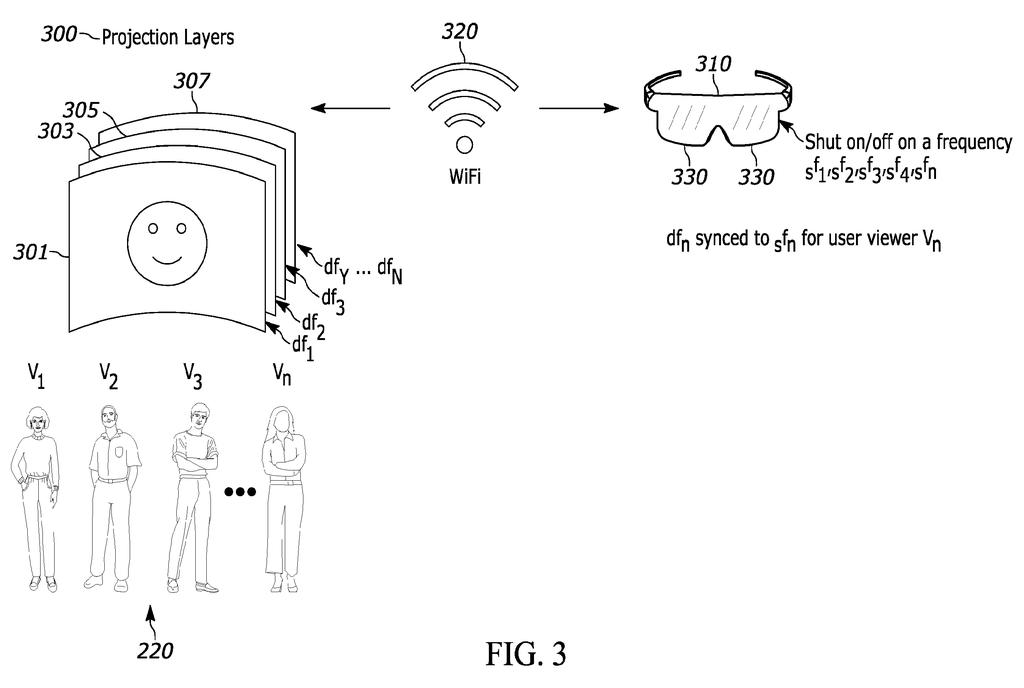
What Sony's shutter-glasses trick actually does for you
Ever watched a massive screen at a concert or sports arena and wished you could see something nobody else could? That is roughly the idea here.
Sony's patent describes a pair of glasses with lenses that can go from clear to opaque very fast, hundreds of times per second. A big display, think a spherical screen filling an entire room or arena, flickers at a matching frequency. The glasses sync up with that flicker so that during certain frames, extra content appears only through the lenses. Everyone else in the room just sees the shared show. You see additional objects, information, or effects layered on top.
The system also tracks where you are standing relative to the screen, so the extra content lines up correctly from your angle. If you walk closer or move to the side, the overlay adjusts to match your new point of view.
… actuate the headset to let light through a transparent display of the headset according to a first frequency for the massive display to present a second content at the headset in relation to the first content presented at the massive display.
Translation: The glasses blink rapidly to match the big screen so wearers see secret images nobody else can view.
How the headset syncs its lens with a giant display's flicker
The patent describes a system with three main parts working together:
- A massive display (the patent specifically mentions a spherical one) that presents shared content to everyone in the space.
- A headset with a transparent, electronically controlled display that can let light through or block it at a precise frequency.
- A processor that knows the headset's position relative to the big screen and coordinates everything.
The core trick is borrowed from old-school 3D cinema tech: shutter glasses. The big display cycles through frames at a set frequency. The glasses' lenses open and close in sync, so they are transparent during frames meant for the wearer and opaque during others. This allows the system to send personalized, viewer-specific content through the glasses while the main screen keeps playing its public show.
The patent calls the extra content XR objects (extended reality, meaning anything from simple text labels to full 3D virtual elements). Critically, the system adjusts the position and scale of those XR objects based on your angle of view toward whatever is happening on the big screen. So if a character on the display is standing in the center and you are off to the left, the overlaid information about that character will still appear to come from the right place in your field of vision.
The second content may be adjusted at the headset according to the angle of view from the headset toward an object in the first content.
Translation: Your private graphics shift depending on where you look on the massive public display.
What this means for arenas, theme parks, and live events
For live events and location-based entertainment, this could change what a shared screen experience feels like. A theme park ride, an esports arena, or a live concert could give each guest personalized information, game stats, or story elements without requiring everyone to stare at their phone.
a growing pile of Sony mixed-reality filings shows the company is clearly thinking about how its PlayStation and entertainment brands could own the physical-venue experience, not just the living room. Whether this particular approach ever ships depends on whether the shutter-sync hardware can work reliably in a large, crowded room without ghosting or crosstalk between viewers.
Sony's 24th filing we've tracked since July in the AR glasses race adds to a run that includes one on spatial audio compression and one on AR depth fixes.
The gap between this patent and a product you can buy is wide. Making shutter glasses sync correctly with a giant spherical screen already requires precise coordination; doing it for dozens of people moving freely at different distances and angles multiplies that challenge considerably.
Sony would need new headsets tuned to this specific display type, real-time location tracking for every person in the room, and software that adjusts each person's overlaid imagery based on where they happen to be standing. That is a lot of infrastructure to build before a single venue can open its doors.
The most realistic near-term version is a small, fixed-seat installation where the variables stay controlled, not a roaming arena experience. File this under a credible long-term direction rather than anything close to a launch.
There are more where this came from
We read every patent application Big Tech publishes and send you the ones worth knowing. Plain English, free, every week.
The drawings
4 drawing sheets from US 2026/0277527 A1 · click any drawing to enlarge


Want this weekly breakdown for a company we don't cover? Patentlyze Pro →