
Sony Patents a Fix for AR Headset Graphics That Appear at the Wrong Distance
One of the most disorienting things about wearing an AR headset is seeing a label or icon floating at a completely wrong depth, so your eyes strain to reconcile it with the real room around you. Sony just filed a patent for a system that automatically anchors those overlays to the right visual distance.
Why Sony's AR overlay depth fix matters to you
A person puts on an AR headset, looks around their living room, and sees a floating game menu hovering in front of the TV. The menu looks pasted-on and slightly wrong, forcing their eyes to constantly readjust. That eye strain is a known problem with almost every AR display on the market today.
Sony's new patent addresses that directly. The headset scans the real objects in your field of view, works out how far away they are, and then places any virtual text or icon at a depth that matches the surrounding scene. If you step closer to the TV, the overlay updates its apparent distance to match.
The result is a display where the virtual stuff and the real stuff feel like they exist in the same space, rather than stuck to the inside of the lenses. That's a small change in description but a big change in how comfortable and natural a headset actually feels to wear.
set a control plane corresponding to a distribution of distances between a user and real objects in a display-target virtual three-dimensional space; determine a virtual distance of a superimposed image to be displayed according to a distance to the control plane in a line-of-sight direction; …
Translation: The system maps distances to real-world objects to figure out where digital images should appear.
How the control plane calculates overlay placement
The patent describes a head-mounted display (HMD) that solves a depth mismatch problem common in augmented reality.
Here's the core mechanism:
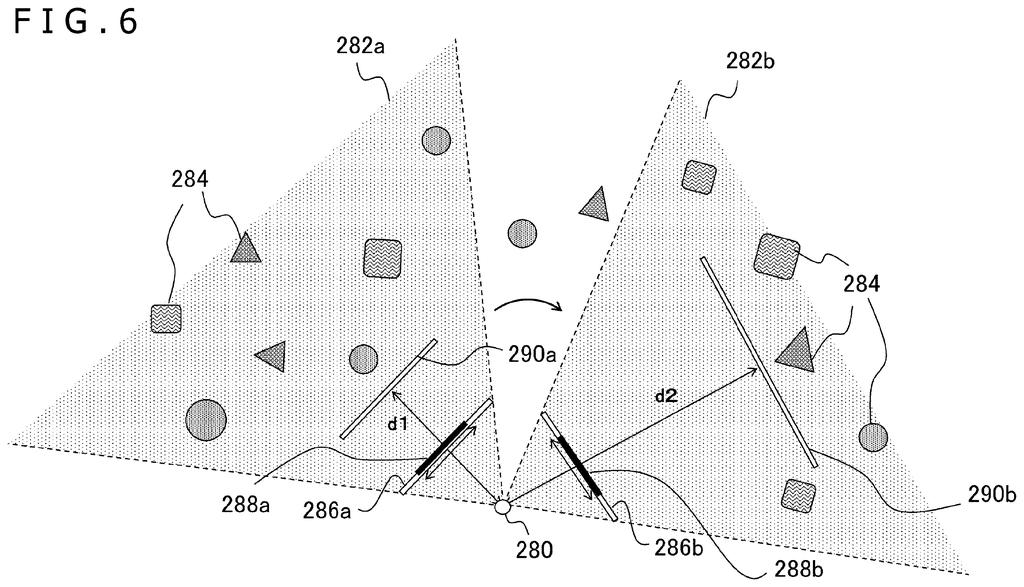
- Control plane: The system constructs an invisible reference surface in 3D space that corresponds to the distribution of distances between the user and the real objects the camera sees. Think of it as a dynamic depth snapshot of the room.
- Line-of-sight distance: When the user looks in a particular direction, the system measures the distance to the control plane along that specific gaze line, not just a fixed average distance.
- Virtual placement: A superimposed image (a game UI element, a notification, a label) is placed in the 3D virtual scene at the depth the control plane specifies, then rendered through a virtual camera so it composites correctly with the passthrough video of the real room.
- Dynamic update: As the user moves, the control plane recalculates, keeping overlay placement accurate even as viewing distances change.
The rendering pipeline places the virtual element inside the 3D scene model first, then generates the final frame, rather than pasting a 2D image on top of the video feed. That ordering is what allows correct depth, occlusion, and stereo separation.
The control plane 350 is updated according to movement of the user 280 . The image processing section decides a virtual distance ds of a superimposed image in the virtual three-dimensional space on the basis of a distance dc from the user 280 to a control plane in a line-of-sight direction, …
Translation: As you move around, the headset recalculates how far away virtual objects should look.
What this means for PlayStation VR and future AR headsets
Eye strain from depth mismatch, sometimes called the vergence-accommodation conflict, is one of the most frequently cited reasons people stop wearing AR and VR headsets after short sessions. If your eyes are telling you an object is two feet away but the display is presenting it as if it's at six feet, your visual system fights itself. Over time that causes headaches and fatigue.
Sony makes the PlayStation VR line and is several Sony filings on spatial display comfort this year, so a patent like this fits directly into the company's headset hardware roadmap. For you as a user, the practical payoff is simple: overlays that feel like they belong in the room, and a headset you can wear for longer without discomfort.
Sony's 22nd filing we've tracked since July in the AR glasses race continues a pattern that includes room-mapping for virtual sound and a fix for 3D decoding slowdowns.
Extended sessions in a mixed-reality headset often end the same way: you take it off because your eyes are worn out, not because you wanted to stop. Sony's patent targets that exact failure by making virtual objects appear at depths that match your real surroundings, so your eyes are not constantly fighting to focus on something that feels physically wrong.
The practical payoff is that a notification or interactive element would sit convincingly in the space around you rather than floating in a way that creates low-level strain you barely notice until it becomes impossible to ignore.
Because the method works through software rather than new hardware, people who already own a compatible headset could benefit from it, which means the improvement arrives as a longer, more comfortable session rather than a reason to upgrade.
There are more where this came from
We read every patent application Big Tech publishes and send you the ones worth knowing. Plain English, free, every week.
The drawings
12 drawing sheets from US 2026/0281292 A1 · click any drawing to enlarge


Want this weekly breakdown for a company we don't cover? Patentlyze Pro →