Sony
Sony · AR / VR · Filed Aug 29, 2025 · USPTO published Aug 20, 2026 · Aug 20 release
Sony Patents a Way to Fix Where Cameras Think You're Looking
Your eyes move faster than most cameras can keep up with. Sony is filing patents for a system that uses a second, ultra-fast type of sensor to catch and fix the errors that happen when a regular camera misreads where you're looking.
- Publication number
- US 2026/0247044 A1(US20260247044A1)
- Applicant
- Sony Interactive Entertainment Inc.
- Filed · Published
- Aug 29, 2025 · Aug 20, 2026
- Inventors
- Hideaki Iwaki, Naoyuki Miyada
- Status when we published
- Waiting for an examiner
- Document
- 18 claims
- US classification
- 348/207.99
- Parent application
- National Stage Entry of PCT/JP2023/010679 (filed Mar 17, 2023)(PCTJP2023010679)
What Sony's attention-correction sensor system actually does
Ever tried to point at something on screen and had the cursor land in the wrong spot? That's roughly what happens inside any device that tracks your eyes or your attention: the camera guesses where you're focused, and sometimes it guesses wrong.
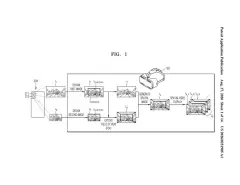
Sony's patent describes a two-sensor setup designed to close that gap. One sensor (a standard camera-style sensor) figures out what you're paying attention to. A second sensor, an event-based camera, watches for the tiniest flickers of light change across every pixel the moment they happen, rather than waiting to snap a full frame. That second sensor generates a correction signal that adjusts the first sensor's result, trimming the error before it ever reaches your device.
The practical effect: whatever Sony device is watching your eyes or face should land on the right spot more often, even when you move quickly or the lighting shifts.
… an event-based sensor for asynchronously generating event signals when detecting a change in the intensity of light incident on each pixel.
Translation: A special camera sensor reacts instantly only to parts of the image that are actually changing.
How the event sensor calculates the correction value
The patent describes a pipeline with three working parts:
- Detection section: a primary sensor reads the scene and identifies an "attention point," meaning wherever a face, eye, or other target is believed to be focused.
- Correction section: takes that raw detection result and adjusts it using a pre-calculated correction value.
- Correction value calculation section: the clever part. It reads the output of an event-based sensor, a camera type that fires a signal per pixel the instant that pixel sees a brightness change, rather than waiting for a timed frame capture. The system looks for event signals that are temporally correlated with the moment the primary sensor produced its output, and uses those to calculate how far off the primary sensor's reading likely is.
Event-based sensors (sometimes called dynamic vision sensors) are unusual because they produce data asynchronously. There is no fixed frame rate; each pixel reports on its own schedule whenever something changes. That means they can capture motion at microsecond precision, something a conventional rolling-shutter camera fundamentally cannot do.
By anchoring the correction to events that happened at the same moment the primary sensor was reading the scene, the system ties the fix to a precise point in time rather than applying a blunt average offset. The result is a correction that tracks the actual dynamics of fast-moving targets.
What this means for eye-tracking in Sony devices
Eye-tracking and attention-detection are load-bearing features in Sony's PlayStation VR headsets, and they are increasingly relevant in any device that adapts its display or interface to where a user is looking. A small timing error in attention detection translates directly into a cursor that drifts, a foveated-rendering zone that chases the wrong patch of the screen, or an autofocus that locks onto the background instead of the subject.
Event-based sensors have been a research focus for years precisely because they solve the motion-blur and latency problems that plague frame-based cameras in fast-moving scenes. Sony's image sensor division (Sony Semiconductor) has manufactured event-based sensors commercially, so the component supply chain for this kind of system already exists within the broader Sony group. Filings like this one sit squarely in the flow of Big Tech patent news around next-generation imaging for AR, VR, and gaming peripherals, where accurate real-time attention data is becoming a core competitive feature.
Sony's 15th filing we've tracked since July in the AR glasses race builds on earlier applications including one on avatar elbow bending and one on glasses that spot workouts.
Source: US 2026/0247044 A1 at the USPTO (PDF). Full patent text and figures are in the official publication.
Get our take in your Top Stories
Liked this breakdown? Add Patentlyze as a preferred source on Google, and our plain-English take shows up more often in your Top Stories the next time Sony patent news breaks.
Add Patentlyze on Google
One click.
There are more where this came from
We read the new patents from Big Tech, carmakers and more and send you the ones worth knowing. Plain English, free, every week.
The drawings · 11 sheets
11 drawing sheets from US 2026/0247044 A1 · click any drawing to enlarge


Show the other 3 sheets


More from Sony
All 722 Sony patents →
More in AR / VR
All 718 AR / VR patents →
Qualcomm
Qualcomm Patents Real-Time AI Vision Analysis Technology for Smart Glasses Wearables
Qualcomm
Qualcomm Patents a Way to Label Every Part of a 3D Model Automatically
Samsung
Samsung Patent Merges Mismatched Camera Views Into a Single AR Display
Samsung