
Google Patents a Way to Aim Its AI Search at Only the Documents You Choose
Most AI search tools scan everything and hand you a pile of loosely related results. A new Google patent describes a system that searches only the specific folders or document groups you select, so the results come from exactly the material you care about.
How Google's scoped document search actually works
Ever tried to find one email in a ten-year archive? You know the answer is in there somewhere, but the search keeps pulling up unrelated stuff from departments you've never worked with.
Google's patent addresses that problem for AI-powered document search. Instead of letting the AI rummage through every file it has access to, the system lets you (or an application) first pick a subset of documents, such as a specific project folder, a set of contracts, or a curated library. The AI then searches only inside that boundary.
The matching itself uses a technique called semantic similarity: the system converts your question and each document chunk into numerical fingerprints called embeddings, then finds the chunks whose fingerprint most closely matches yours. By limiting that comparison to the chosen subset, the results are more focused and the search is faster.
… performing, by the computing system, a similarity search for the text embedding with respect to only chunk embeddings that are associated with document chunks that are included in the one or more selected document subsets …
Translation: The AI searches only inside the specific files you chose instead of looking at everything.
How the embedding filter narrows the similarity search
When you type a question, the system runs it through a machine-learning model that converts the text into a compact numerical representation called an embedding (think of it as a fingerprint that captures meaning rather than exact words).
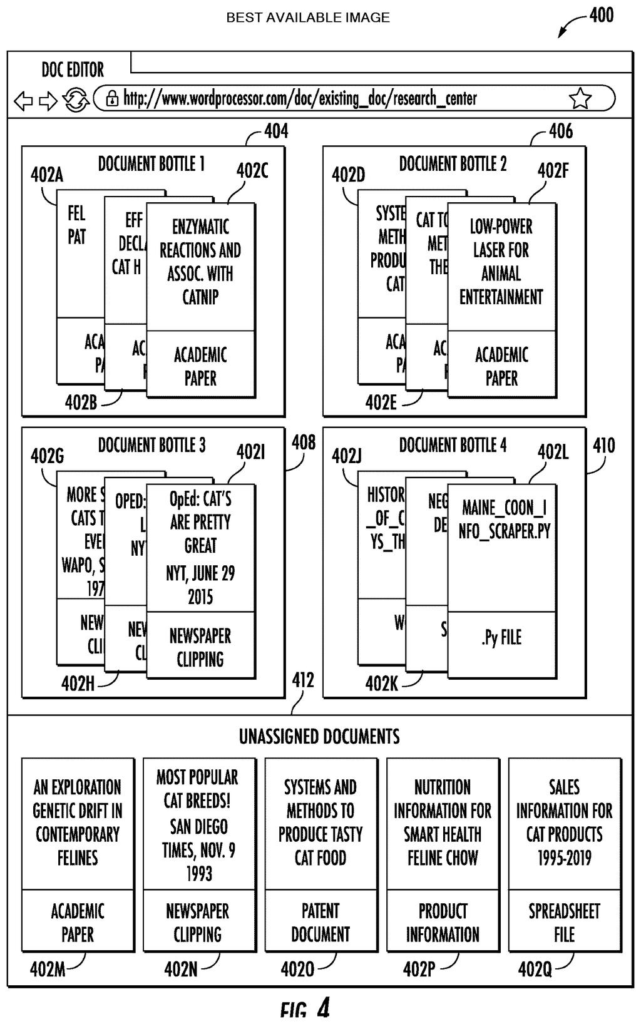
All the documents in the system have already been pre-processed the same way: each document is split into chunks, and every chunk has its own embedding stored in a database. Those documents are organized into named groups, called document subsets.
Here is what happens at search time:
- The user or application signals which document subset(s) to search.
- The system performs a similarity search only against embeddings belonging to chunks inside those subsets, ignoring everything else.
- The closest-matching chunks are retrieved and displayed in the interface.
The key engineering choice is where the filtering happens: it occurs before the similarity comparison, not after. That means the system never computes distances against irrelevant documents at all, which reduces both wasted compute and result noise.
Data indicative of a text query is received. A text embedding for the text query is generated using a machine-learned embedding generation model.
Translation: The system takes your search words and turns them into a mathematical format the AI can understand.
What this means for AI tools built on large document libraries
For products built on top of large language models, the ability to restrict a search to a defined scope is more useful than it might sound. Enterprise tools, legal research platforms, and coding assistants all deal with libraries where mixing sources is a liability, not a convenience. A lawyer searching case files does not want results bleeding in from unrelated client matters.
Google has been filing around AI search and retrieval since at least 2023 and this patent fits that pattern. The practical upside for you as an end user is fewer hallucinations and irrelevant citations: when the AI only sees the documents it is supposed to, it has less opportunity to pull in a plausible-sounding but wrong passage from somewhere else in the corpus.
Google's 87th filing in the Language AI patents we cover since May follows a text-zoom slider and an AI task picker for search as the company keeps applying to reshape how people read and find things.
AI search tools that scan every document at once carry a hidden cost: the more sources they touch, the more likely they are to surface a confident-sounding answer drawn from the wrong one. In a legal team, a hospital, or a financial firm, that is not a minor inconvenience. It is a liability.
This patent addresses that cost by narrowing the search before it starts. Rather than scanning everything and sorting results afterward, the system checks only the documents a user has already designated as relevant. Fewer comparisons means less opportunity for a plausible but mismatched answer to slip through.
The concrete value depends on the implementation details, and particularly on how naturally users can designate which document groups apply to a given question. Get that interaction right and the accuracy gains follow almost automatically. Get it wrong and users will skip the step entirely, which defeats the purpose.
There are more where this came from
We read every patent application Big Tech publishes and send you the ones worth knowing. Plain English, free, every week.
The drawings
19 drawing sheets from US 2026/0278007 A1 · click any drawing to enlarge


Want this weekly breakdown for a company we don't cover? Patentlyze Pro →
Be the first to weigh in