
Google Patents a Way to Build AI Training Data That's Still Readable by Humans
Training an AI well usually means feeding it enormous amounts of real human writing. Google is patenting a way to generate artificial training data that works just as well, without sacrificing the plain-English quality that makes it useful.
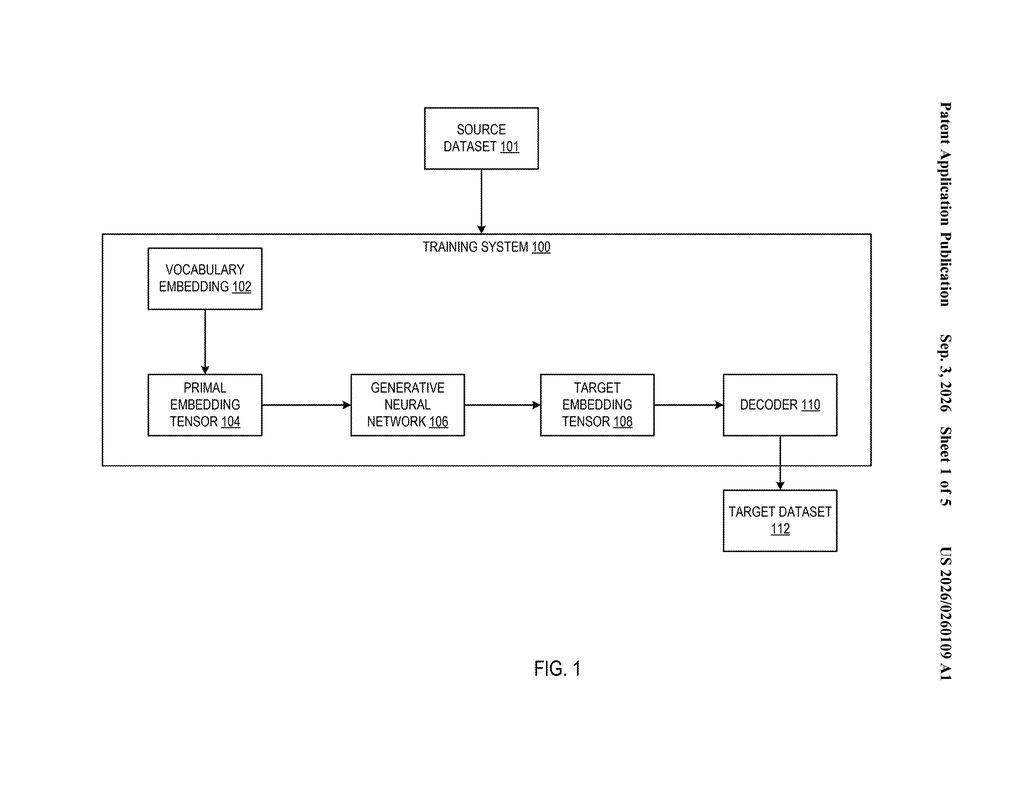
What Google's synthetic training text actually does
AI models today are fine-tuned (that is, specialized for specific jobs) by training them on large sets of example text. The problem is that real-world examples are often hard to find, expensive to label, or simply not available in big enough quantities.
Google's patent describes a system that generates its own training examples from scratch. The trick is that the system doesn't just produce any text, it specifically builds text that improves the AI's performance on a target task while also keeping the output readable by a human. That second part matters: if the synthetic text were pure machine gibberish, it would be nearly impossible to check whether it was correct or safe.
The result is a pipeline that could let Google (or any team using this approach) train specialized AI models faster, with less dependence on hand-collected datasets, while still keeping a human in the loop for quality checks.
Methods, systems, and apparatus, including computer programs encoded on a computer storage medium, for generating human-readable synthetic text for training generate neural networks thereon.
Translation: This patent covers software tools that create artificial text which people can actually read to train AI systems.
How the optimizer balances readability and model performance
The system takes a source dataset, a collection of real examples for whatever task the AI needs to learn, and uses it as a benchmark.
From there, an optimization process generates a target dataset of new, synthetic text samples. The optimizer runs two checks simultaneously:
- Performance metric: it measures how well the AI model does on the real source data after being trained on the synthetic data, trying to maximize that score.
- Readability constraint: every synthetic sample must hit a minimum readability score, meaning a human could still read and understand it. This rules out outputs that are just statistical noise or token soup.
The technical term here is constrained optimization, meaning the system is maximizing one goal (AI performance) while being forced to respect a hard rule (readable text). The synthetic samples are sequences of tokens drawn from the same vocabulary the AI already knows, so there's no mismatch between training data and the model's internal language.
Finally, the AI is fine-tuned on this synthetic target dataset. The loop produces training data that is both machine-useful and human-legible.
… generating a target dataset for the downstream task by optimizing a performance metric that measures a performance of the generative neural network on the source dataset after being trained on the target data set while constraining each sample in the target dataset to be a respective sequence of tokens in the vocabulary having a readability score that satisfies a threshold …
Translation: The system builds new training data by improving AI performance while forcing the output to stay readable.
What this means for the next wave of AI fine-tuning
For AI teams, the bottleneck isn't always the model itself; it's finding enough good examples to teach it a specific job. Synthetic data generation is one answer, but purely machine-generated text has historically been hard to audit. Google's approach bakes readability directly into the generation process, which means the output can be spot-checked by a person without needing a separate review pipeline.
Google's run of AI training-data filings suggests the company is thinking hard about reducing dependence on costly human annotation. For you as a user, the downstream effect could be AI tools that specialize faster and more reliably, whether that's a search feature, a writing assistant, or a customer-service bot that actually understands your industry.
That makes this Google's 77th filing in our Language AI work we've tracked since May, adding to earlier applications like a page-reading browser AI and one on sorting search queries.
Getting an AI system to learn from cleaner, more readable practice material sounds simple, and structurally it is: no new equipment is needed, no supply chain has to shift. The whole change lives in how training text gets prepared before it ever reaches the system.
That said, the document leaves real work undone. There is no method yet for measuring whether the synthetic text is actually readable enough, and no evidence the approach holds at larger scale. Those gaps sit between this filing and anything a person could use.
The underlying bet is on economics: preparing good training data costs real money, and a reliable way to reduce that cost would matter to everyone building these systems. This reads like a method being locked in early, with the harder engineering still ahead.
Get our take in your Top Stories
Liked this breakdown? Add Patentlyze as a preferred source on Google, and our plain-English take shows up more often in your Top Stories the next time Google patent news breaks.
There are more where this came from
We read every patent application Big Tech publishes and send you the ones worth knowing. Plain English, free, every week.
The drawings
5 drawing sheets from US 2026/0260109 A1 · click any drawing to enlarge


Want this weekly breakdown for a company we don't cover? Patentlyze Pro →
Be the first to weigh in